As AI computing, cloud services, high-performance computing, and large-scale data processing continue to grow, data centers are facing much higher thermal loads than before. Modern CPUs, GPUs, AI accelerators, and high-density server modules generate concentrated heat that traditional air cooling systems can no longer handle efficiently.
For this reason, data center liquid cooling has become an important solution for next-generation thermal management. Among different liquid cooling technologies, the liquid cooling plate, also known as a Liquid Cold Plate or water cooling plate, plays a critical role in transferring heat from high-power chips to the coolant loop.
However, selecting the right liquid cooling plate structure is not simply a matter of choosing copper or aluminum. Engineers must balance thermal performance, pressure drop, flow rate, manufacturing cost, material compatibility, reliability, and rack-level cooling efficiency.
For data centers using high-power CPUs, GPUs, and AI chips, the right cold plate design can directly affect chip temperature, system stability, pumping power, energy efficiency, and long-term operation cost.
Why Liquid Cooling Plates Are Becoming Essential in Data Centers
Traditional air cooling relies on fans and heat sinks to remove heat from servers. This method works for moderate heat loads, but as chip power continues to increase, air cooling faces several limitations:
Higher fan power consumption
Limited heat removal capacity
Higher server inlet and outlet temperature difference
Hot spots around CPUs, GPUs, and AI accelerators
Difficulty cooling dense rack configurations
Higher noise and lower energy efficiency
Limited scalability for AI and HPC clusters
A data center liquid cooling plate solves these problems by placing a coolant channel close to the heat source. Heat is transferred from the chip to the cold plate base, then removed by circulating coolant.
Compared with air cooling, liquid cooling provides much higher heat transfer efficiency because liquid has better heat carrying capacity than air. This makes liquid cold plates especially suitable for:
AI server cooling
GPU cooling
CPU cooling
HPC cluster cooling
High-density rack cooling
Edge data center cooling
Cloud computing infrastructure
Power electronics inside data center systems
For data centers moving toward higher power density, liquid cooling is no longer just an advanced option. It is becoming a necessary thermal management strategy.
Key Factors in Liquid Cooling Plate Structure Selection
The “best” liquid cooling plate structure depends on the actual operating conditions. A cold plate with the lowest thermal resistance is not always the best choice if it creates too much pressure drop or is too expensive to manufacture.
Before selecting a custom liquid cold plate, engineers should evaluate the following factors.
1. Thermal Load and Heat Flux
The first step is to define the total heat load of the component. This is usually measured in watts. For example, a high-power GPU or AI accelerator may generate several hundred watts or more, while multiple chips on one board may create a much higher combined heat load.
In addition to total power, heat flux is also important. Heat flux describes how much heat is concentrated in a specific area. A chip with high heat flux requires faster heat spreading and a more efficient internal cold plate structure.
For high-power GPUs and AI chips, the flow rate may often fall in the range of 1–3 LPM per cold plate, depending on chip power, coolant type, pressure drop target, and thermal resistance requirement.
2. Thermal Resistance
Thermal resistance is one of the most important indicators of cold plate performance. Lower thermal resistance means the cold plate can transfer heat more efficiently from the chip to the coolant.
However, thermal resistance is affected by many factors:
Cold plate material
Base thickness
Internal channel structure
Coolant flow rate
Contact surface flatness
Thermal interface material
Chip size and heat distribution
Manufacturing quality
Coolant inlet temperature
A high-performance microchannel cold plate may provide very low thermal resistance, but it may also increase pressure drop and manufacturing complexity.
3. Pressure Drop and Pumping Power
Pressure drop is another key factor in liquid cooling plate design. If the internal channel is too narrow or too complex, the coolant may experience high flow resistance. This requires stronger pumps and increases energy consumption.
In a single cold plate, pressure drop may seem manageable. But in a full data center rack with multiple servers and multiple cold plates, pressure drop becomes a system-level issue.
A good data center liquid cooling plate should not only remove heat efficiently but also maintain reasonable hydraulic performance. This helps reduce pumping power and improves total cooling system efficiency.
4. Flow Distribution
For multi-chip modules, large CPUs, GPUs, or accelerator boards, uniform coolant distribution is very important. Poor flow distribution may cause some areas to receive less coolant, creating local hot spots.
The internal structure of the cold plate should guide coolant evenly across the heat source area. This is especially important for AI chip cooling and high-density GPU cooling, where heat is concentrated and thermal margins are narrow.
5. Material Selection
Material selection affects thermal performance, cost, weight, corrosion resistance, and manufacturing process.
The two most common materials for liquid cold plates are aluminum and copper.
| Material | Advantages | Limitations | Best Use Case |
|---|
| Aluminum | Cost-effective, lightweight, easy to machine, suitable for large structures | Lower thermal conductivity than copper, requires corrosion control | General data center cooling, large-size cold plates, cost-sensitive projects |
| Copper | Excellent thermal conductivity, better for high heat flux, strong heat spreading | Higher cost, heavier, more difficult to process | High-power GPU cooling, AI chip cooling, high heat flux applications |
| Copper-Aluminum Hybrid | Balances heat spreading and weight/cost | Requires reliable bonding process | Custom Cold Plates requiring both thermal performance and cost control |
For data centers, aluminum cold plates are often attractive due to cost and weight advantages. Copper cold plates are preferred when the chip heat flux is very high and thermal performance is the top priority.
6. Manufacturing Method
Different manufacturing methods lead to different cold plate structures, costs, and performance levels.
Common manufacturing methods include:
For a custom liquid cold plate manufacturer, the key is not only to design a high-performance channel, but also to ensure that the structure can be manufactured reliably at scale.

Common Liquid Cooling Plate Structures for Data Centers
Different internal cold plate structures are suitable for different data center workloads. The main types include skived fin cold plates, microchannel cold plates, topology-optimized cold plates, and other advanced high-performance structures.
1. Skived Fin Liquid Cold Plate
A skived fin cold plate uses thin fins inside the liquid channel to increase the heat transfer area. The coolant flows through the fin structure and removes heat from the base.
This is a relatively traditional and widely used structure. It offers stable performance and is suitable for general data center workloads.
Advantages of Skived Fin Cold Plates
Mature manufacturing process
Good heat transfer area
Suitable for medium to high-power components
Cost-effective compared with more complex structures
Easier to customize for different sizes
Limitations
Thermal resistance may be higher than advanced microchannel designs
Pressure drop depends heavily on fin density and flow path
Not always the best option for extremely high heat flux AI chips
Skived fin liquid cold plates are suitable for general server cooling, CPU cooling, and data center applications where cost, reliability, and manufacturability are important.
2. Microchannel Liquid Cold Plate
A microchannel cold plate uses very small internal channels to increase the coolant contact area and improve heat transfer performance. This structure works like a highly efficient liquid-cooled heat sink inside the cold plate.
Microchannel designs are especially useful for high-density heat sources such as GPUs, AI accelerators, and HPC processors.
Advantages of Microchannel Cold Plates
Very low thermal resistance
High heat transfer efficiency
Strong performance for concentrated heat sources
Suitable for AI chip cooling and GPU cooling
Compact structure for high-power density applications
Limitations
Higher pressure drop than simple channel designs
More sensitive to coolant cleanliness
More difficult to manufacture
Higher cost compared with standard cold plates
Requires careful flow distribution design
For modern AI data centers, microchannel liquid cold plates are becoming increasingly important because chip power and heat flux are rising quickly.
3. Topology-Optimized Cold Plate
A topology-optimized cold plate uses advanced design methods to optimize internal flow paths. The goal is to reduce pressure drop while maintaining good thermal performance.
In some designs, topology optimization can reduce pressure drop by more than 20%. This can be valuable in systems where pumping power is a major constraint.
Advantages
Lower pressure drop
Better hydraulic efficiency
Can be optimized for specific chip layouts
Useful for rack-level energy efficiency
Limitations
More complex design process
Higher manufacturing cost
Performance gain may not always justify cost
Requires simulation and validation
Topology-optimized structures are suitable for data centers where the cooling loop must handle many cold plates and pumping power is a key concern.
4. Advanced High-Power Cold Plate Structures
For extremely high-power chips or modules, advanced structures may be required. These structures are designed to handle very high TDPs, sometimes above several thousand watts at the system level.
Such designs may combine:
Microchannels
Manifold flow distribution
Optimized inlet and outlet layout
Multi-layer channel structures
High-conductivity copper bases
Low-pressure-drop internal geometry
Custom sealing and welding processes
These cold plates are typically used in AI clusters, HPC systems, high-power accelerator modules, and dense rack-level cooling solutions.
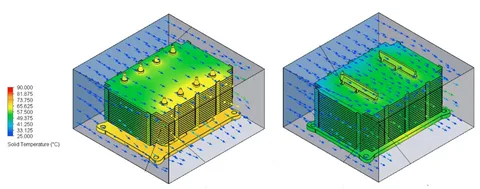
Performance Comparison of Liquid Cooling Plate Structures
The following table summarizes the typical performance characteristics of different liquid cold plate structures.
| Structure Type | Thermal Resistance | Pressure Drop | Manufacturing Cost | Best Use Case |
|---|
| Simple Channel Cold Plate | Medium | Low | Low | General electronics cooling, low to medium heat load |
| Skived Fin Cold Plate | Standard to Low | Medium | Medium | General data center workloads and CPU cooling |
| Microchannel Cold Plate | Very Low | Medium to High | Medium to High | High-density AI chips, GPUs, HPC processors |
| Topology-Optimized Cold Plate | Low | Lower than traditional complex channels | High | Systems where pumping power is a major constraint |
| Advanced Manifold Cold Plate | Very Low | Optimized depending on design | High | High-power AI/HPC clusters and multi-chip modules |
The right choice depends on whether the customer values lowest chip temperature, lowest pressure drop, lowest cost, easiest manufacturing, or best total system efficiency.
Thermal Resistance vs. Pressure Drop: The Key Trade-Off
In liquid cold plate design, thermal resistance and pressure drop are often connected.
A denser fin structure or smaller microchannel can reduce thermal resistance because it increases the heat transfer area. However, it can also increase flow resistance, creating a higher pressure drop.
On the other hand, a wider channel may reduce pressure drop, but it may not provide enough heat transfer performance for high-power chips.
This creates a common engineering trade-off:
| Design Direction | Benefit | Risk |
|---|
| Smaller channels | Lower thermal resistance | Higher pressure drop and clogging risk |
| Larger channels | Lower pressure drop | Lower heat transfer efficiency |
| Higher flow rate | Better cooling performance | Higher pumping power |
| Lower flow rate | Lower energy consumption | Higher chip temperature |
| Copper base | Better heat spreading | Higher cost and weight |
| Aluminum base | Lower cost and weight | Lower thermal conductivity |
For data center applications, the goal is not to design the most powerful cold plate in isolation. The goal is to design the best cold plate for the entire cooling loop, including pumps, manifolds, quick connectors, coolant distribution units, and rack-level thermal requirements.
How to Select the Right Cold Plate Structure for Different Data Center Applications
Different data center workloads require different cold plate structures.
General Data Center Servers
For standard CPU servers and moderate heat loads, aluminum or copper skived fin cold plates can provide a good balance of performance, cost, and reliability.
Recommended structure:
Aluminum or copper cold plate
Simple channel or skived fin structure
Moderate flow rate
Low to medium pressure drop
Cost-effective manufacturing method
AI Training Servers
AI training servers usually use high-power GPUs and accelerators. These chips generate high heat flux and often require more advanced cooling structures.
Recommended structure:
Copper base cold plate
Microchannel structure
Optimized flow distribution
Higher flow rate capability
Low thermal resistance design
HPC Clusters
HPC systems often require stable long-term operation and high cooling efficiency. Both thermal resistance and pressure drop must be carefully controlled.
Recommended structure:
Copper or copper-aluminum cold plate
Microchannel or manifold flow design
Low pressure drop optimization
Reliable sealing and welding
System-level validation
Edge Data Centers
Edge data centers may have limited space and may be deployed in less controlled environments. Reliability and compact structure are very important.
Recommended structure:
Aluminum cold plate for lightweight design
Compact channel structure
Corrosion-resistant surface treatment
Reliable leak testing
Easy installation and maintenance
Design Checklist for Data Center Liquid Cooling Plates
Before developing a custom liquid cooling plate, engineers should confirm key parameters at the early design stage.
| Selection Factor | What to Confirm | Why It Matters |
|---|
| Chip power | Total heat load in watts | Determines basic cooling capacity |
| Heat flux | Heat concentration on chip surface | Affects channel density and base material |
| Coolant type | Water, water-glycol, dielectric coolant | Affects corrosion, sealing, and thermal performance |
| Flow rate | Required LPM per cold plate | Impacts thermal resistance and pressure drop |
| Pressure drop limit | Maximum allowable hydraulic resistance | Determines channel structure and pump requirement |
| Cold plate material | Aluminum, copper, or hybrid structure | Affects thermal performance, cost, and weight |
| Contact area | Chip size and mounting surface | Affects heat spreading and interface design |
| Surface flatness | Required contact quality | Impacts thermal interface resistance |
| Manufacturing process | CNC, brazing, FSW, microchannel, skiving | Determines cost, reliability, and scalability |
| Leak testing requirement | Pressure and sealing standard | Ensures long-term data center reliability |
| Rack-level integration | Manifold, connectors, hose layout | Affects deployment and maintenance |
This checklist helps reduce design mistakes and allows the customer and manufacturer to communicate more efficiently.
Manufacturing Considerations for Data Center Cold Plates
A high-performance cold plate must not only perform well in simulation. It must also be manufacturable, reliable, and suitable for long-term data center operation.
1. Sealing Reliability
Data centers require extremely high reliability. Any coolant leakage may cause serious damage to servers and electrical systems. Therefore, cold plates must go through strict leak testing and pressure testing.
2. Corrosion Control
When aluminum cold plates are used, coolant compatibility and corrosion protection must be carefully considered. Surface treatment and coolant chemistry are important to long-term reliability.
3. Flatness and Surface Finish
The contact surface between the chip and the cold plate must be flat and smooth enough to reduce interface thermal resistance. Poor flatness may cause uneven contact pressure and hot spots.
4. Internal Cleanliness
For microchannel cold plates, internal cleanliness is very important. Small particles may block microchannels and affect cooling performance. Proper cleaning and inspection are required during production.
5. Scalable Manufacturing
Data center projects often require batch production. A cold plate design should be optimized not only for performance but also for repeatable manufacturing, quality control, and cost stability.
How Kingka Supports Data Center Liquid Cooling Plate Projects
Kingka provides customized liquid cold plate, water cooling plate, FSW Liquid Cold Plate, CNC machined cold plate, aluminum cold plate, copper cold plate, and complete thermal management solutions for high-power electronics and data center applications.
For data center cooling projects, Kingka can support:
Cold plate structural design
Material selection
Internal channel optimization
Microchannel cold plate development
Skived fin cold plate manufacturing
CNC machining
Friction stir welding
Brazing and soldering
Surface treatment
Leak testing
Pressure drop evaluation
Custom design based on customer drawings
Kingka’s engineering support focuses on practical performance, manufacturability, cost control, and long-term reliability. Instead of simply choosing one cold plate structure, we help customers evaluate the complete thermal system and select the most suitable solution for their application.
Cold Plate Structure Selection Summary
| Customer Requirement | Recommended Cold Plate Direction |
|---|
| Lowest cost | Aluminum simple channel cold plate |
| Better general performance | Skived fin liquid cold plate |
| High-power GPU cooling | Copper microchannel cold plate |
| AI chip cooling | Microchannel or manifold cold plate |
| Lower pumping power | Topology-optimized flow design |
| Large-scale deployment | Manufacturable aluminum or copper cold plate |
| High reliability | Strict sealing, leak testing, and corrosion control |
| Custom rack-level integration | Custom cold plate and manifold design |
Selecting the right data center liquid cooling plate structure requires balancing thermal performance, pressure drop, manufacturing cost, material selection, and system-level reliability.
For general data center servers, skived fin or simple channel cold plates may provide a practical and cost-effective solution. For high-density AI chips, GPUs, and HPC processors, microchannel cold plates or advanced manifold designs may be required to achieve lower thermal resistance. For systems where pumping power is the main concern, topology-optimized cold plates can help reduce pressure drop and improve hydraulic efficiency.
The best liquid cold plate is not always the most complex one. It is the structure that matches the actual heat load, flow rate, pressure drop limit, material requirement, manufacturing budget, and rack-level cooling architecture.
Kingka provides customized liquid cooling plates, liquid cold plates, water cooling plates, heat sinks, and complete thermal management solutions for data centers, AI servers, HPC systems, and high-power electronics. By combining material expertise, structural design, precision manufacturing, and reliability testing, Kingka helps customers build efficient, stable, and scalable cooling solutions for next-generation data centers.