In modern electronic devices, power density is increasing rapidly. Power modules, LED systems, industrial control equipment, communication devices, power supplies, and other electronic components generate more heat than ever before. If this heat is not removed efficiently, the internal temperature of the equipment will rise, leading to performance degradation, unstable operation, shortened service life, or even component failure.
For many projects, customers do not only need a standard aluminum heat sink. They need a more compact, efficient, and easy-to-install custom heat sink that can provide better cooling performance within limited installation space.
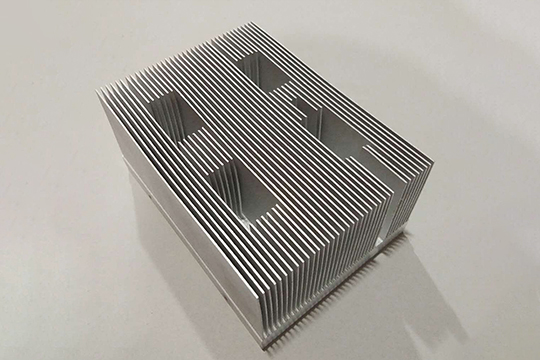
To solve this problem, Kingka designs a folded fin aluminum heat sink structure with a heat sink base, longitudinal heat conduction grooves, transverse heat dissipation grooves, metal heat conducting plates, and additional heat dissipation fins. Compared with a traditional straight-fin heat sink, this design increases the total heat exchange area, improves airflow guidance, and enhances heat dissipation efficiency in height-limited environments.
Why Traditional Heat Sinks May Not Be Enough
A conventional heat sink usually consists of a base plate and several vertical fins. This structure is simple and widely used, but it may not always meet the requirements of compact electronic systems.
In many real applications, the height of the heat sink is strictly limited by the equipment housing, PCB layout, connectors, fans, or other mechanical components. When the available height is reduced, the fin length must also be shortened. This directly reduces the heat exchange area and weakens the cooling performance.
Common problems of traditional heat sinks include:
Limited heat dissipation area under low-height conditions
Poor airflow distribution between straight fins
Local heat accumulation near the heat sink base
Lower cooling efficiency in compact spaces
Difficult installation in restricted mechanical structures
Insufficient thermal performance for high-power electronic components
For customers working on compact electronics, industrial equipment, LED modules, telecom devices, and power electronics, these problems can directly affect product reliability and long-term stability.
Folded Fin Heat Sink Design Concept
The key idea of a folded fin heat sink is to increase the effective heat exchange area without simply increasing the overall height of the heat sink.
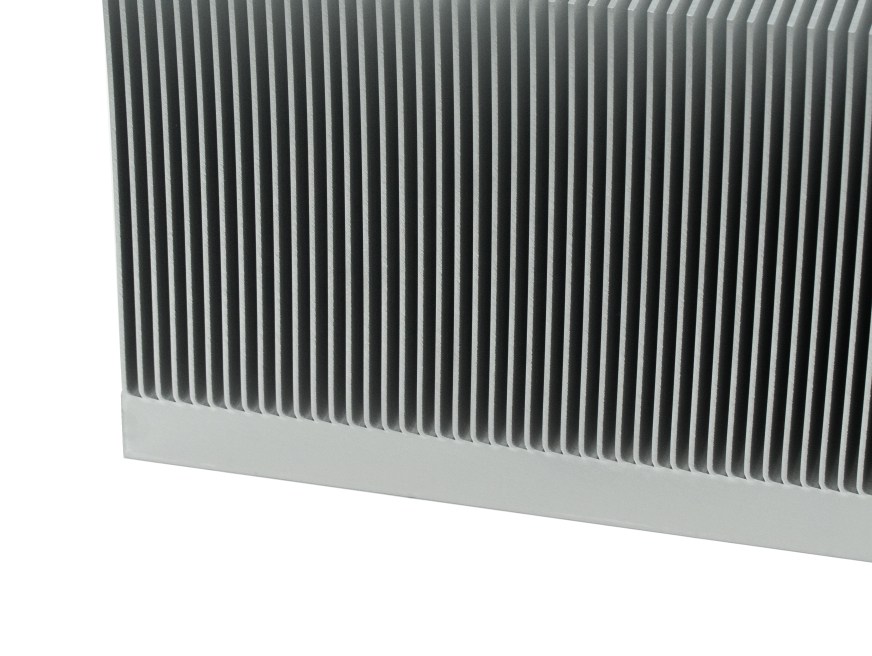
Instead of using only vertical straight fins, this design adopts a metal heat conducting plate with a folded curved surface. The lower part of the metal heat conducting plate is vertically connected to the heat sink base, while the upper part forms a folded surface structure. This creates a larger exposed surface area within the same height limit.
At the same time, multiple heat dissipation fins are arranged on the metal heat conducting plates. These fins are installed in rows and staggered positions to increase contact with air and improve convection heat transfer.
This structure allows the heat sink to achieve better cooling performance while keeping a compact size.
Main Structure of the Aluminum Heat Sink
The heat sink mainly consists of the following parts:
| Structure | Function | Design Benefit |
|---|
| Heat sink base | Absorbs heat from the electronic component | Provides stable contact and heat conduction path |
| Longitudinal heat conduction grooves | Increase air contact area on the base | Helps improve heat dissipation from the base area |
| Transverse heat dissipation grooves | Guide airflow across the heat sink | Helps hot air move out more efficiently |
| Metal heat conducting plates | Transfer heat from the base to the upper fin area | Increases vertical and folded heat exchange surface |
| Heat dissipation fins | Increase contact area with air | Improves convection cooling efficiency |
| Heat conduction holes | Connect with transverse grooves for better airflow and heat transfer | Helps improve internal air circulation |
| Mounting slots | Located on both sides of the base | Makes installation easier and more stable |
This structure is suitable for customized aluminum heat sink, compact heat sink, power electronics heat sink, and other thermal management solutions where both space and cooling performance are important.
Key Structural Features
1. Folded Metal Heat Conducting Plates
The metal heat conducting plate is divided into a lower metal heat conducting section and an upper metal heat conducting section. The lower section is vertically arranged on the upper surface of the heat sink base, while the upper section is connected to form a folded curved surface.
This folded structure increases the total heat exchange area compared with a traditional vertical fin structure. Under the same installation height, the heat sink can provide more surface area for heat transfer.
This is especially useful when the heat sink height is limited but the required cooling capacity is still high.
Design Advantage
| Traditional Straight Fin | Folded Heat Conducting Plate |
|---|
| Heat exchange area depends mainly on fin height | Increases heat exchange area through folded surface |
| Cooling performance decreases when fin height is limited | Maintains better cooling performance in compact space |
| Airflow path may be simple and less optimized | Improves heat exchange through more exposed surfaces |
| Suitable for basic cooling applications | Suitable for compact and higher-performance thermal designs |
For applications such as compact power supplies, LED lighting systems, communication modules, and industrial controllers, this folded fin structure can improve heat dissipation without increasing product size.
2. Staggered Heat Dissipation Fins
The heat dissipation fins are arranged in rows and staggered on the metal heat conducting plates. This staggered layout increases the contact area between the fins and air, helping the heat sink transfer more heat to the surrounding environment.
Compared with a simple straight-row fin arrangement, a staggered fin layout can improve air disturbance and enhance convection heat transfer. This helps reduce thermal resistance and improves the overall efficiency of the heat sink.
Benefits of Staggered Fin Arrangement
| Design Feature | Cooling Benefit |
|---|
| Row arrangement | Increases total fin coverage area |
| Staggered placement | Improves air contact and airflow disturbance |
| Additional fin surfaces | Enhances convection heat dissipation |
| Compact fin layout | Improves cooling density within limited space |
This design is suitable for custom aluminum heat sink applications where airflow is limited but efficient heat exchange is still required.
3. Longitudinal Heat Conduction Grooves
Several longitudinal heat conduction grooves are arranged between the metal heat conducting plates. These grooves increase the contact area between the heat sink base and the air.
The base of a heat sink is not only a support structure. It also plays an important role in absorbing and spreading heat from the electronic component. By adding longitudinal grooves, the heat sink base gains more exposed surface area, which helps release part of the heat directly into the air.
This design helps reduce heat accumulation at the base and improves the overall cooling path.
4. Transverse Heat Dissipation Grooves
In addition to longitudinal grooves, the structure also includes transverse heat dissipation grooves between the metal heat conducting plates.
These transverse grooves help guide hot air out of the heat sink structure more efficiently. When airflow passes through the heat sink, the grooves can create a more organized air path, reducing heat stagnation and improving heat dissipation.
For compact equipment, airflow is often restricted. A better airflow path can make a significant difference in cooling performance.
Function of Heat Dissipation Grooves
| Groove Type | Main Function | Thermal Benefit |
|---|
| Longitudinal heat conduction grooves | Increase contact area between base and air | Improves base-level heat dissipation |
| Transverse heat dissipation grooves | Guide hot air movement | Helps remove heat more efficiently |
| Heat conduction holes | Connect air paths and support internal heat transfer | Improves airflow circulation and thermal exchange |
This groove design is one of the key reasons why the folded fin heat sink can provide better performance than a simple solid-base heat sink.
5. Heat Conduction Holes
The bottom of the metal heat conducting plates is provided with heat conduction holes corresponding to the transverse heat dissipation grooves.
These holes help support heat transfer and airflow communication between different areas of the heat sink. They allow the heat generated at the base area to be transferred and released more effectively through the groove and fin structure.
In practical applications, this design can help reduce local heat accumulation and improve temperature uniformity.
6. Arc-Shaped Fin and Plate Tops
The top ends of the metal heat conducting plates and heat dissipation fins are designed with an arc shape.
Compared with sharp or flat ends, arc-shaped tops can increase the contact area with air and improve airflow smoothness. This design also helps reduce mechanical stress concentration and improves safety during handling and installation.
For heat sinks used in equipment with frequent assembly or maintenance, rounded structures can improve both thermal and practical performance.
7. Side Mounting Slots for Easy Installation
The heat sink base is provided with mounting slots on the left and right sides. This makes the heat sink easier to install in electronic equipment, power modules, housings, or mechanical brackets.
For customers, thermal performance is important, but installation convenience is also a key factor. A heat sink that is difficult to install may increase assembly time, reduce production efficiency, or cause poor thermal contact.
The side mounting slot design helps improve assembly stability and makes the heat sink more practical for batch production.
Why Aluminum Alloy Is Suitable for This Heat Sink
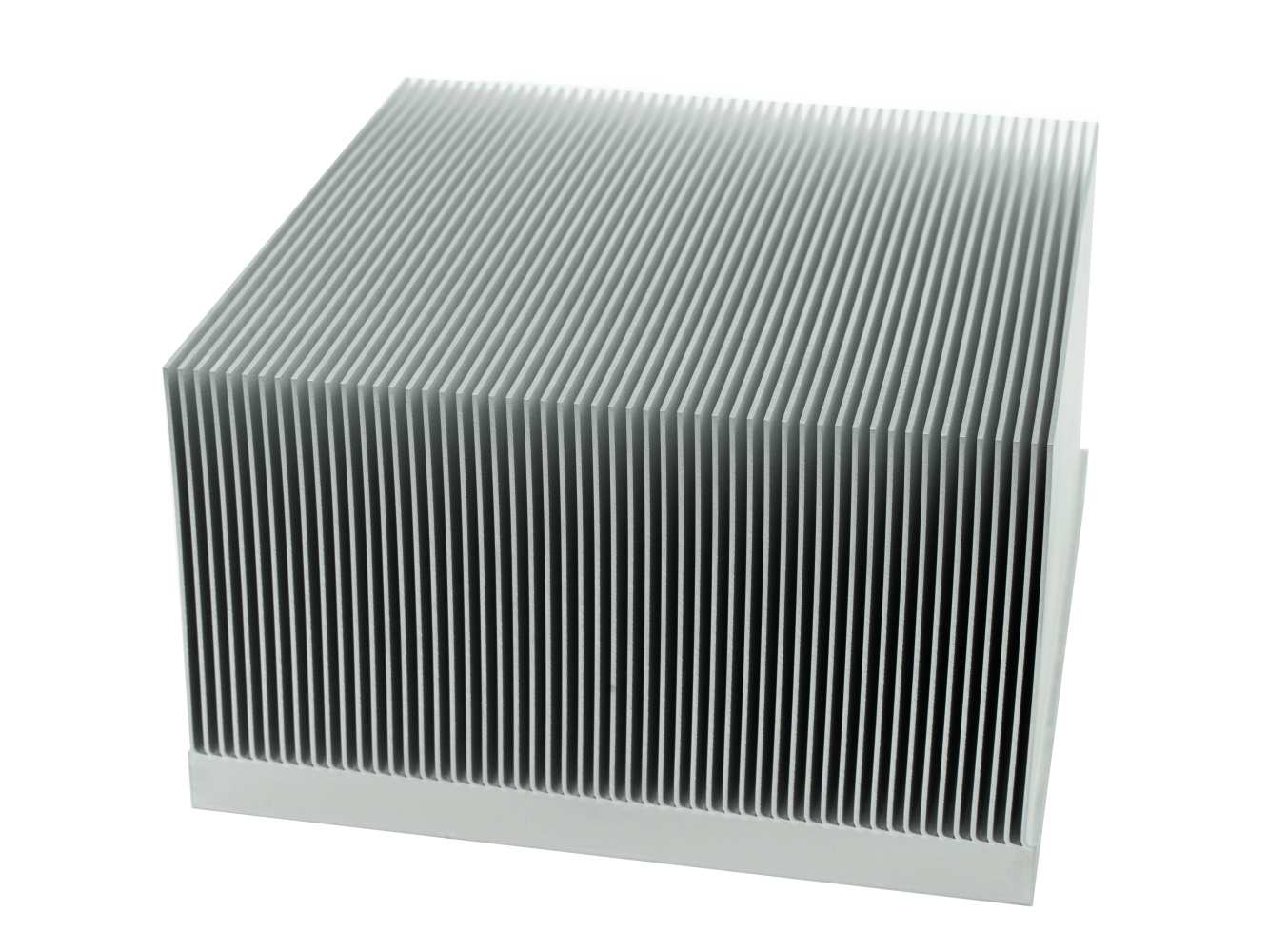
The metal heat conducting plates can be made of aluminum alloy. Aluminum alloy is widely used in heat sink manufacturing because it provides a good balance of thermal conductivity, weight, processing performance, and cost.
Advantages of Aluminum Alloy Heat Sinks
| Material Feature | Benefit |
|---|
| Good thermal conductivity | Helps transfer heat efficiently |
| Lightweight | Reduces total product weight |
| Good machinability | Suitable for complex heat sink structures |
| Corrosion resistance after surface treatment | Improves long-term durability |
| Cost-effective | Suitable for mass production |
| Flexible processing | Supports extrusion, skiving, CNC machining, and custom forming |
For many applications, an aluminum heat sink is more practical than a full Copper Heat Sink, especially when weight and cost must be controlled.
How This Heat Sink Solves Customer Pain Points
This folded fin aluminum heat sink is designed for real engineering problems, not only theoretical cooling improvement.
Pain Point 1: Limited Installation Height
Many electronic products have strict height limitations. If traditional vertical fins are shortened, the cooling area becomes smaller and the heat sink may not meet the thermal requirement.
The folded metal heat conducting plate increases the total heat exchange area within the same height, helping customers achieve better cooling performance without changing the product structure too much.
Pain Point 2: Insufficient Heat Dissipation Area
For high-power components, the heat sink must provide enough surface area for convection cooling. The folded plates and staggered heat dissipation fins increase the effective air contact area, improving heat transfer efficiency.
Pain Point 3: Poor Airflow Inside Compact Equipment
In compact devices, airflow is often blocked or uneven. The longitudinal and transverse grooves help guide air movement and reduce heat stagnation, allowing hot air to escape more effectively.
Pain Point 4: Difficult Installation
The mounting slots on both sides of the base make the heat sink easier to fix in equipment. This helps improve assembly efficiency and ensures stable contact between the heat sink and the heat source.
Pain Point 5: Need for Custom Thermal Design
Different applications have different space, power, airflow, and mounting requirements. A standard heat sink may not match the customer’s product. Kingka can provide custom heat sink design according to drawings, heat load, size limits, airflow conditions, and installation methods.
Application Areas
This folded fin aluminum heat sink can be used in many industries where compact structure and reliable heat dissipation are required.
| Application | Cooling Requirement |
|---|
| Power supplies | Compact heat sink with stable heat dissipation |
| LED lighting systems | Large heat exchange area within limited space |
| Industrial control equipment | Reliable cooling for long-term operation |
| Telecom equipment | Compact and efficient thermal management |
| Power electronics | Heat dissipation for modules and components |
| Automation equipment | Stable thermal performance in enclosed systems |
| Consumer electronics | Lightweight and compact cooling structure |
| Embedded systems | Low-profile heat sink design |
For higher heat load applications, this heat sink can also be combined with other thermal solutions, such as copper heat sinks, heat pipe heat sinks, or liquid cold plates, depending on the actual cooling requirement.
Folded Fin Heat Sink vs. Traditional Straight Fin Heat Sink
| Comparison Item | Folded Fin Aluminum Heat Sink | Traditional Straight Fin Heat Sink |
|---|
| Heat exchange area | Larger area within limited height | Mainly depends on vertical fin height |
| Compact space performance | Better for height-limited installations | Performance decreases when fin height is reduced |
| Airflow guidance | Longitudinal and transverse grooves help guide air | Airflow path is usually simpler |
| Heat dissipation efficiency | Improved by folded plates and staggered fins | Suitable for general cooling needs |
| Installation | Side mounting slots improve installation convenience | Mounting design depends on standard structure |
| Customization | Suitable for customized thermal design | Less flexible for special structures |
This comparison shows why a folded fin heat sink can be a better choice when customers need higher cooling performance in limited space.
Kingka Custom Heat Sink Manufacturing Capabilities
Kingka provides customized heat sink and thermal management solutions for power electronics, LED systems, telecom equipment, industrial devices, automotive electronics, energy systems, and other applications.
Our thermal products include:
Custom aluminum heat sink
Copper heat sink
extruded heat sink
Skived Fin Heat Sink
CNC machined heat sink
Heat pipe heat sink
Copper-aluminum heat sink
Liquid cold plate
Water cooling plate
FSW liquid cold plate
Custom thermal management components
For custom heat sink projects, Kingka can support customers from concept design to manufacturing. We can optimize material, fin structure, groove layout, mounting method, surface treatment, and production process based on actual thermal requirements.
How to Choose the Right Custom Heat Sink
Before designing or selecting a heat sink, customers should confirm several key factors:
| Selection Factor | What to Confirm | Why It Matters |
|---|
| Heat load | Total power or heat generation of the component | Determines required cooling capacity |
| Installation height | Maximum available height inside the device | Affects fin structure and heat exchange area |
| Base size | Contact area with the heat source | Affects heat spreading and mounting stability |
| Airflow condition | Natural convection or forced airflow | Determines fin spacing and groove design |
| Material | Aluminum, copper, or copper-aluminum structure | Affects thermal conductivity, weight, and cost |
| Mounting method | Screws, slots, brackets, or custom fixation | Affects assembly efficiency and contact pressure |
| Surface treatment | Anodizing, nickel plating, passivation, etc. | Improves corrosion resistance and appearance |
| Operating environment | Indoor, outdoor, humid, dusty, or high-temperature condition | Affects material and structural design |
By confirming these details early, Kingka can help customers develop a more accurate and reliable custom heat sink solution.
As electronic devices become more compact and powerful, heat sink design must solve two problems at the same time: limited installation space and increasing heat dissipation demand.
The folded fin aluminum heat sink structure provides an effective solution. By using a heat sink base, folded metal heat conducting plates, staggered heat dissipation fins, longitudinal heat conduction grooves, transverse heat dissipation grooves, heat conduction holes, and side mounting slots, this design increases the total heat exchange area, improves airflow guidance, enhances cooling efficiency, and makes installation easier.
Compared with traditional straight-fin heat sinks, this structure is more suitable for height-limited applications where customers still need reliable cooling performance.
Kingka can provide customized aluminum heat sinks, Skived Fin Heat Sinks, heat pipe heat sinks, liquid cold plates, and complete thermal management solutions according to customer drawings, heat load, space limitations, and application requirements.
For customers looking for a compact, efficient, and manufacturable cooling solution, a folded fin aluminum heat sink can help improve product reliability, reduce thermal risk, and support stable long-term operation.