High-power IGBT modules are widely used in power electronics, renewable energy systems, industrial drives, traction systems, energy storage equipment, and high-voltage power conversion devices. During operation, IGBT modules generate a large amount of heat. If this heat is not removed efficiently, the junction temperature may rise quickly, leading to reduced efficiency, thermal stress, power derating, or even module failure.
For many high-power applications, a heat pipe heat sink is often considered because heat pipes can transfer heat efficiently over a certain distance. However, in harsh environments such as outdoor, high-humidity, high-altitude, and low-temperature conditions, heat pipe-based cooling solutions may face reliability risks. Heat pipe working fluid may freeze in extremely cold environments, and the sealed pipe structure may suffer from leakage or long-term performance degradation.
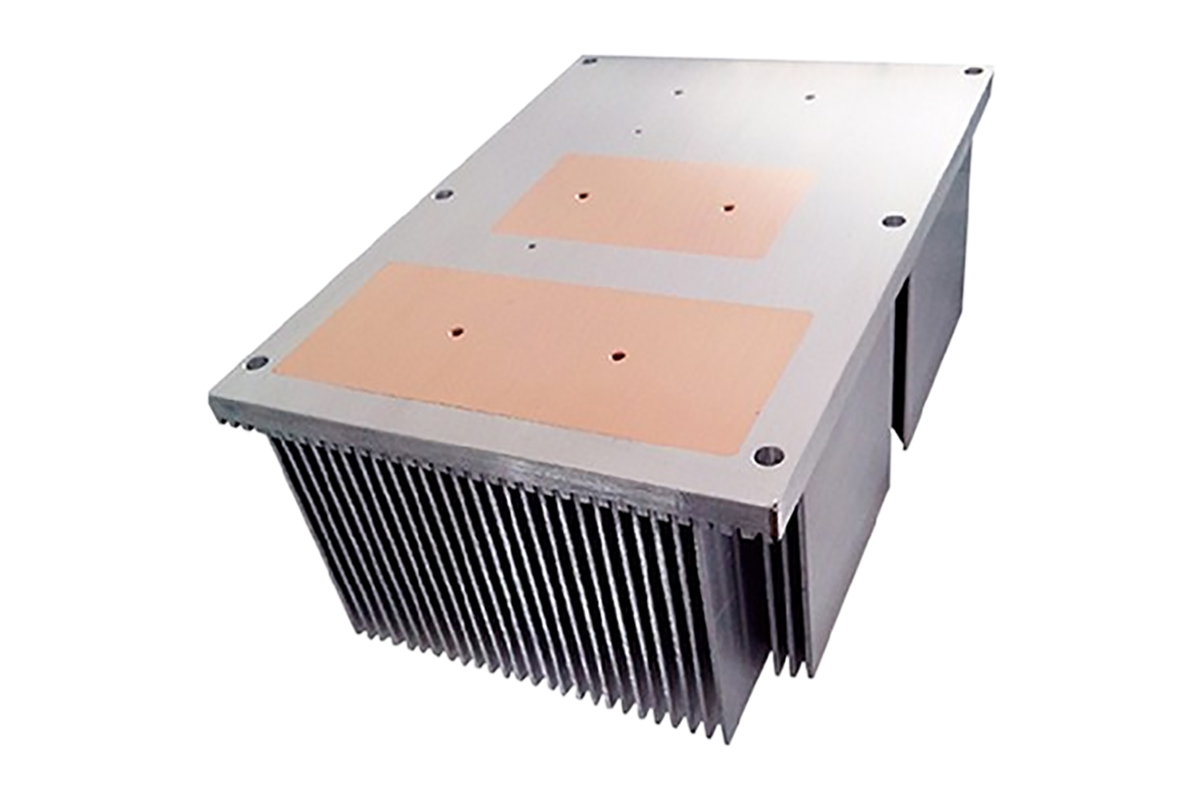
To solve these problems, Kingka has developed a copper-aluminum soldered heat sink based on a copper base plate, aluminum skived fins, and high-temperature solder paste bonding technology. This structure avoids the use of heat pipes and relies on solid-state heat conduction through copper and aluminum materials, offering a more stable and reliable IGBT cooling solution for harsh working conditions.
Why High-Power IGBT Cooling Is a Critical Design Challenge
IGBT modules are core power components in many electrical systems. They switch high voltage and high current, which means they produce significant heat during operation. When the heat cannot be transferred away from the module quickly enough, the device temperature rises and affects both performance and lifetime.
In real applications, IGBT thermal management is not only about reducing temperature. Customers usually care about several deeper issues:
How to reduce local hot spots under the IGBT module
How to improve heat spreading across the heat sink base
How to maintain stable cooling performance in outdoor environments
How to avoid leakage, freezing, and maintenance risks
How to balance cooling capacity, structural reliability, weight, and cost
How to build a customized heat sink that matches the actual installation space
For this reason, a standard aluminum heat sink is often not enough for high-power IGBT applications. A more reliable custom heat sink structure is required.
Common Problems of Heat Pipe Heat Sinks in Harsh Environments
Heat pipe heat sinks can be effective in many controlled environments. However, for outdoor and extreme-condition applications, they may create technical risks that cannot be ignored.
1. Risk of Freezing in Low-Temperature Environments
A heat pipe contains working fluid inside the sealed tube. In low-temperature environments, this internal fluid may freeze. Once freezing occurs, the fluid volume can expand and damage the internal structure of the heat pipe. In severe cases, the pipe may crack, causing the entire heat transfer function to fail.
For high-power IGBT systems used in cold regions, outdoor power stations, high-altitude equipment, or winter operating conditions, this is a major reliability concern.
2. Risk of Leakage and Sealing Failure
A heat pipe depends on a sealed structure. If the sealing area ages, cracks, or fails under long-term vibration, humidity, thermal cycling, or mechanical stress, the internal working fluid may leak. Once leakage occurs, the heat pipe will lose its heat transfer ability.
For power electronics cooling, this type of failure may not be easy to detect in the early stage, but it can directly affect the safety and reliability of the whole system.
3. Performance Degradation Over Long-Term Use
The heat transfer performance of a heat pipe depends on internal working fluid circulation, wick structure, and vapor-liquid phase change. Under harsh working conditions, long-term thermal cycling and mechanical stress may reduce performance stability.
This is why, for some harsh-condition IGBT cooling projects, a solid conduction heat sink with no internal working fluid can be a more reliable choice.
Copper-Aluminum Soldered Heat Sink Design Concept
The copper-aluminum soldered heat sink is designed to solve the reliability problems of heat pipe-based cooling systems. Instead of using internal fluid circulation, the heat sink uses a copper base plate for heat spreading and aluminum fins for heat dissipation.
The copper base plate quickly absorbs and spreads the heat from the IGBT module, while the aluminum fin structure increases the heat dissipation area and transfers heat to the surrounding air.
This design combines the advantages of copper and aluminum:
Copper provides excellent thermal conductivity and heat spreading
Aluminum provides lightweight structure and large-area heat dissipation
Solder bonding improves interface contact between copper and aluminum
No heat pipe means no freezing, no leakage, and higher environmental reliability
This structure is especially suitable for high-power IGBT cooling, outdoor power electronics cooling, and customized thermal management solutions used in harsh environments.
Core Structure Parameters of the Copper-Aluminum Heat Sink
The heat sink structure is designed around the principle of “heat spreading + efficient heat dissipation.” The copper base plate handles concentrated heat from the IGBT module, while the aluminum fins increase the effective cooling area.
Main Structural Parameters
| Component | Specification | Function | Design Benefit |
|---|
| Copper base plate | 5 mm thickness | Spreads heat from the IGBT bottom surface | Reduces local hot spots and improves temperature uniformity |
| Aluminum base plate | 10 mm thickness | Provides structural support and thermal connection with fins | Improves mechanical strength and heat transfer stability |
| Total base thickness | 15 mm, including 10 mm aluminum + 5 mm copper | Forms a copper-aluminum composite base | Balances thermal conductivity, strength, and weight |
| Aluminum fin length | 850 mm | Increases heat dissipation area | Suitable for large-size high-power IGBT cooling |
| Aluminum fin height | 100 mm | Expands convection surface | Improves air-side heat dissipation efficiency |
| Aluminum fin thickness | 1.5 mm | Provides stable fin structure | Balances heat transfer, strength, and manufacturing feasibility |
| Solder paste | 230°C high-temperature solder paste | Bonds copper and aluminum interface | Reduces interface thermal resistance |
| Bonding process | Stencil printing soldering process | Controls solder paste thickness and uniformity | Improves bonding consistency and production stability |
This parameter combination is suitable for large-size custom aluminum heat sink, copper aluminum heat sink, and IGBT cooling heat sink applications that require stable thermal performance and strong environmental adaptability.
Why Use a 5 mm Copper Base Plate?
The bottom surface of an IGBT module often generates concentrated heat. If this heat is transferred directly to an aluminum heat sink, local temperature differences may occur because aluminum has lower thermal conductivity than copper.
A 5 mm copper base plate helps solve this issue by spreading the heat more evenly before it enters the aluminum fin structure. This reduces the risk of local overheating and improves the working stability of the IGBT module.
The copper base plate provides several advantages:
Better heat spreading under the IGBT module
Lower temperature difference across the heat sink base
Reduced local hot spots
Improved contact thermal performance
Better protection for high-power semiconductor devices
For high-power applications, the copper base plate is not only a thermal conduction layer. It is also the key part that improves temperature uniformity and module reliability.
Aluminum Skived Fin Design for Large-Area Heat Dissipation
The aluminum fin section is designed to release heat into the surrounding environment. In this solution, the fin length reaches 850 mm, the height is 100 mm, and the fin thickness is 1.5 mm. This large fin structure provides a wide heat dissipation area, making it suitable for high-power heat loads.
Aluminum is selected because it offers a good balance between thermal performance, weight, cost, and manufacturability. Compared with a full copper heat sink, a copper-aluminum composite structure can reduce overall weight while still maintaining strong heat spreading performance at the heat source area.
For this type of Skived Fin Heat Sink, the fin geometry is important because it directly affects air-side thermal resistance. Fin height, fin spacing, fin thickness, and airflow direction should be optimized according to the actual working condition.
Advantages of Aluminum Fin Structure
| Design Factor | Benefit for IGBT Cooling |
|---|
| Large fin area | Improves convection heat dissipation |
| 100 mm fin height | Increases heat exchange surface |
| 1.5 mm fin thickness | Provides a balance between strength and thermal conduction |
| 850 mm fin length | Suitable for large-format power electronics cooling |
| Aluminum material | Reduces weight compared with full copper heat sink |
| Custom fin design | Can be optimized according to airflow and installation space |
This makes the solution suitable for power electronics heat sinks, IGBT module heat sinks, industrial cooling systems, and other high-power thermal management applications.
Copper-Aluminum Interface Bonding with 230°C Solder Paste
The interface between copper and aluminum is one of the most important parts of the entire heat sink. Even if both materials have good thermal conductivity, poor interface bonding can create high contact thermal resistance and reduce the overall cooling effect.
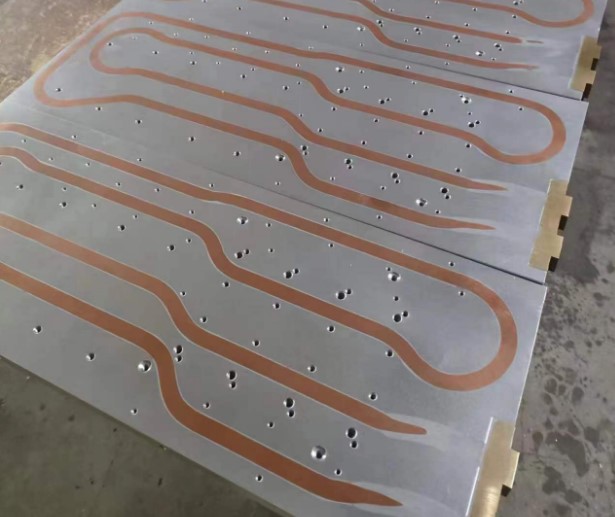
To improve interface quality, this heat sink uses a 230°C high-temperature solder paste combined with a stencil printing process. The solder paste is printed evenly on the bonding area through a customized steel stencil. After accurate alignment and controlled heating, the solder melts and forms a strong thermal and mechanical connection between the copper base plate and aluminum structure.
Key Process Steps
| Process Step | Description | Purpose |
|---|
| Surface preparation | Clean and prepare copper and aluminum bonding surfaces | Improve solder wetting and bonding quality |
| Stencil design | Customize steel stencil according to bonding area | Control solder paste distribution |
| Solder paste printing | Print 230°C solder paste evenly on the copper-aluminum interface | Avoid insufficient solder or excessive solder accumulation |
| Precision alignment | Align copper base plate and aluminum fin structure accurately | Ensure full contact and uniform bonding |
| High-temperature soldering | Heat to complete solder melting and solidification | Form strong mechanical and thermal connection |
| Post-process inspection | Check bonding strength and interface quality | Prevent voids, weak bonding, or delamination |
Through this process, the copper-aluminum interface can achieve close contact and lower thermal resistance, which is essential for high-power IGBT cooling.
Why Stencil Printing Matters in Solder Bonding
For a large-size copper-aluminum heat sink, solder paste cannot be applied randomly. If the solder layer is too thin, some areas may not bond properly. If the solder layer is too thick, it may increase thermal resistance or cause uneven bonding.
Stencil printing helps solve this problem by controlling the solder paste thickness and distribution. This improves consistency, repeatability, and production efficiency.
The benefits of stencil printing include:
More uniform solder paste thickness
Better control of bonding area
Reduced risk of local voids
Improved copper-aluminum contact quality
Better process repeatability for batch production
More stable thermal performance
For a custom heat sink manufacturer, process stability is just as important as material selection. A good design must be manufacturable, repeatable, and reliable in real working conditions.
Copper-Aluminum Heat Sink vs. Heat Pipe Heat Sink
For harsh-condition IGBT cooling, the copper-aluminum soldered heat sink provides several advantages over a traditional heat pipe heat sink.
| Comparison Item | Copper-Aluminum Soldered Heat Sink | Heat Pipe Heat Sink |
|---|
| Heat transfer method | Solid conduction through copper and aluminum | Phase-change heat transfer through internal working fluid |
| Freezing risk | No internal fluid, no freezing risk | Working fluid may freeze in low-temperature environments |
| Leakage risk | No sealed pipe, no fluid leakage | Sealing failure may cause working fluid leakage |
| Long-term reliability | High reliability under harsh environments | Performance depends on heat pipe sealing and internal fluid condition |
| Maintenance risk | Lower maintenance requirement | Failure may be difficult to detect before performance drops |
| Structural stability | Strong solid-state structure | Heat pipe may be affected by vibration, bending, and thermal cycling |
| Suitable environment | Outdoor, cold, humid, high-altitude, harsh applications | More suitable for controlled or moderate environments |
| Design flexibility | Suitable for large-area IGBT heat spreading | Good for transferring heat over distance, but limited by heat pipe condition |
This does not mean heat pipe heat sinks are not useful. In many applications, heat pipes remain a strong solution. However, when the main customer concern is freezing, leakage, and long-term reliability in harsh environments, a copper-aluminum soldered heat sink may be more suitable.
Application Advantages in Harsh Environments
This copper-aluminum composite heat sink is designed for applications where reliability is more important than only short-term thermal performance.
1. No Heat Pipe Failure Risk
Because the heat sink does not use heat pipes, it does not rely on internal working fluid, vapor circulation, or sealed tube structures. This eliminates the risks of fluid leakage, pipe cracking, and heat pipe aging.
For IGBT systems that must operate continuously, this is a major advantage.
2. No Freezing Problem in Low-Temperature Conditions
In cold regions or outdoor applications, heat pipe working fluid may freeze and damage the pipe. The copper-aluminum heat sink uses solid-state conduction, so it is not affected by internal fluid freezing.
This makes it suitable for:
High-altitude power equipment
Outdoor electrical cabinets
Wind power systems
Energy storage systems
Railway and traction power systems
Industrial equipment in cold regions
Harsh outdoor power electronics cooling
3. Better Heat Spreading Under the IGBT Module
The 5 mm copper base plate helps distribute heat more evenly across the heat sink base. This reduces the temperature concentration at the IGBT bottom surface and helps improve module reliability.
4. Stronger Structural Reliability
The copper-aluminum soldered structure is mechanically stable. It avoids the fragile sealed structure of heat pipes and is better suited for vibration, humidity, thermal cycling, and outdoor operating conditions.
5. Suitable for Customized Production
The solder paste stencil printing process is controllable and repeatable. It can be adapted to different heat sink sizes, bonding areas, fin structures, and customer thermal requirements.
When Should You Choose a Copper-Aluminum Soldered Heat Sink?
A copper-aluminum soldered heat sink is suitable when the customer needs a reliable cooling solution for high-power electronics but wants to avoid heat pipe risks.
Recommended Application Scenarios
| Application Condition | Why This Solution Is Suitable |
|---|
| High-power IGBT cooling | Copper base improves heat spreading, aluminum fins improve heat dissipation |
| Outdoor power electronics | No heat pipe leakage or freezing risk |
| Low-temperature environment | Solid conduction structure avoids working fluid freezing |
| High-humidity environment | No sealed fluid tube structure, lower failure risk |
| Large-size heat sink requirement | Aluminum fin structure supports large heat dissipation area |
| Long-term continuous operation | Stable structure improves service life |
| Customer concerns about heat pipe failure | Copper-aluminum design eliminates heat pipe-related risks |
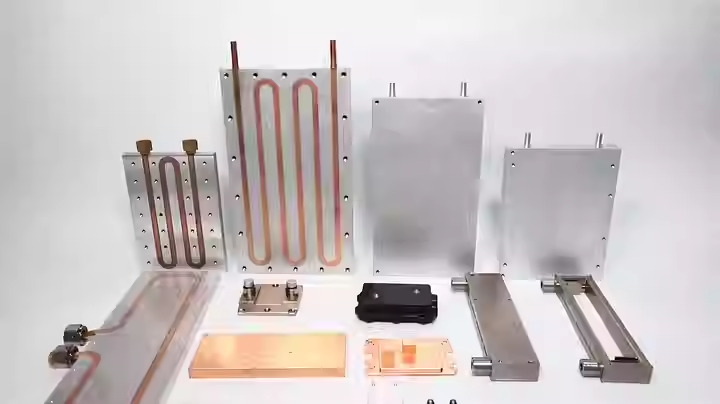
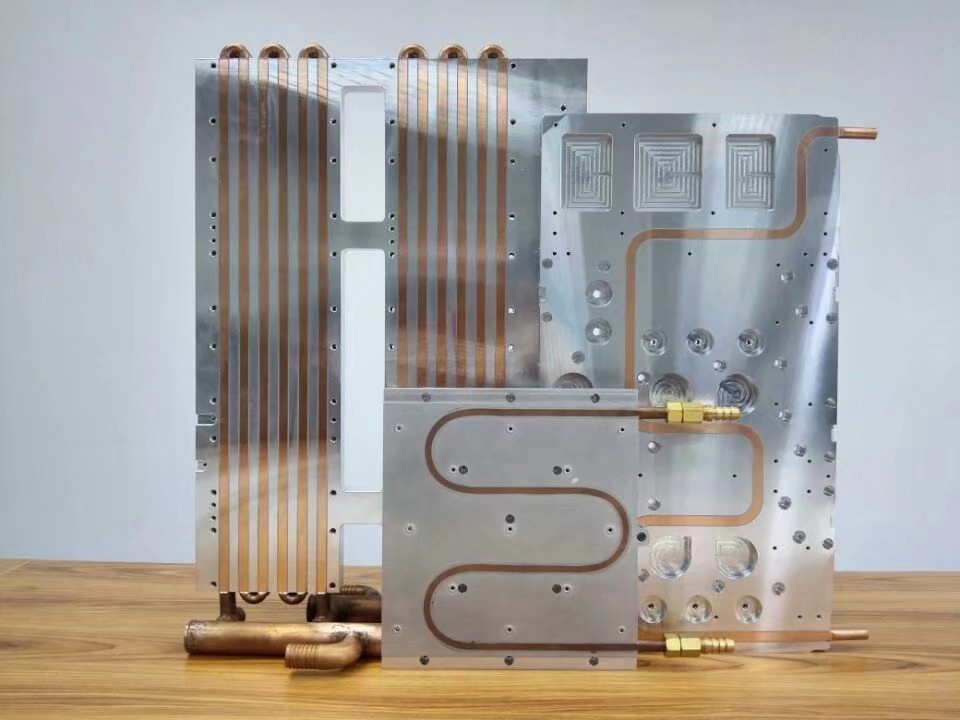
For some extremely high heat flux applications, a liquid cold plate may still be required. Kingka can also provide custom liquid cold plate, water cooling plate, FSW liquid cold plate, and CNC machined cold plate solutions when air cooling or solid conduction heat sinks are not enough.
Copper-Aluminum Heat Sink or Liquid Cold Plate: How to Choose?
Both copper-aluminum heat sinks and liquid cold plates are used in high-power thermal management, but they solve different problems.
| Cooling Solution | Suitable Situation | Main Advantage | Key Consideration |
|---|
| Copper-aluminum soldered heat sink | High-power air cooling, harsh environment, no liquid system preferred | No freezing or leakage risk from heat pipes | Requires suitable airflow and enough installation space |
| Heat pipe heat sink | Need to transfer heat from one area to another in a controlled environment | High heat transfer efficiency over short/medium distance | May have freezing or leakage concerns in harsh environments |
| Liquid cold plate | Very high heat flux or compact high-power system | Strong cooling capacity with coolant flow | Requires pump, coolant, sealing, and system-level design |
| Hybrid thermal solution | Complex heat sources and special installation space | Combines multiple cooling methods | Requires customized thermal design and validation |
If the customer’s main concern is harsh environment reliability, the copper-aluminum soldered heat sink is a strong option. If the heat flux is too high for air cooling, a liquid cold plate may be more suitable.
How Kingka Supports Custom IGBT Cooling Projects
Kingka focuses on customized thermal management components for power electronics, energy storage, industrial equipment, LED systems, telecom equipment, automation systems, and high-power electronic devices.
Our products and services include:
Custom aluminum heat sink
Copper heat sink
Copper-aluminum heat sink
Skived Fin Heat Sink
Extrusion Heat Sink
Heat pipe heat sink
IGBT cooling heat sink
Liquid cold plate
Water cooling plate
FSW liquid cold plate
CNC machined cold plate
Custom thermal management solutions
For IGBT cooling projects, Kingka can support structural design, material selection, fin design, copper-aluminum bonding, soldering process optimization, CNC machining, surface treatment, and customized production according to customer drawings or application requirements.
Our goal is not only to manufacture a heat sink, but to help customers solve practical thermal problems, including hot spots, limited space, harsh environment operation, reliability risks, and long-term performance stability.
For high-power IGBT modules used in harsh environments, traditional heat pipe heat sinks may face risks such as working fluid freezing, leakage, sealing failure, and long-term performance degradation. These problems can become serious concerns in outdoor, high-humidity, high-altitude, and low-temperature applications.
Kingka’s copper-aluminum soldered heat sink provides a more reliable alternative. By using a 5 mm copper base plate for heat spreading, a 10 mm aluminum base and large aluminum fins for heat dissipation, and 230°C solder paste with stencil printing technology for copper-aluminum bonding, this solution delivers stable thermal performance without relying on heat pipes.
The result is a robust, manufacturable, and environment-resistant IGBT cooling heat sink suitable for demanding power electronics applications.
For customers who need customized heat sink, copper aluminum heat sink, skived fin heat sink, liquid cold plate, or complete thermal management solutions, Kingka can provide reliable design and manufacturing support based on actual heat load, installation space, operating environment, and long-term reliability requirements.