In high-power electronics cooling, a heat pipe is not just a simple copper tube. It is a highly efficient passive heat transfer component that helps move heat from a concentrated heat source to a larger heat dissipation area.
For products such as power electronics, IGBT modules, LED lighting systems, telecom equipment, battery packs, industrial control devices, servers, and energy storage systems, the correct heat pipe design can greatly improve the performance of a heat sink, Heat Pipe Heat Sink, or even a hybrid cooling structure combined with a Liquid Cold Plate.
However, many thermal design problems happen because the heat pipe is selected only by diameter, while the actual length, wall thickness, flattened size, bending radius, working orientation, heat load, and heat sink structure are ignored.
This article explains how to select the right heat pipe for high-power electronics cooling, and how to combine heat pipes with custom heat sinks, Liquid Cold Plates, and other thermal management solutions.
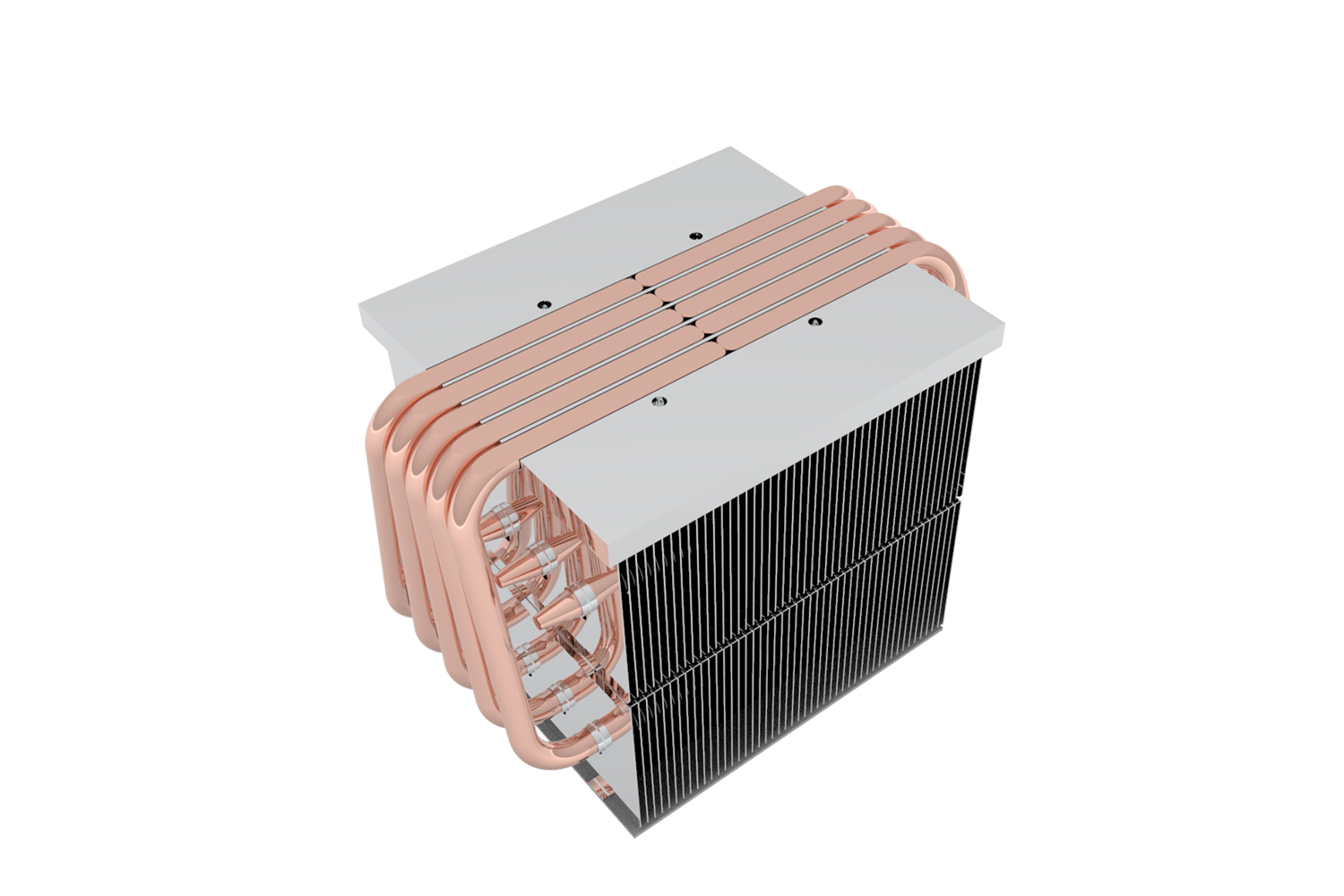
What Is a Heat Pipe in Thermal Management?
A heat pipe is a sealed copper tube filled with a small amount of working fluid. Inside the heat pipe, there is usually a wick structure that helps the liquid return from the condenser section to the evaporator section.
When one end of the heat pipe contacts the heat source, the working fluid absorbs heat and evaporates. The vapor moves to the cooler end of the pipe, releases heat, condenses back into liquid, and then returns through the internal wick structure.
This continuous phase-change process allows the heat pipe to transfer heat much faster than solid metal conduction alone.
In a heat pipe heat sink, the heat pipe usually works together with an aluminum or Copper Heat Sink base and fins. The heat pipe spreads heat from a local hot spot to a wider fin area, while the fins release heat into the air through natural or forced convection.
For higher-power systems, heat pipes may also be used together with a liquid cold plate, water cooling plate, or other custom thermal modules to build a more advanced cooling solution.
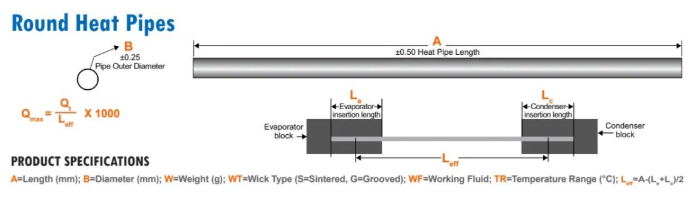
Why Heat Pipes Are Used in Heat Sink Design
A traditional aluminum heat sink mainly depends on metal conduction and airflow. When the heat source is large and evenly distributed, this structure can work well. But when the heat source is small, concentrated, or has very high power density, local overheating may occur.
This is where a heat pipe becomes useful.
A heat pipe can quickly transfer heat away from the hot spot and distribute it across a larger area of the heat sink. This helps reduce temperature difference, improve heat dissipation efficiency, and protect electronic components from thermal failure.
Heat pipes are commonly used in:
Power electronics cooling
Custom heat pipe heat sink solutions
For many applications, a custom heat pipe heat sink can provide better heat spreading performance without adding pumps, coolant, or complicated liquid cooling components.
Why Heat Pipe Diameter Matters
The diameter of the heat pipe is one of the most important factors affecting heat transfer capacity. In general, a larger heat pipe diameter provides more internal vapor flow space and more working fluid capacity, which helps improve the maximum heat transfer limit.
Small-diameter heat pipes are suitable for compact electronics and low-power applications. Medium-diameter heat pipes are widely used in standard heat pipe heat sink designs. Larger-diameter heat pipes are usually selected for high-power electronics and large heat sink assemblies.
However, a larger diameter is not always the best solution. It also requires more installation space and may increase structural difficulty, especially when the heat pipe needs to be flattened or bent.
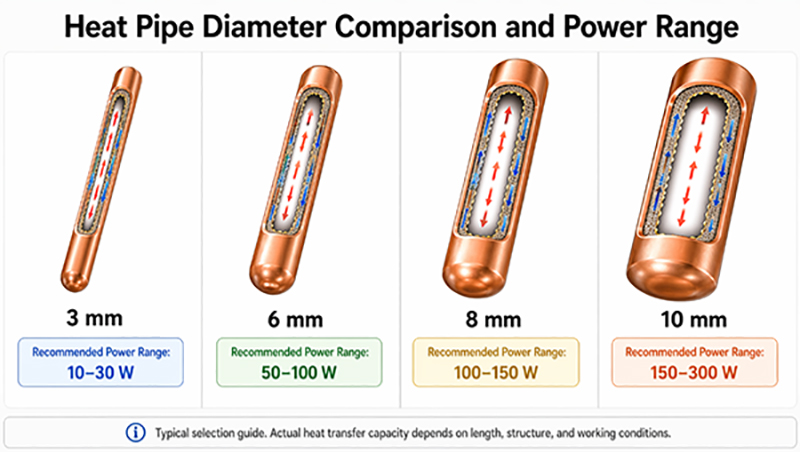
Heat Pipe Diameter Selection Reference
| Heat Pipe Diameter | Typical Heat Load Range | Recommended Applications | Design Notes |
|---|
| 3–4 mm | 10–50W | Compact electronics, small LED modules, thin thermal modules | Suitable for limited space and short-distance heat transfer |
| 6–8 mm | 50–150W | Standard heat pipe heat sink, power supply, telecom equipment, industrial control devices | Common choice for medium-power heat dissipation |
| 10 mm and above | 150–300W+ | High-power electronics, IGBT modules, battery systems, large heat sink assemblies | Higher heat transfer capacity, but requires more installation space |
From a design point of view, the heat pipe diameter should be selected according to the heat load, available space, contact area, and final heat sink structure. If the product has enough space and the heat load is high, a larger heat pipe may be suitable. If the structure is compact, a smaller or flattened heat pipe may be more practical.
Why Heat Pipe Length Affects Heat Transfer Capacity
Heat pipe length has a direct influence on thermal performance. A shorter heat pipe usually has lower internal resistance and smaller heat loss because the vapor and liquid return path is shorter.
When the heat pipe becomes longer, the internal flow distance increases. This may reduce the heat transfer capacity, especially when the pipe is installed in an unfavorable direction or the heat source power is high.
In thermal design, engineers should not only ask, “What diameter is the heat pipe?” They also need to ask, “How far does the heat need to be transferred?”
Heat Pipe Length and Thermal Performance Reference
| Heat Pipe Length | Thermal Performance Characteristics | Suitable Applications | Design Suggestions |
|---|
| 30–80 mm | Short transfer distance, low thermal loss, high efficiency | Compact heat sink, local hot spot cooling | Preferred when the heat source and cooling area are close |
| 80–200 mm | Balanced performance and flexibility | General heat pipe heat sink, electronic thermal modules | Most common length range for custom heat sink design |
| 200 mm+ | Heat transfer capacity may decrease as length increases | Long-distance heat transfer, special equipment structure | Requires larger diameter, optimized wick structure, and careful layout |
For example, a 6.35 mm diameter heat pipe with a wall thickness of around 0.8–1.0 mm may transfer about 100W at 100 mm length under certain test conditions. But when the same heat pipe is extended to 600 mm, its heat transfer capacity may drop to around 15W.
This shows that heat pipe capacity is not fixed. The same heat pipe may perform very differently under different length conditions.
Example: Heat Transfer Capacity of 6.35 mm Heat Pipe
| Heat Pipe Diameter | Wall Thickness | Length | Approx. Heat Transfer Capacity | Design Meaning |
|---|
| 6.35 mm | 0.8–1.0 mm | 100 mm | About 100W | Suitable for short-distance medium-power heat transfer |
| 6.35 mm | 0.8–1.0 mm | 300 mm | About 35–40W | Capacity decreases as length increases |
| 6.35 mm | 0.8–1.0 mm | 600 mm | About 15W | Long-distance transfer requires careful thermal design |
The above data is for design reference only. Actual performance may change depending on wick type, working fluid, evaporator length, condenser length, airflow condition, contact pressure, and operating temperature.
Wall Thickness and Internal Flow Space
Wall thickness affects both structural strength and heat transfer performance.
A thicker wall can improve mechanical strength and make the heat pipe more resistant to deformation during assembly, flattening, or bending. This is important for thermal modules that require press-fitting, embedding, or complex forming.
However, if the outer diameter remains the same, a thicker wall reduces the inner diameter. This limits the internal vapor channel and working fluid space, which may reduce heat transfer performance.
A thinner wall can provide more internal flow space, which may improve heat transfer efficiency. But if the wall is too thin, the heat pipe may be easier to deform, collapse, or become damaged during production.
Therefore, wall thickness should be selected based on both thermal and mechanical requirements.
Key factors include:
Heat transfer capacity
Mass production reliability
For a custom heat pipe heat sink, wall thickness is not only a material parameter. It directly affects the balance between thermal performance and manufacturing stability.
Flattened Heat Pipe Design for Compact Heat Sinks
In many electronic products, the available installation height is very limited. A round heat pipe may not fit into the structure, so it needs to be flattened.
A flattened heat pipe can provide a larger contact surface with the heat source or heat sink base. This helps reduce contact thermal resistance and improves heat spreading performance.
Flattened heat pipes are commonly used in:
Thin heat sink modules
Compact industrial electronics
However, flattening must be controlled carefully. If the heat pipe is flattened too much, the internal wick structure and vapor channel may be compressed. This can reduce the heat transfer capacity and affect long-term reliability.
Heat Pipe Flattening Size Reference
| Round Heat Pipe Diameter | Common Flattened Thickness Range | Width Range After Flattening | Design Notes |
|---|
| 6.35 mm | 3.5–5.5 mm | Around 6.9–8.2 mm | Suitable for compact heat sink modules and limited-height spaces |
| 8 mm | 2.0–6.5 mm | Around 9.45–11.72 mm | Flexible for thin heat pipe heat sink design |
| 9.5 mm | 5.0–8.5 mm | Around 10.25–12.55 mm | Suitable for larger contact area and medium-high heat loads |
| 10 mm | 5.0–9.0 mm | Around 11.0–13.3 mm | Common for high-power heat pipe modules |
| 12 mm | 5.0–11.0 mm | Around 12.6–16.6 mm | Suitable for large heat sink assemblies and higher thermal loads |
When designing a flattened heat pipe, it is important to confirm the final height, contact area, heat source size, pressing method, and heat sink base structure. The design should leave enough internal flow space instead of only focusing on reducing thickness.
A properly designed flattened heat pipe can improve thermal contact and solve space limitations. But over-flattening may reduce performance and increase failure risk.
Bending Radius and Structural Reliability
Heat pipes are often bent to match the product structure. For example, the heat source and heat dissipation area may be located in different positions, or the heat pipe may need to avoid screws, connectors, capacitors, or structural parts.
Although heat pipes can be bent, the bending radius must be controlled. If the bending radius is too small, the internal wick structure may be damaged, the vapor channel may become blocked, and the pipe wall may collapse.
In general, the minimum bending radius of a heat pipe is about 1.5 times the diameter. For safer and more stable design, it is usually recommended to use 2 times the diameter as the bending radius.
Heat Pipe Bending Design Reference
| Heat Pipe Diameter | Minimum Bending Radius | Recommended Bending Radius | Design Risk if Radius Is Too Small |
|---|
| 6 mm | ≥9 mm | ≥12 mm | Wick damage, vapor channel blockage, reduced heat transfer |
| 8 mm | ≥12 mm | ≥16 mm | Pipe collapse, poor liquid return, unstable thermal performance |
| 10 mm | ≥15 mm | ≥20 mm | Higher forming risk, lower reliability after bending |
| 12 mm | ≥18 mm | ≥24 mm | Not recommended for tight spaces without structural verification |
For custom thermal module design, the bending requirement should be confirmed at the early design stage. If the bending position is too close to the evaporator or condenser area, it may affect the effective heat transfer length and reduce cooling performance.
Good bending design should consider:
Bending radius
Wick structure protection
This is especially important for complex heat pipe heat sink assemblies used in high-power electronic systems.
Heat Pipe Heat Sink vs. Liquid Cold Plate
Both heat pipe heat sinks and liquid cold plates are used in high-power thermal management, but they are suitable for different working conditions.
A heat pipe heat sink is usually used when the system still has airflow and needs better heat spreading without using liquid circulation. It is passive, reliable, and easier to maintain.
A liquid cold plate is more suitable when the heat load is very high, the heat source is dense, or air cooling cannot meet the thermal requirement. A liquid cold plate uses coolant flow to remove heat from the heat source, making it suitable for power electronics, battery packs, EV systems, laser equipment, energy storage, and high-performance computing.
In some advanced applications, heat pipes and liquid cold plates can also be combined. For example, heat pipes can transfer heat from multiple hot spots to a larger base area, while the liquid cold plate removes the accumulated heat through coolant circulation.
Heat Pipe Heat Sink vs. Liquid Cold Plate Comparison
| Cooling Solution | Main Cooling Method | Suitable Heat Load | Advantages | Limitations |
|---|
| Standard Heat Sink | Metal conduction + air convection | Low to medium | Simple structure, low cost, easy installation | Limited heat spreading for high heat flux |
| Heat Pipe Heat Sink | Heat pipe transfer + fin heat dissipation | Medium to high | Improves heat spreading, reduces hot spots, no pump required | Performance affected by length, orientation, and bending |
| Liquid Cold Plate | Liquid circulation cooling | High to very high | Strong cooling capacity, suitable for dense heat sources | Requires pump, coolant, sealing, and system-level design |
| Hybrid Cooling Solution | Heat pipe + heat sink or liquid cold plate | High and complex conditions | Flexible for multi-source and limited-space cooling | Requires custom thermal design and manufacturing validation |
For customers who are not sure whether to choose a heat pipe heat sink or a liquid cold plate, the best method is to evaluate the heat load, heat source size, space limitation, working environment, and reliability requirements together.
Common Pain Points in High-Power Electronics Cooling
In real projects, many customers do not just need a standard heat sink. They need a cooling solution that can solve specific thermal and structural problems.
Limited Installation Space
Many high-power devices have limited height, especially compact power supplies, LED modules, and industrial electronic equipment. In this case, a standard round heat pipe may not fit. A flattened heat pipe or embedded heat pipe design may be required.
Local Hot Spot Problems
When the heat source is small but the power is high, heat may concentrate in one area of the heat sink base. This creates a hot spot and reduces component reliability. Heat pipes help spread heat to a larger area and reduce temperature difference.
Long-Distance Heat Transfer
Sometimes the heat source and the cooling area are far apart. If the heat pipe is too long, its heat transfer capacity may decrease. The diameter, wick type, length, and working orientation must be carefully designed.
Complex Structure and Bending Requirements
Many products require heat pipes to avoid other internal components. This often means the heat pipe must be bent or flattened. If the bending radius is too small or the flattening ratio is too high, thermal performance may be affected.
Balance Between Performance and Cost
A larger heat pipe, thicker heat sink base, or liquid cold plate may improve performance, but it also increases cost, weight, and manufacturing complexity. The best cooling solution should be selected according to the actual thermal load, not simply by choosing the largest component.
Recommended Heat Pipe Selection Checklist
Before selecting a heat pipe, engineers should confirm the key thermal and structural conditions of the project.
| Selection Factor | What to Confirm | Why It Matters |
|---|
| Heat Load | Total power in watts | Determines heat pipe diameter and quantity |
| Heat Transfer Distance | Distance from heat source to cooling area | Longer distance reduces heat transfer capacity |
| Installation Space | Available height, width, and layout | Determines whether round or flattened heat pipe is needed |
| Flattening Requirement | Final flattened height and width | Over-flattening may reduce internal vapor flow |
| Bending Requirement | Bend angle and bending radius | Too small radius may damage the wick structure |
| Heat Sink Structure | Fin size, base thickness, airflow direction | Affects final heat dissipation efficiency |
| Working Orientation | Horizontal, vertical, or against gravity | Impacts liquid return inside the heat pipe |
| Cooling Method | Air cooling or liquid cooling | Helps decide between heat pipe heat sink and liquid cold plate |
This checklist helps reduce design risk and makes the communication between customer, thermal engineer, and manufacturer more efficient.
How Kingka Supports Custom Thermal Management Projects
Kingka provides customized thermal management products for customers in power electronics, energy storage, industrial equipment, LED lighting, telecom, automation equipment, and other high-power applications.
Our main products include:
Custom aluminum heat sink
Custom thermal management components
For heat pipe heat sink projects, Kingka can support different heat pipe diameters, lengths, flattened shapes, bending structures, and heat sink base designs. We can help customers select suitable heat pipe specifications according to power, size, airflow, and installation conditions.
For higher-power applications, Kingka also provides customized liquid cold plate solutions, including internal flow channel design, CNC machining, brazing, friction stir welding, leak testing, and surface treatment.
Our goal is not only to provide a single cooling part, but to help customers develop reliable, manufacturable, and cost-effective thermal management solutions.
Heat pipe selection should not be based on diameter alone. The actual cooling performance is affected by diameter, length, wall thickness, flattened height, bending radius, wick structure, working orientation, airflow, and the final heat sink design.
For example, a 6.35 mm heat pipe with 0.8–1.0 mm wall thickness may transfer about 100W at 100 mm length under certain conditions. But when the length increases to 600 mm, the heat transfer capacity may drop to around 15W. This proves that heat pipe design must be evaluated together with the real application structure.
For medium to high-power electronics, a well-designed heat pipe heat sink can improve heat spreading, reduce hot spots, and enhance system reliability. For very high heat loads or dense heat sources, a liquid cold plate or hybrid cooling solution may be more suitable.
Kingka provides customized heat sink, heat pipe heat sink, liquid cold plate, water cooling plate, and complete thermal management solutions for demanding industrial applications.
If your project has limited space, high heat density, long-distance heat transfer, or special structural requirements, a custom heat pipe or liquid cooling solution can help improve thermal performance, extend component life, and ensure stable system operation.