Choosing the right
aluminum extruded heatsink is critical for achieving reliable thermal performance, extending component lifespan, and reducing system failure risks. Heat sink manufacturing is not simply about choosing a larger size or more fins. The correct design depends on multiple factors, including heat load, airflow conditions, installation space, material properties, thermal resistance, and application requirements.
For engineers and product designers, understanding how to select an
extruded aluminum heat sink helps ensure efficient cooling solutions for power electronics, LED lighting, industrial equipment, automotive systems, renewable energy devices, and communication infrastructure.
This guide explains the key factors to consider when choosing the right
aluminum extrusion heatsink for your thermal management application.
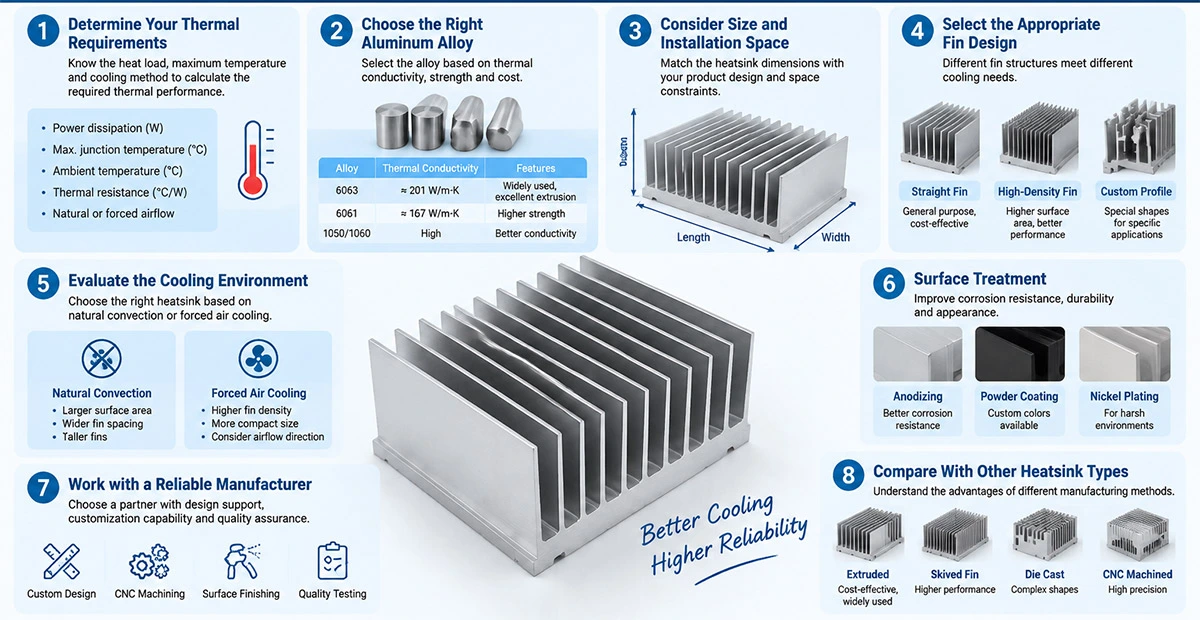
1. Understand Your Thermal Requirements First
The first step in selecting an
aluminum extruded heatsink is understanding how much heat needs to be dissipated.
Every electronic component generates heat during operation. If the heat cannot be transferred away efficiently, the operating temperature will increase, causing reduced performance or premature failure.
Key thermal parameters include:
| Parameter | Description |
|---|
| Power Dissipation (W) | Amount of heat generated by the component |
| Maximum Junction Temperature (°C) | Highest allowable operating temperature |
| Ambient Temperature (°C) | Surrounding environmental temperature |
| Thermal Resistance (°C/W) | Ability of the heatsink to transfer heat |
| Cooling Method | Natural convection or forced airflow |
The required heatsink performance can be estimated by:
Thermal Resistance = Temperature Difference ÷ Heat Load
A lower thermal resistance means better heat dissipation capability.
For example, high-power applications such as
IGBT modules, EV power systems, inverters, and industrial controllers typically require heatsinks with larger surface areas and optimized fin structures.
2. Select the Appropriate Aluminum Alloy
The material of an
extruded aluminum heat sink directly affects thermal conductivity, weight, strength, and cost.
Common aluminum alloys include:
| Aluminum Alloy | Thermal Conductivity | Characteristics |
|---|
| 6063 Aluminum | Approx. 201 W/m·K | Excellent extrusion performance, widely used for heatsinks |
| 6061 Aluminum | Approx. 167 W/m·K | Higher mechanical strength, suitable for structural applications |
| 1050/1060 Aluminum | High conductivity | Used where thermal performance is the priority |
For most commercial thermal applications,
6063-T5 aluminum extrusion is widely selected because it provides an excellent balance between:
Thermal performance
Extrusion capability
Corrosion resistance
Surface finish quality
Manufacturing cost
If the heatsink requires additional mechanical strength,
6061 aluminum heatsink extrusion may be a better choice.
3. Consider Heat Sink Size and Available Installation Space
The physical dimensions of the heatsink must match your equipment structure.
Important design factors include:
Length
Width
Height
Base thickness
Fin height
Fin spacing
A larger heatsink generally provides more surface area for heat dissipation. However, a bigger size is not always better because it may increase weight, cost, and installation limitations.
An optimized
custom aluminum extruded heatsink balances:
For example:
Compact electronics → low-profile extrusion heatsinks
Industrial power modules → large fin extrusion heatsinks
Server systems → high-density fin structures
4. Choose the Right Fin Design
The fin structure is one of the most important factors affecting heatsink performance.
Different applications require different fin designs.
Straight Fin Heat Sink
Straight fins are the most common type of extruded aluminum heatsink.
Advantages:
Applications:
LED lighting
Power supplies
Control systems
High-Density Fin Heat Sink
High-density fins increase surface area and improve cooling performance.
Suitable for:
Forced air cooling
Data center equipment
Industrial electronics
Customized Extrusion Profiles
For special applications, manufacturers can design customized extrusion profiles with:
This helps improve thermal efficiency while reducing overall system size.
5. Evaluate Cooling Environment
The operating environment greatly affects heatsink selection.
Natural Convection Cooling
When there is no fan or airflow:
Larger surface area is needed
Wider fin spacing is preferred
Taller fins improve airflow movement
Common applications:
LED fixtures
Outdoor electronics
Passive cooling systems
Forced Air Cooling
With fans or blowers:
Higher fin density can be used
Smaller heatsinks may achieve better performance
Airflow direction should be considered
Common applications:
Servers
Industrial controllers
Communication equipment
6. Consider Manufacturing Method and Customization Capability
Aluminum extrusion is one of the most cost-effective manufacturing methods for producing heatsinks.
The extrusion process allows manufacturers to create long aluminum profiles with customized cross-sectional designs.
Typical manufacturing process:
Aluminum billet preparation
High-pressure extrusion forming
Cutting to required length
CNC machining
Surface treatment
Quality inspection
Additional processes include:
CNC drilling
Milling
Anodizing
Powder coating
Nickel plating
A reliable
aluminum Heatsink Manufacturer should provide complete support from thermal design to mass production.
7. Compare Aluminum Extruded Heatsink With Other Types
Different heatsink manufacturing technologies have different advantages.
| Type | Advantages | Applications |
|---|
| Extruded Aluminum Heatsink | Cost-effective, customizable, lightweight | Electronics, industrial equipment |
| Skived Fin Heatsink | Higher fin density, excellent thermal performance | High-power cooling |
| Die Cast Heatsink | Complex shapes, high volume production | Automotive, consumer electronics |
| CNC Machined Heatsink | High precision, prototype production | Specialized applications |
For many applications requiring a balance between performance and cost,
extruded aluminum heatsinks remain one of the most practical solutions.
8. Check Surface Treatment Requirements
Surface treatment improves durability and appearance.
Common options include:
Anodizing
Benefits:
Improves corrosion resistance
Enhances surface hardness
Provides better appearance
Powder Coating
Benefits:
Additional protection
Custom colors available
Nickel Plating
Benefits:
The correct surface treatment depends on the application environment, such as outdoor exposure, humidity, or industrial conditions.
9. Work With an Experienced Aluminum Extruded Heatsink Manufacturer
Choosing the right heatsink requires more than selecting a standard catalog product.
A professional manufacturer can help optimize:
Thermal simulation
Extrusion profile design
Fin structure
Material selection
Manufacturing cost
Production scalability
A reliable supplier should provide: