A
Cold Plate is a compact heat exchanger designed to transfer thermal energy directly away from heat-generating components (like CPUs, power electronics, batteries, or laser diodes) to a circulating liquid coolant.
Instead of relying on air cooling—which becomes inefficient when dealing with extreme power densities—a cold plate uses the High Thermal Conductivity of metals combined with liquid flow to absorb and transport heat elsewhere, such as a remote radiator or chiller.
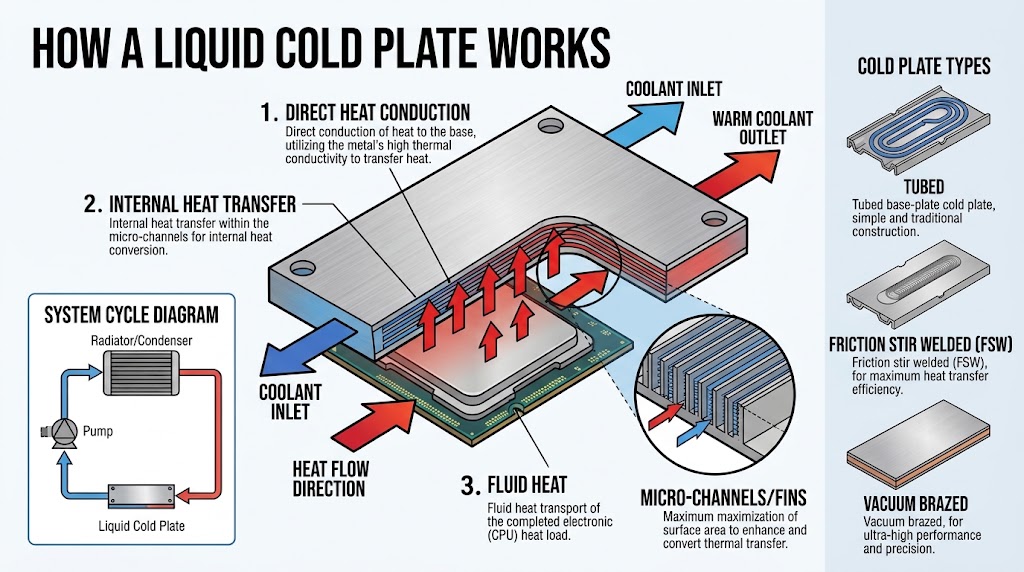
Core Working Principle
The operation of a Liquid Cold Plate follows a three-step thermodynamic process:
Direct Thermal Conduction
The flat metal base of the cold plate (usually copper or aluminum) is mounted tightly against the heat source, with thermal interface material (TIM) applied between them to eliminate air gaps.
Heat generated by the component flows rapidly into the cold plate’s metal body via conduction.
Internal Heat Transfer to Coolant
Inside the plate, the metal body features engineered micro-channels, fins, or pin-fin arrays to maximize internal surface area.
Coolant (typically water, glycol mixtures, or dielectric fluids) enters through an inlet port and flows directly through these micro-structures.
As the fluid passes over the internal fins, heat transfers from the hot metal into the liquid via forced convection.
Fluid Heat Transport
The warmed fluid flows out through the outlet port into a closed liquid loop.
A pump pushes the hot liquid to a Heat Sink, radiator, or liquid-to-air exchanger where the heat is released into the surrounding air.
The cooled liquid then returns to the cold plate inlet, continuously repeating the cycle.
Internal Structure & Design Features
| Component / Feature | Function & Importance |
| Contact Plate (Base) | Ultra-flat machined surface ensuring maximum contact area with the heat source. High thermal conductivity metals(Copper: ~400 W/m·K, Aluminum: ~200 W/m·K) are preferred. |
| Micro-Channels / Pin Fins | Internal structures that dramatically expand surface area and create localized turbulence, breaking boundary layers to maximize heat transfer rates. |
| Flow Distribution Manifold | Internal channels engineered to balance fluid pressure and flow rate evenly across all micro-channels, preventing hot spots. |
| Sealing Assembly | O-rings, vacuum brazing, or friction stir welding (FSW) used to permanently seal the plate shell and prevent high-pressure liquid leaks. |
Key Construction & Manufacturing Types
Tubed Cold Plates: Metal tubes (copper or stainless steel) are pressed or embedded into a machined aluminum base block. Simple, cost-effective, and highly reliable against leaks, but offers moderate thermal performance.
Friction Stir Welded (FSW) Cold Plates: High-strength solid plates with internal CNC-machined flow channels sealed using solid-state welding. Ideal for high structural durability and moderate-to-high heat loads.
Vacuum Brazed Micro-Channel Cold Plates: Dense, high-aspect-ratio micro-fins stacked and joined in a vacuum furnace. Offers the highest surface area density and superior thermal performance for high-wattage components.
Common Applications
High-Performance Computing (HPC) & AI Servers: Cools high-TDP processors (CPUs/GPUs) in dense server racks.
Electric Vehicles (EVs): Mounted under battery packs and traction inverters to manage heavy thermal loads during fast charging and acceleration.
Power Electronics: Cools IGBT modules, high-power lasers, and medical devices (e.g., MRI gradient coils).
Aerospace & Defense: Cools radar systems and avionics electronics operating in vacuum or high-altitude environments where air cooling fails.