💡 Article Summary and Quick Guide
Heat sink manufacturing involves converting thermally conductive materials such as aluminum and copper into heat-dissipation components using processes including extrusion, skiving, CNC Machining, cold forging, die casting, and bonded-fin assembly.
Get A Quote
Table of contents
1.What Is Heat Sink Manufacturing?
Heat sink manufacturing is the specialized engineering process of fabricating thermal management devices designed to absorb and dissipate excess thermal energy from high-performance components (such as CPUs, GPUs, power electronics, and LEDs) to maintain safe operating temperatures.
The Extruded Heatsink Process utilizes Aluminum Extrusion Technology to produce heatsinks with integrated fin structures.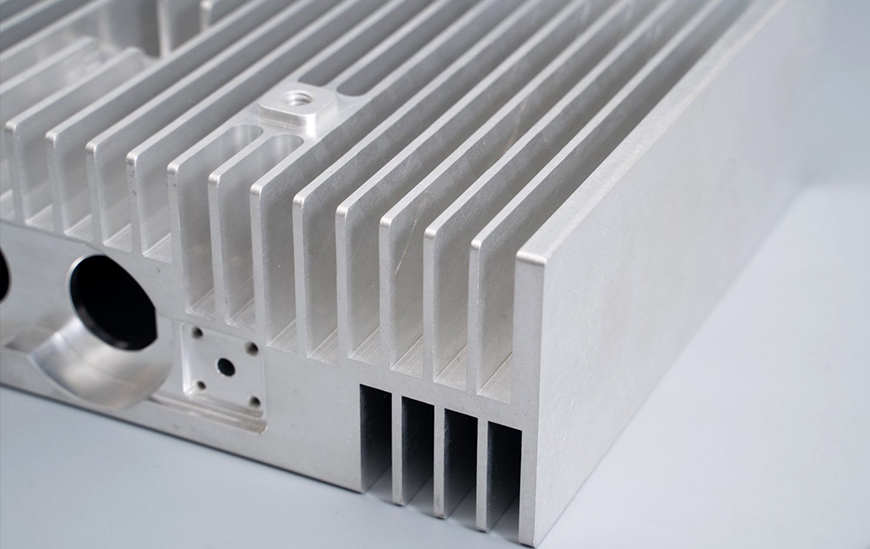
In this method, heated aluminum alloy is forcibly extruded through a specially designed mold, forming long profiles with specific shapes - such as multiple fins.
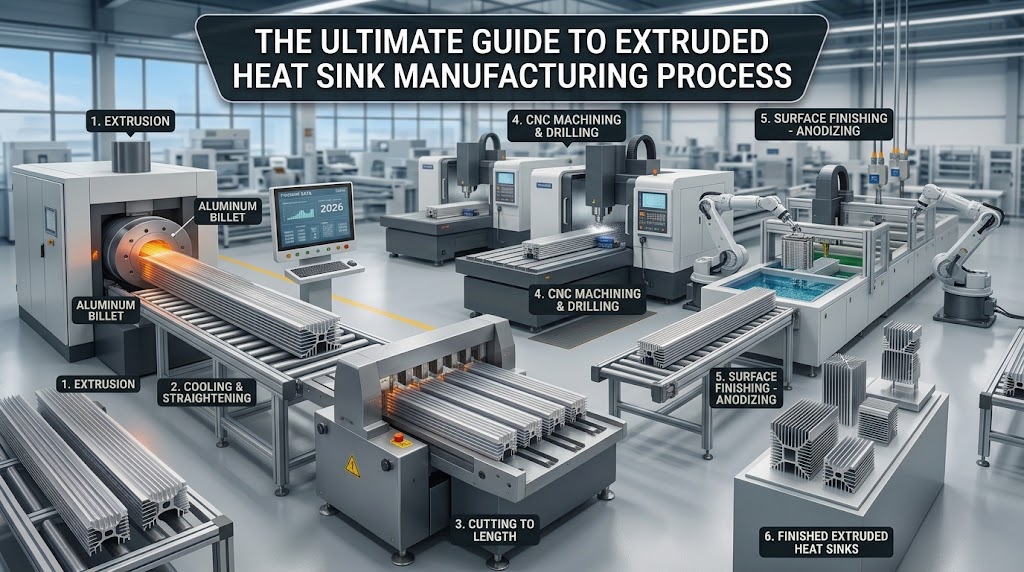
The extruded profiles are then cut to length, CNC machined, and anodized according to design requirements to create the final heatsink product.
KINGKA aluminum extruded heat sink modules, paired with high-efficiency DC fans, deliver efficient heat dissipation, enabling design flexibility and cost competitiveness.
From single heat sinks to large cooling systems, we can create the optimal solution tailored to your needs.
Typical application scenarios
Industrial power modules (IGBT/MOSFET)
AI/server CPU & GPU systems
Renewable energy inverters and UPS power systems
Laser equipment and high-power semiconductors
Industrial automation and welding equipment
High-power LEDs and chassis
2. How Are Heat Sinks Manufactured?
The manufacturing of heat sinks is a rigorous, highly disciplined engineering process designed to transform raw metals into high-efficiency thermal management solutions. Producing a functional heat sink involves a step-by-step workflow spanning thermal simulation, precision forming, surface finishing, and quality verification.
Engineers evaluate component heat dissipation (TDP), volumetric airflow, spatial constraints, and target junction temperatures. Using Computational Fluid Dynamics (CFD) software, thermal models are simulated to optimize fin geometry, spacing, base thickness, and pressure drop characteristics before tool production begins.
Based on thermal load requirements and weight budgets, suitable raw alloys are chosen:
Aluminum 6063 / 6061: Ideal for extrusions and CNC machining due to high thermal conductivity (~200 W/m·K), low weight, and cost-effectiveness.
Copper C1100: Selected for extreme heat flux applications requiring rapid thermal absorption (~400 W/m·K).
The baseline geometry is produced using one of several primary forming techniques:
Extrusion: Pushing heated aluminum through shaped dies for continuous profile shapes.
Skiving: Slicing thin fins directly from a solid metal block for high aspect ratios.
Die Casting: Injecting molten alloy into complex molds for intricate 3D pin-fin arrays.
Stamping: Pressing thin sheet metal into stacked or folded fin structures.
Formed raw blanks undergo precision
CNC Milling, drilling, and fly-cutting. Key features added at this stage include ultra-flat contact bases (
Ra ≤ 0.8 µm), mounting holes, alignment pockets, and cutouts for surrounding PCB components.
Bare metals undergo chemical or electrochemical surface finishing to prevent oxidation and improve thermal emissivity:
Anodizing (Black/Clear): Creates a protective oxide layer on aluminum while increasing surface emissivity for improved radiation cooling.
Nickel Plating: Applied to copper bases to prevent tarnishing and facilitate direct soldering.
Chromate Conversion / Passivation: Offers corrosion protection with minimal electrical contact resistance.
Manufactured parts undergo strict Quality Assurance (QA):
Coordinate Measuring Machine (CMM): Verifies critical dimensions and hole patterns.
Profilometer Inspection: Measures base flatness and surface roughness.
Thermal Testing: Thermal chamber or burn-in testing to verify actual thermal resistance against CFD simulations.
For multi-component heat sink assemblies, final integration includes installing heat pipes, vapor chambers, push-pins, mounting springs, or pre-applying Thermal Interface Materials (TIM) such as phase-change pads or thermal grease.
3. Why choose aluminum extruded heat sink?
Cost-effectiveness: Low mold costs make it suitable for mass production.
Material advantages: Aluminum alloy offers acid and alkali resistance, corrosion resistance, and lightweight properties.
Design flexibility: Complex structures (such as sunflower teeth) can be created, increasing heat dissipation and convection efficiency.
Aesthetic and diverse surface treatments: Anodizing, sandblasting, and brushing can create a variety of color finishes, suitable for applications such as industrial computer casings.
In electronic thermal management, aluminum extruded heat sinks remain the most popular, cost-effective, and reliable solution for cooling power components, CPUs, LED lighting, and industrial electronics.
Heat Sink Manufacturing Processes: A Complete Engineering Comparison
In thermal management engineering, selecting the right manufacturing process directly impacts thermal resistance, structural integrity, tooling expenses, and mass-production lead times. Below is a detailed breakdown of the five primary heat sink manufacturing technologies: Extrusion, Skived Fin, Cold Forging, Die Casting, and FSW / Vacuum Brazing.
Process Comparison Overview
| Manufacturing Process | Common Materials | Fin Thickness / Pitch Limit | Aspect Ratio | Tooling Cost & Lead Time | Thermal Performance | Primary Applications |
| Extrusion | Al 6063-T5 / Al 6061 | Fin ≥ 1.0 mm
Pitch ≥ 2.0 mm | Standard ≤ 10:1
(Max 15:1) | Low
($1,000–$3,000)
1–2 weeks | Moderate
Continuous grain flow; low interface resistance | Industrial PCs, LED lighting, power supplies, consumer electronics |
| Skived Fin | Al 1070 / C1100 Pure Copper | Fin ≥ 0.2 mm
Pitch ≥ 0.5 mm | Ultra-High
(25:1 up to 50:1) | Zero Tooling
(Machined via CNC skiving knife)
3–5 days samples | Exceptional
Single-piece base & fin structure; zero thermal interface | Server CPUs/GPUs, high-power inverters, medical equipment |
| Cold Forging | Al 1070 / Al 1050 (High-purity Al) | Supports Pin-Fin designs
Fin ≥ 1.5 mm | Moderate
( ≤ 12:1) | High
($5,000–$15,000)
3–4 weeks | High
High-pressure grain compaction; excellent isotropic conduction | High-bay LED spotlights, automotive headlights, round forced-air modules |
| Die Casting | ADC12 / A380 (Cast Al Alloy) | Fin ≥ 1.5 mm
(Requires 1°–3° draft angle) | Low
( ≤ 6:1) | Very High
($10,000–$30,000+)
4–6 weeks | Fair to Low
ADC12 conductivity ≈ 96 W·m⁻¹·K⁻¹; risk of porosity | Enclosure-integrated heatsinks, telecom outdoor units, automotive ECU housings |
| FSW / Brazing | Al 6061 + C1100 / Copper Tubes | Dependent on internal channel design | N/A
(Liquid cold plates) | Moderate to High
(Custom welding fixtures & vacuum furnaces) | Maximum (Liquid Cooling)
Leak-proof, high-pressure tolerance for extreme heat flux | Energy storage Pack cold plates, EV traction inverters, AI data center liquid cooling |
Below are the key advantages that make extruded aluminum the material and method of choice across industries
3.1 Exceptional Thermal Efficiency and Conductivity
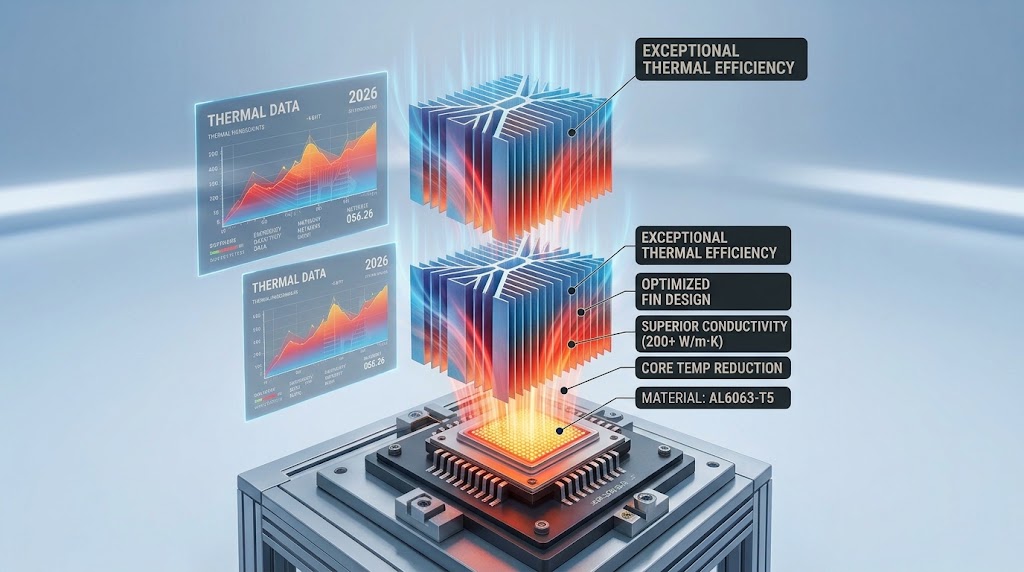
Aluminum alloys—most notably 6061-T6—offer high thermal conductivity (approx. 200–220 W/m·K). The extrusion process allows manufacturers to create intricate fin profiles that maximize surface area relative to footprint. This dramatically increases convection heat dissipation, keeping critical components within safe operating temperatures.
3.2 High Cost-Efficiency and Fast Production Cycles
 Compared to CNC machining from solid blocks or complex die-casting, aluminum extrusion is significantly more cost-effective:
Lower Tooling Cost: Extrusion dies are far less expensive than complex casting molds.
Material Utilization: The process produces minimal raw material waste.
Scalability: Once the die is created, high-volume production can be executed rapidly with consistent quality.
3.3 Lightweight and High Strength-to-Weight Ratio
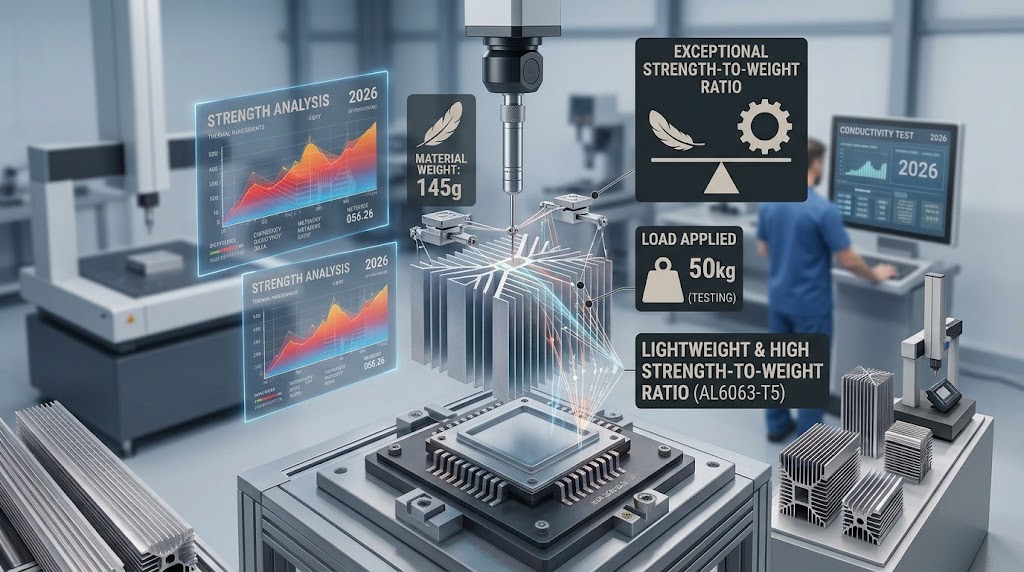 Aluminum has about one-third the density of copper (~2.7 g/cm³ vs. ~8.96 g/cm³). For applications with strict weight budgets—such as automotive electronics, aerospace, telecommunications, and portable devices—extruded aluminum provides structural strength without adding unnecessary mass.
3.4 Versatile Design and Secondary Machining Flexibility
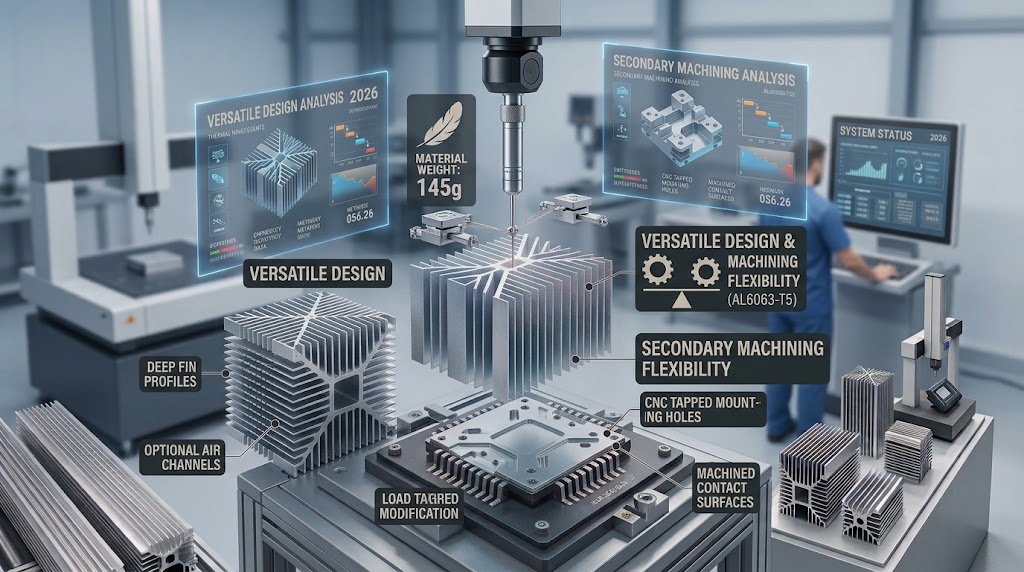 The extrusion process allows for versatile cross-sectional geometry, including straight fins, pin-fins, cross-cuts, and mounting channels. Furthermore, extruded profiles are easy to post-process:
Precision CNC Machining: For custom mounting holes, cutouts, or flat contact surfaces.
Cross-Cutting: Converting long profiles into individual heat sinks of varying lengths.
3.5 Superior Surface Finishing Options
Aluminum naturally forms a protective oxide layer, but extruded heat sinks readily accept advanced surface treatments to enhance durability and thermal radiation:
Anodizing (Black/Clear): Increases corrosion resistance, electrical insulation, and thermal emissivity (black anodizing significantly improves radiation heat transfer).
Nickel Plating & Powder Coating: Provides specialized environmental protection and custom aesthetic options.
4. Why Choose KINGKA for Extruded Heat Sinks?
Building on the inherent benefits of aluminum extrusion, customized manufacturing solutions elevate thermal efficiency through precise engineering:
High-Aspect-Ratio Fin Design: Enables thinner, taller fins with tighter spacing to maximize cooling surface area within compact enclosures.
Optimized Base Plate Flatness: Precision-machined contact surfaces ensure minimal thermal interface resistance between the heat source and the heatsink base.
Custom Alloy Selection: Utilizing premium 6063-T5 aluminum for optimal thermal conductivity and structural stability.
Integrated Secondary Processing: Complete in-house CNC drilling, tapping, cross-cutting, and anodizing for seamless plug-and-play assembly.
Strict Quality Control: 100% dimensional and thermal surface inspection guarantees consistent reliability in demanding power and industrial applications.
KINGKA founded in 2010, is a professional manufacturer specializing in aluminum alloy solutions. Our main products include high-performance Heat Sinks and Liquid Cold Plates, designed to meet demanding thermal management requirements. KINGKA’s products are widely applied in telecom, aerospace, automotive, industrial control, power electronics, medical instruments, security electronics, LED lighting, and multimedia/consumer applications.multimedia/consumer etc.
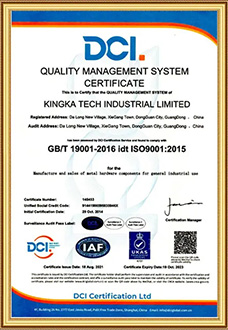
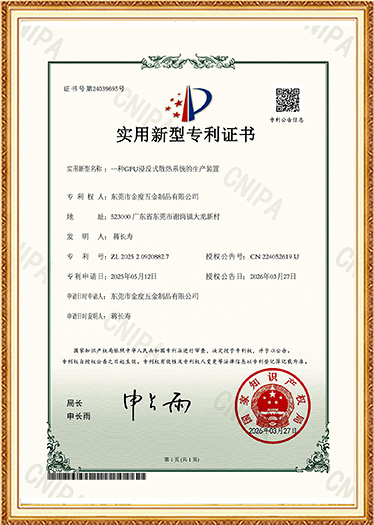
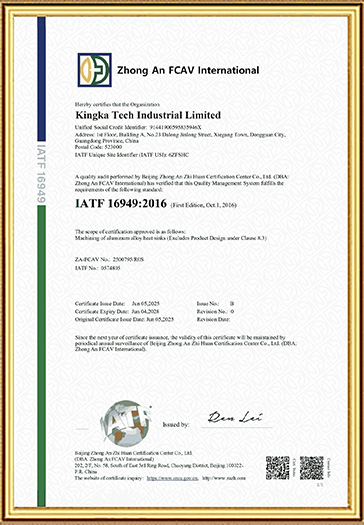
The company has obtained ISO 9001 quality management system certification (GB/T 19001-2016 idt ISO 9001:2015) , IATF 16949:2016 and RoHS test reports, and has also secured a patent for a manufacturing apparatus for a GPU immersion cooling system.
5. Extruded Heat Sink Manufacturing FAQ
What is an extruded heat sink?
A cooling component made by forcing heated aluminum through a shaped die to create high-surface-area cooling fins.
Which aluminum alloy is best for extruded heat sinks?
Aluminum 6063-T5 is preferred for high thermal conductivity, while 6061-T6 is chosen when higher structural strength is required.
What are the main steps in the extrusion manufacturing process?
Billet heating, die extrusion, cooling/stretching, cutting to length, precision CNC machining, and surface anodizing.
Why choose aluminum over copper for heat sink extrusion?
Aluminum is lighter, more cost-effective, and easier to extrude, despite copper having higher absolute thermal conductivity.
What is the maximum aspect ratio for extruded heat sink fins?
Standard aspect ratios (fin height to fin gap) range from 8:1 to 10:1, while advanced precision tooling can reach up to 16:1 or higher.
Why is anodizing important for extruded heat sinks?
Anodizing improves corrosion resistance, surface durability, electrical insulation, and heat radiation (especially with black anodizing).
What is the difference between natural convection and forced convection heat sinks?
Natural convection relies on passive air movement with wider fin spacing, whereas forced convection uses fans and denser fin profiles.
Can extruded heat sinks be customized after extrusion?
Yes, through secondary CNC machining such as cross-cutting, drilling, tapping, milling mounting surfaces, and fly cutting.
How does fin density affect heat sink performance?
Higher fin density increases surface area for cooling, but requires forced air (fans) to prevent air resistance from blocking flow.
What tooling costs are involved in custom heat sink extrusion?
Extrusion requires a custom steel die, which has a relatively low one-time tooling cost compared to die-casting molds.
What is the typical lead time for a custom extruded heat sink profile?
Die creation usually takes 2–3 weeks, followed by 1–2 weeks for sample prototyping and mass extrusion.
How does cross-cutting turn an extrusion into a cross-cut pin fin heat sink?
Transverse cuts are machined across the extruded fins to create isolated pin fins, improving omnidirectional airflow.
What thermal interface material (TIM) should be used with heat sinks?
Thermal paste, phase-change pads, or gap fillers are applied between the heat sink base and component to eliminate air gaps.
What is the base flatness tolerance for high-performance heat sinks?
Precision fly cutting typically achieves a base flatness of 0.02 mm to 0.05 mm per 100 mm for optimal thermal contact.
Are extruded heat sinks suitable for high-power electronics?
Yes, especially when integrated with heat pipes, vapor chambers, or optimized forced-air cooling designs.
How do you prevent oxidation on raw extruded aluminum heat sinks?
By applying surface finishes such as anodizing, chromate conversion coating, or clear powder coating.
What design factors limit extruded heat sink geometry?
Fin thickness, fin height, base thickness, gap width, and die structural integrity limit extreme extrusion profiles.
What is the environmental impact of aluminum heat sink production?
Aluminum is 100% recyclable, and scrap generated during extrusion and CNC machining is melted down and reused.
How are quality control checks conducted during manufacturing?
Using CMM dimensional checks, surface roughness tests, anodizing thickness checks, and thermal simulation/testing.
When should you choose bonded fin or skived fin over extruded heat sinks?
Choose skived or bonded fins when required fin aspect ratios or fin densities exceed the physical limits of standard extrusion dies.