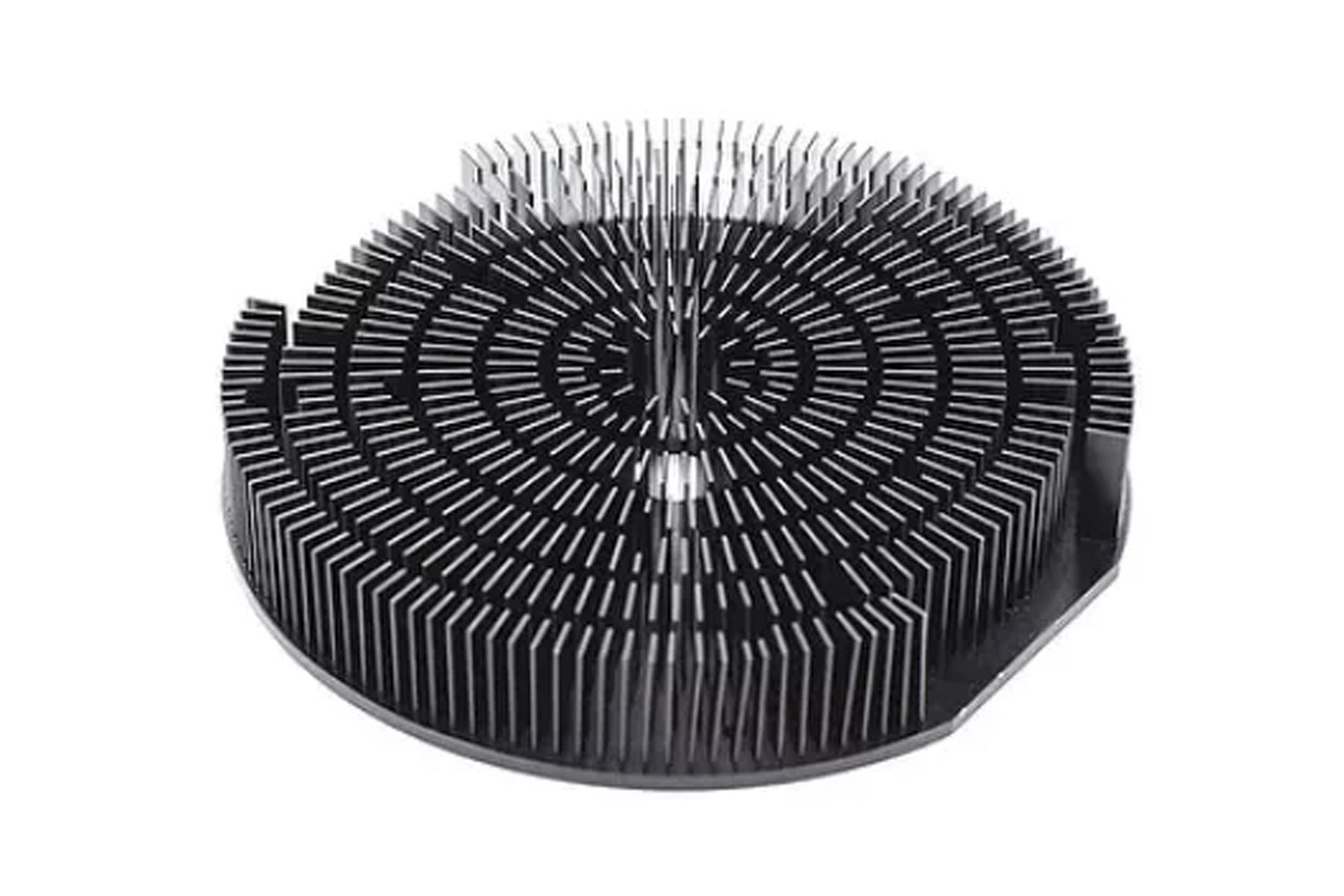
A Cold Forging Heat Sink, also known as a cold forged heat sink, is a thermal management component manufactured by shaping aluminum or copper under high pressure. During the cold forging process, the metal billet undergoes plastic deformation and is formed into an integrated base and fin structure.
Compared with conventional machining, cold forging can produce dense pin fin structures, good mechanical strength, and efficient heat transfer. Cold forged heatsinks are widely used in LED lighting, automotive electronics, IGBT modules, power electronics, telecom equipment, inverters, and industrial systems.
 How Does a Cold Forged Heat Sink Work?
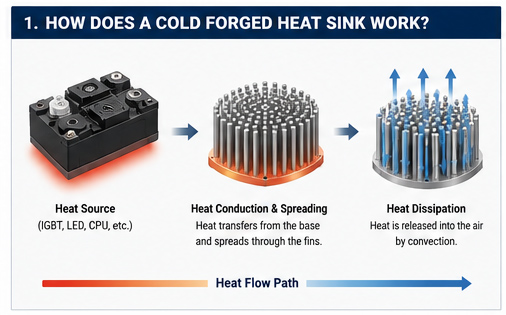
The main purpose of a cold forged heat sink is to transfer heat away from electronic components and dissipate it into the surrounding air.
Heat generated by components such as IGBTs, MOSFETs, LEDs, CPUs, and power modules is first transferred to the heat sink base. The heat then spreads through the metal by thermal conduction and moves into the fins.
The fins increase the available heat dissipation surface area. Heat is finally released into the air through natural convection or forced convection.
Important thermal factors include:
Thermal conductivity
Thermal resistance
Heat flux
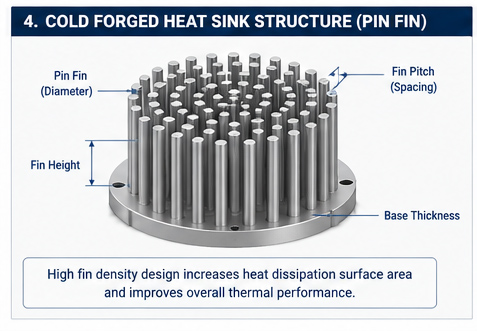
Fin density
Fin height
Fin pitch
Airflow
Base thickness
A well-designed cold forged heatsink balances these parameters to achieve effective cooling.
 How Are Cold Forged Heat Sinks Manufactured?
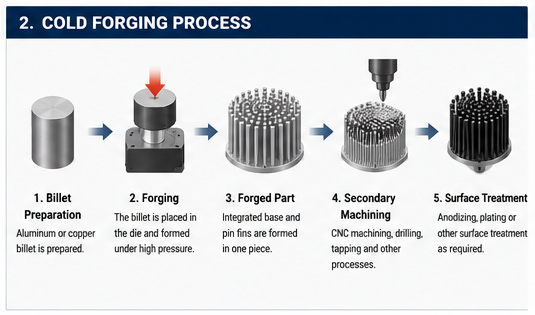
Cold forging uses high compressive pressure to shape metal at or near room temperature.
A typical manufacturing process includes:
1. Material Preparation
An aluminum or copper billet is selected according to the required thermal performance and product dimensions.
2. Forging
The billet is placed into a precision forging die. A high-pressure forging press forces the material into the die cavities, forming the heat sink base and fins.
Cold forging is particularly suitable for producing round pin fins, square pin fins, radial fins, and high-density fin arrays.
3. Secondary Machining
After forging, additional processes may include:
CNC machining
Drilling
Tapping
Milling
Surface flattening
Deburring
4. Surface Treatment
Depending on the application, aluminum heat sinks may be anodized, while Copper Heat Sinks may use nickel plating or other protective treatments.
Aluminum Cold Forged Heat Sink
Aluminum is the most commonly used material for cold forged heat sinks because it provides a good combination of thermal performance, lightweight construction, and cost efficiency.
Its thermal conductivity is approximately 200 W/m·K, depending on the alloy and material condition.
The density of aluminum is around 2.7 g/cm³, which makes it significantly lighter than copper.
Key advantages of an aluminum cold forged heat sink include:
Good thermal conductivity
Low weight
Good formability
Suitable for complex fin structures
Lower material cost
Easy CNC machining
Good anodizing performance
Aluminum cold forged heatsinks are widely used in LED lighting, automotive electronics, industrial equipment, and power electronics.
Copper Cold Forged Heat Sink
Copper is mainly used when higher thermal conductivity is required.
Its thermal conductivity is approximately 390–400 W/m·K, making it almost twice as conductive as aluminum.
This allows copper to spread heat more efficiently, especially in applications with high heat flux or concentrated heat sources.
However, copper has a density of approximately 8.9 g/cm³, making it much heavier than aluminum. It is also more expensive and more demanding to process during cold forging.
A copper cold forged heat sink is therefore commonly selected for:
 Aluminum vs Copper Cold Forged Heat Sink
| Feature | Aluminum | Copper |
|---|
| Thermal Conductivity | Approx. 200 W/m·K | Approx. 390–400 W/m·K |
| Density | Approx. 2.7 g/cm³ | Approx. 8.9 g/cm³ |
| Weight | Lightweight | Heavy |
| Cost | Lower | Higher |
| Thermal Performance | Good | Excellent |
| Typical Applications | LED, automotive, industrial electronics | High-power and high heat flux systems |
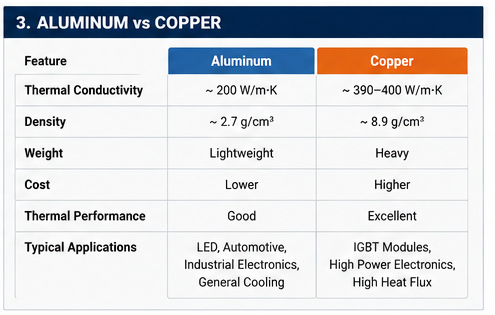
Aluminum is generally preferred when weight and cost are important, while copper is more suitable when maximum thermal performance is required.
 Advantages of Cold Forged Heat Sinks
Cold forged heat sinks offer several benefits.
High Fin Density
The forging process can create dense pin-fin structures, increasing the heat dissipation surface area.
Integrated Structure
The fins and base are formed from the same piece of metal, reducing additional thermal interfaces between the base and fins.
Multidirectional Airflow
Pin-fin structures allow air to pass through the heat sink from different directions, which can be useful when airflow direction is not fixed.
Good Mechanical Strength
Cold working can improve material strength and structural stability.
Suitable for Mass Production
Once the forging die is completed, cold forging can provide good production efficiency for medium- and high-volume projects.
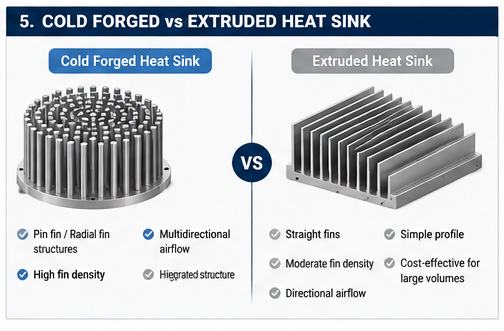
An extruded heat sink is manufactured by forcing heated aluminum through an extrusion die. It is mainly suitable for straight fins and constant cross-sectional profiles.
A cold forged heat sink is formed by compressing metal into a die and can produce more complex three-dimensional fin structures.
| Feature | Cold Forged Heat Sink | Extruded Heat Sink |
| Process | Cold forging | Aluminum extrusion |
| Fin Design | Pin fins, radial fins | Straight parallel fins |
| Material | Aluminum or copper | Mainly aluminum |
| Fin Density | High | Moderate |
| Airflow | Multidirectional | Mainly directional |
| Typical Use | Compact, high-density cooling | General electronic cooling |
Cold forging is usually preferred when high fin density or complex pin-fin structures are required, while extrusion is often more economical for conventional straight-fin heat sinks.
 Applications of Cold Forged Heat Sinks
Cold forged heat sinks are commonly used in:
LED lighting
IGBT modules
Power supplies
Inverters
Automotive electronics
Telecom equipment
Industrial computers
Motor drives
Power electronics
For higher-power applications where air cooling is no longer sufficient, liquid cold plates or microchannel cooling plates may also be considered.
A cold Forging Heat Sink is an efficient thermal management solution manufactured by shaping aluminum or copper under high pressure.
Aluminum cold forged heat sinks offer a good balance of thermal conductivity, low weight, and cost, while copper cold forged heat sinks provide better heat spreading for high-power and high heat flux applications.
With advantages such as high fin density, integrated fin structures, multidirectional airflow, and good mechanical strength, cold forged heat sinks are widely used in LED lighting, IGBT cooling, automotive electronics, power electronics, and industrial equipment.




 Cold Forged Heat Sink vs