An extruded heat sink is a thermal management component manufactured by forcing heated aluminum through a specially designed extrusion die to create a continuous profile with a base and multiple cooling fins. The extruded profile is then cut to the required length and may undergo additional processes such as CNC Machining, drilling, tapping, anodizing, or surface finishing before being assembled into electronic equipment.
Extruded heat sinks are widely used because they combine good thermal conductivity, relatively low manufacturing cost, flexible profile design, and suitability for both low- and high-volume production.
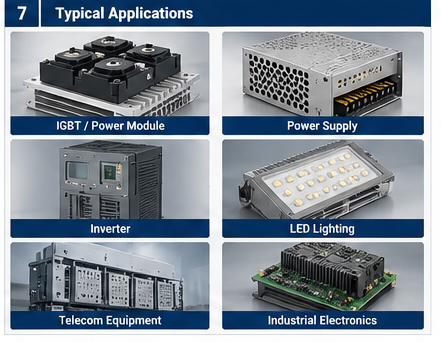
They are commonly found in power electronics, LED lighting, industrial control systems, telecommunications equipment, power supplies, motor drives, inverters, and other electronic systems that generate heat during operation.
 How Does an Extruded Heat Sink Work?
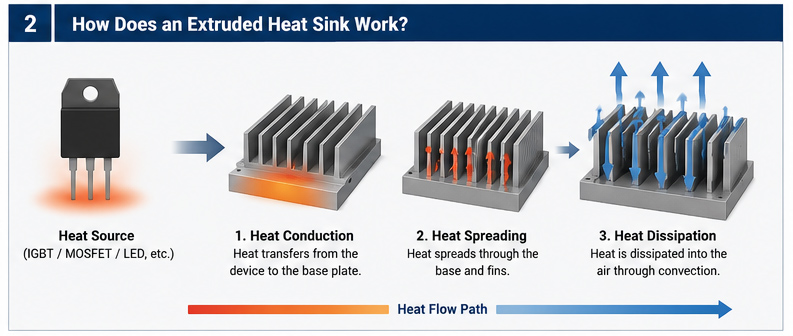
The primary purpose of an extruded heat sink is to transfer heat away from an electronic component and dissipate it into the surrounding air.
The heat transfer process normally involves three stages:
1. Heat conduction
Heat generated by a device such as an IGBT, MOSFET, CPU, power module, LED, or power transistor is first transferred into the heat sink base.
Because aluminum has relatively high thermal conductivity, heat spreads through the heat sink base plate toward the cooling fins.
2. Heat spreading through the fins
The fins increase the effective surface area available for heat dissipation.
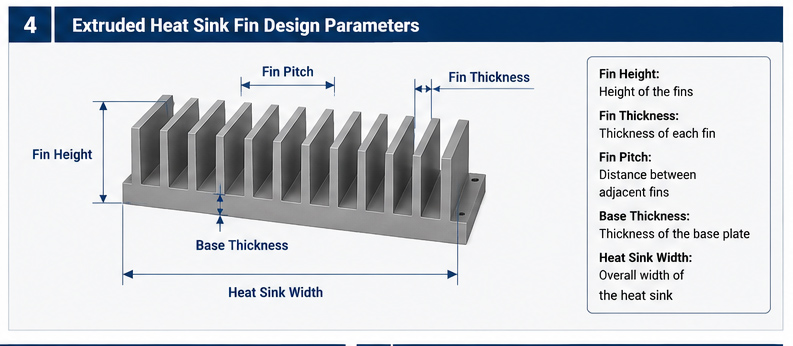
Important structural parameters include:
Fin height
Fin thickness
Fin pitch
Fin spacing
Base thickness
Heat sink width
Heat sink length
Fin aspect ratio
The relationship between these parameters directly affects airflow, thermal resistance, structural strength, and manufacturability.
3. Heat dissipation into the air
Heat is finally transferred from the aluminum fins to the surrounding air through convection.
Extruded heat sinks can operate under:
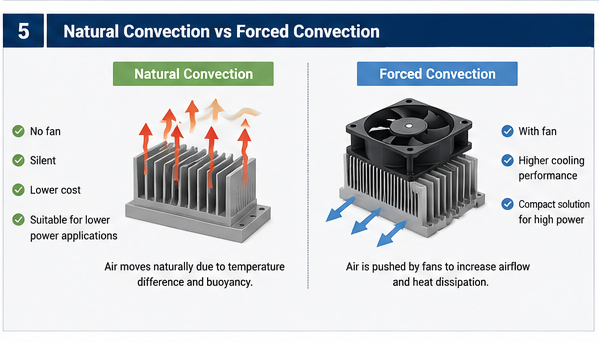
Natural convection
Forced convection
Natural convection relies on the natural movement of heated air. Forced convection uses fans or blowers to increase airflow through the fin channels.
Forced-air cooling generally allows the heat sink to dissipate more heat from a smaller volume, but fin spacing must be carefully designed to avoid excessive airflow resistance and pressure drop.
 How Is an Extruded Heat Sink Manufactured?
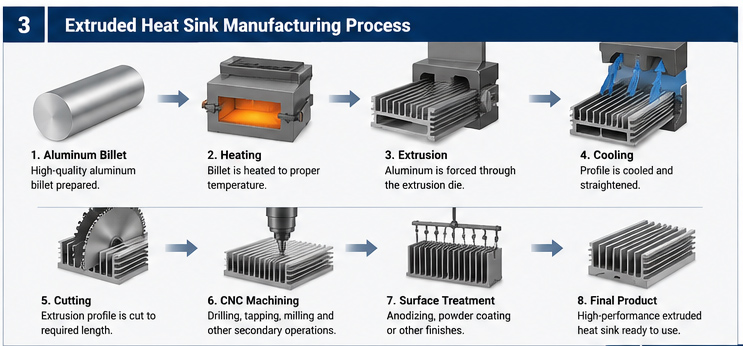
The manufacturing process is one of the main differences between an extruded heat sink and other types of heat sinks.
1. Aluminum Billet Preparation
The process begins with an aluminum billet, usually made from an extrusion-grade aluminum alloy.
The billet is heated to a controlled temperature so that the aluminum becomes soft enough for extrusion without melting.
2. Aluminum Extrusion
The heated billet is placed inside an extrusion press.
A hydraulic ram applies high pressure and forces the aluminum through an extrusion die.
The shape of the die determines the cross-sectional geometry of the heat sink, including:
Base width
Base thickness
Fin thickness
Fin spacing
Fin height
Mounting features
The result is a long, continuous aluminum extrusion profile.
Because the cross-section remains essentially constant along the extrusion direction, extrusion is particularly suitable for manufacturing heat sinks with long, straight fins.
3. Cooling and Straightening
After extrusion, the aluminum profile is cooled and straightened.
This process helps control dimensional accuracy and minimizes distortion before further machining.
4. Cutting
The continuous extrusion is cut into individual heat sink sections according to the required product length.
Different cut lengths can often be produced from the same extrusion profile, making the process flexible for multiple product configurations.
5. CNC Machining
Many extruded heat sinks require additional CNC machining.
Typical secondary machining operations include:
Milling
Drilling
Tapping
Slot machining
Counterboring
Pocket machining
Mounting hole machining
Surface flattening
CNC machining allows the basic extrusion profile to be customized for different electronic components, PCB layouts, mounting systems, and enclosure designs.
6. Surface Treatment
Extruded heat sinks may also receive surface treatments such as:
Anodizing is particularly common because it improves corrosion resistance, surface durability, and appearance.
Black anodized heat sinks can also improve thermal radiation under certain operating conditions, although convection usually remains the dominant heat-transfer mechanism in most forced-air applications.
What Materials Are Used for Extruded Heat Sinks?
Aluminum is the most common material used for extruded heat sinks.
One of the most widely used alloys is 6063 aluminum, especially 6063-T5.
Aluminum 6063
6063 aluminum is popular because it offers a good combination of:
Thermal conductivity
Extrudability
Surface finish
Corrosion resistance
Mechanical strength
Anodizing performance
Its excellent extrusion characteristics allow manufacturers to produce relatively complex heat sink profiles with consistent fin structures.
Aluminum 6061
6061 aluminum may also be used when higher mechanical strength is required.
However, 6061 is generally more difficult to extrude into very complex or thin-fin profiles compared with 6063.
Therefore, material selection depends on the balance between:
thermal performance, mechanical strength, profile complexity, machining requirements, and cost.
 Important Extruded Heat Sink Design Parameters
An extruded heat sink cannot be evaluated simply by looking at its overall size.
Several engineering parameters have a significant impact on cooling performance.
Thermal Resistance
Thermal resistance, usually expressed in °C/W or K/W, describes how effectively a heat sink transfers heat from the heat source to the surrounding environment.
Lower thermal resistance generally indicates better heat dissipation performance.
However, actual thermal resistance depends on several factors, including:
Fin Thickness
The fin thickness affects both thermal conduction and extrusion manufacturability.
Very thin fins provide more surface area within a limited width, but extrusion dies have practical limits regarding how thin and tall a fin can be manufactured reliably.
Fin Pitch
Fin pitch refers to the distance between adjacent fins.
A smaller fin pitch allows more fins to fit within the same heat sink width, increasing surface area.
However, if the spacing becomes too narrow, airflow resistance increases.
This is particularly important for forced convection heat sinks.
Fin Height
Increasing fin height increases surface area, but excessively tall fins may reduce extrusion stability and increase pressure drop.
The relationship between fin height and fin thickness is often described as the fin aspect ratio.
Extrusion processes have practical limitations on achievable aspect ratios.
Base Thickness
The base plate thickness influences heat spreading.
A thicker base can improve heat distribution from a concentrated heat source, but it also increases material usage, weight, and cost.
Heat sink design therefore requires a balance between heat spreading and overall thermal mass.
 Advantages of Extruded Heat Sinks
Extruded heat sinks are one of the most widely used heat sink technologies because they offer several practical advantages.
Cost-Effective Manufacturing
Once the extrusion die has been produced, long lengths of heat sink profile can be manufactured efficiently.
This makes extrusion particularly suitable for medium- and high-volume production.
Good Thermal Performance
Aluminum provides good thermal conductivity while remaining lightweight and relatively economical.
Combined with properly designed fins, extruded aluminum heat sinks can provide effective cooling for a wide range of electronics.
Flexible Length
The same extruded profile can be cut into different lengths.
This allows manufacturers to use one profile for multiple product configurations.
Lightweight
Aluminum has a much lower density than copper, which helps reduce the overall weight of electronic assemblies.
Easy Secondary Machining
Extruded aluminum profiles can be easily processed using CNC machining, drilling, tapping, milling, and other secondary operations.
Good Surface Treatment Capability
6063 aluminum is particularly suitable for anodizing, making it possible to produce heat sinks with good corrosion resistance and consistent appearance.
Limitations of Extruded Heat Sinks
Although extruded heat sinks are widely used, the extrusion process also has several limitations.
Fin Aspect Ratio Limitations
Extrusion dies cannot produce infinitely thin and tall fins.
The higher the fin aspect ratio, the more difficult the profile becomes to extrude reliably.
Fin Spacing Limitations
Very narrow fin spacing can create die manufacturing and material-flow challenges.
This can limit the achievable surface area compared with some other heat sink technologies.
Constant Cross-Section
An extrusion normally maintains the same cross-sectional profile along its length.
Complex three-dimensional fin structures generally require additional machining or another manufacturing process.
Die Cost
Custom profiles require a dedicated extrusion die.
Although the die cost can be distributed across large production volumes, it may be less attractive for very small prototype quantities.
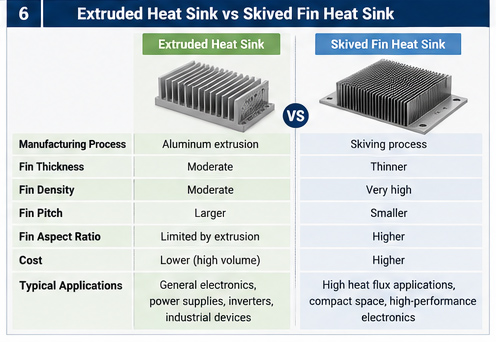
Extruded and skived fin heat sinks are both widely used aluminum thermal solutions, but their manufacturing processes and design capabilities are very different.
| Feature | Extruded Heat Sink | Skived Fin Heat Sink |
|---|
| Manufacturing Process | Aluminum extrusion | Skiving process |
| Typical Material | Aluminum 6063 / 6061 | Aluminum or copper |
| Fin Structure | Fins formed during extrusion | Fins cut and raised directly from the base |
| Fin Thickness | Limited by extrusion process | Can generally achieve thinner fins |
| Fin Density | Moderate to high | Very high |
| Fin Aspect Ratio | Limited by extrusion die | Higher aspect ratios possible |
| Thermal Interface | Integral structure | Integral structure |
| Tooling | Extrusion die required | No extrusion die required |
| Production Efficiency | Excellent for volume production | Suitable for specialized high-performance designs |
| Cost | Generally economical | Usually higher |
| Typical Applications | General electronics and power systems | High heat flux and compact cooling systems |
Fin Density
One of the biggest differences is fin density.
Extruded heat sinks are limited by the aluminum flow characteristics and the strength of the extrusion die.
A skived fin heat sink, however, is produced by slicing thin layers from a solid metal block and bending them upward to create fins.
This process can achieve:
Thinner fins
Smaller fin pitch
Higher fin density
Higher fin aspect ratios
As a result, skived fin designs can provide significantly more cooling surface area within a limited footprint.
Thermal Performance
For moderate heat loads, an extruded heat sink is often sufficient and more economical.
When the system requires a large cooling surface area within a compact space, a skived heat sink may provide better thermal performance.
Skived fin heat sinks are particularly suitable for applications involving:
Manufacturing Cost
Extrusion becomes highly cost-effective when the same profile is produced in larger quantities.
Skiving does not require an extrusion die, but the machining process itself can be more expensive.
Therefore, the best choice depends on both thermal requirements and production volume.
 Where Are Extruded Heat Sinks Used?
Extruded heat sinks are used across many industries because of their balance between thermal performance, cost, and manufacturing flexibility.
Typical applications include:
Power Electronics
Extruded aluminum heat sinks are widely used to cool:
IGBTs
MOSFETs
Rectifiers
Power transistors
Power modules
DC-DC converters
Inverters
Solar inverters, industrial inverters, and energy conversion systems generate significant heat from switching devices and other power components.
Extruded heat sinks provide a practical solution for removing this heat.
LED Lighting
LED modules require effective thermal management to control junction temperature and maintain light output and service life.
Extruded aluminum profiles are commonly integrated directly into LED lamp housings.
Power Supplies
AC/DC power supplies, switching power supplies, and industrial power units often use extruded heat sinks to cool switching components and rectifiers.
Industrial Automation
Servo drives, PLC systems, motor controllers, frequency converters, and industrial computers can also use aluminum Extrusion Heat Sinks.
Telecommunications Equipment
Communication systems such as base stations, amplifiers, power modules, and networking equipment require continuous thermal management.
Automotive Electronics
Extruded heat sinks may be used in EV power electronics, charging systems, DC-DC converters, control units, and other automotive electronic assemblies where appropriate.
When Should You Choose an Extruded Heat Sink?
An extruded heat sink is usually a good choice when:
The required thermal performance is moderate
Product volumes are medium to high
A constant cross-sectional profile is acceptable
Weight reduction is important
Aluminum is suitable for the application
Secondary CNC machining is required
Cost control is important
A skived fin heat sink may be more suitable when:
Higher fin density is required
Fin spacing must be very small
A high fin aspect ratio is required
Available installation space is limited
Heat flux is relatively high
Conventional extrusion cannot achieve the required geometry
Extruded Heat Sink Design and Customization
In practical applications, heat sink selection should not be based only on external dimensions.
A custom thermal solution should consider the complete operating environment, including:
Heat source power
Heat source dimensions
Maximum allowable component temperature
Ambient temperature
Natural or forced convection
Airflow direction
Air velocity
Available installation space
Mounting method
Thermal interface material
Weight limitations
Surface treatment requirements
Production quantity
Engineers can then optimize the base thickness, fin height, fin thickness, fin pitch, airflow channel, and overall profile dimensions to achieve the required thermal resistance.
Thermal simulation, prototype testing, and thermal performance testing may also be used to verify the final design before mass production.
An extruded heat sink is an aluminum thermal management component manufactured by forcing heated aluminum through a shaped extrusion die to create an integrated base-and-fin profile.
Its combination of good thermal conductivity, lightweight construction, relatively low cost, flexible length, and easy CNC machining makes aluminum extrusion one of the most widely used heat sink manufacturing methods.
For many applications involving power supplies, LEDs, inverters, industrial electronics, telecommunications equipment, and power semiconductor devices, an extruded aluminum heat sink provides an effective balance between thermal performance and manufacturing cost.
However, extrusion has practical limitations in fin thickness, fin pitch, and fin aspect ratio. When very high fin density or compact high-performance cooling is required, a skived fin heat sink may provide greater design flexibility.
Ultimately, choosing between an extruded heat sink and a skived fin heat sink should be based on the required thermal resistance, heat flux, airflow conditions, available space, manufacturing volume, and total system cost.