Liquid cooling has become one of the most discussed thermal management system technologies in modern electronics. From gaming PCs to industrial equipment, users often ask: is liquid cooling actually worth it? The answer depends on performance requirements, heat load, and system design.A liquid cooling system offers significantly better heat dissipation compared to traditional air cooling, especially in high-power applications such as CPU liquid cooling, GPU liquid cooling, and advanced electronic cooling systems.
What Is a Liquid Cooling System?
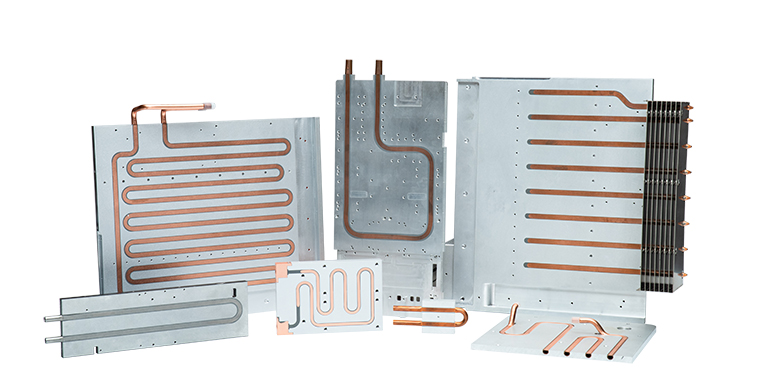
A liquid cooling system is a cooling system for electronics that uses liquid (usually water or coolant fluid) to transfer heat away from components.
When people search for liquid cooling solution, they usually want to understand how it works and why it is used in high-performance environments.
Compared with air cooling, liquid cooling is more efficient at transferring heat due to the higher thermal conductivity of liquids.
Common applications include:
 Liquid Cooling vs Air Cooling
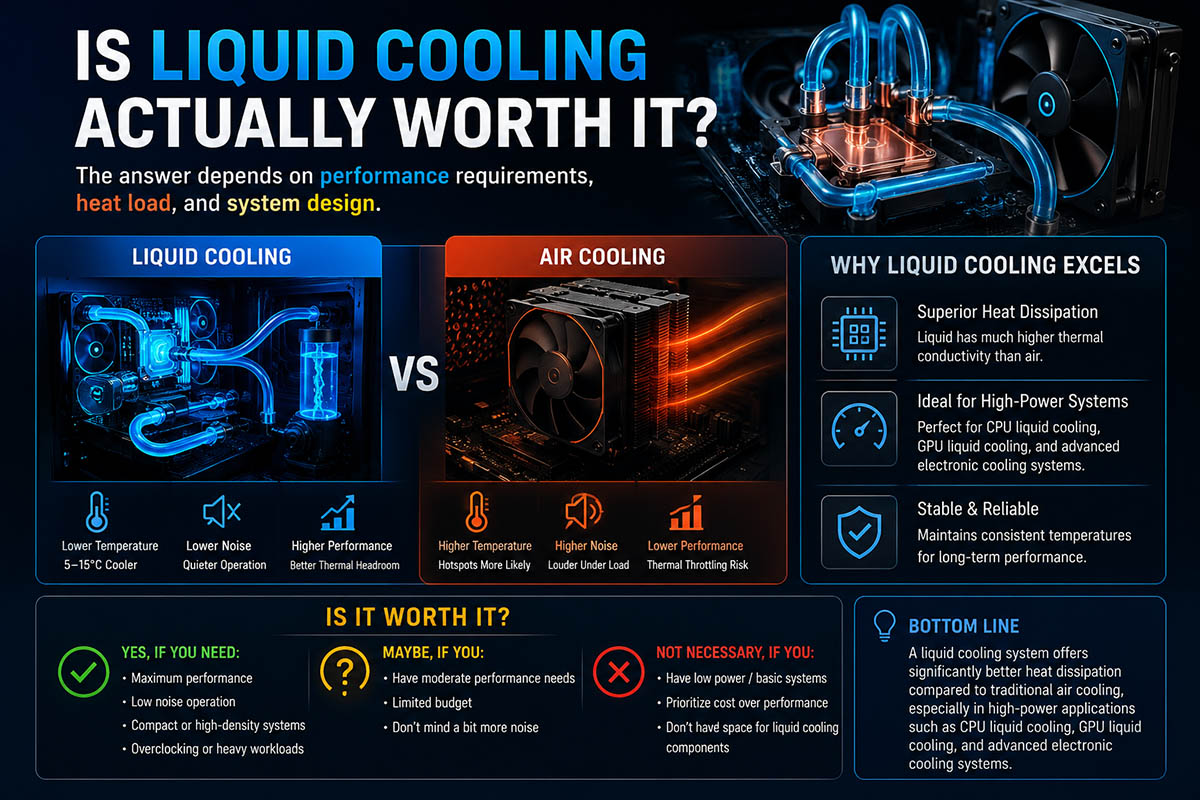
To understand liquid cooling vs air cooling, we need to compare performance and efficiency.
Air cooling relies on heat sinks and fans to dissipate heat, while liquid cooling uses coolant circulation to move heat away from the source.
Air Cooling:
Liquid Cooling:
Higher cooling efficiency
Better for high-performance systems
More stable under heavy load
Supports advanced thermal management system designs
For high-power density applications, liquid cooling is often the preferred advanced cooling solution.
Is Liquid Cooling Actually Worth It?
The answer depends on your system requirements.
Liquid cooling is worth it when:
The system generates high heat (CPU/GPU overclocking, industrial power modules)
Stable performance is critical
Space is limited but heat load is high
Long-term reliability is required
It may not be necessary when:
The system has low power consumption
Cost needs to be minimized
Simple cooling is sufficient
In high-performance environments, liquid cooling significantly improves heat dissipation and system stability.
 Key Liquid Cooling Technologies
Modern liquid cooling systems include several advanced designs used in electronics and industrial applications.
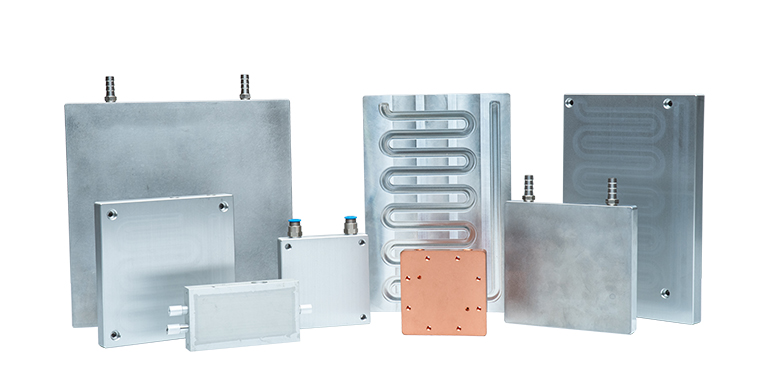
Liquid Cold Plate
A core component used in many thermal systems. It directly removes heat from high-power devices and transfers it into coolant channels.
Friction Stir Welding (FSW) technology creates strong and leak-proof cooling channels with excellent thermal performance.
Tube Liquid Cold Plate
Uses embedded tubing structures to circulate coolant efficiently for uniform heat removal.
Brazed Liquid Cold Plate
A high-strength design using brazing technology, suitable for demanding industrial environments.
GPU Water Block
A specialized cooling component designed for GPU liquid cooling, ensuring stable performance under heavy computational loads.
Liquid Cooling in Thermal Management Systems
In advanced electronics, liquid cooling is often integrated into a complete thermal management system, combining multiple technologies such as:
This combination allows engineers to achieve optimal heat dissipation for complex and high-power systems.
So, is liquid cooling actually worth it?
Yes—when applied to high-performance systems requiring efficient thermal management, liquid cooling delivers superior heat dissipation, better stability, and longer system lifespan compared to traditional air cooling.
However, for low-power or cost-sensitive applications, air cooling may still be sufficient.
As electronics continue to evolve toward higher power density, liquid cooling systems and liquid cold plate technologies will play an increasingly important role in next-generation cooling system for electronics design.