As CPUs, GPUs, power modules, EV batteries, inverters, and industrial electronics become more powerful and compact, thermal management is becoming increasingly important.
Two of the most common cooling approaches are air cooling and Liquid Cold Plate cooling.
Air cooling uses heat sinks and airflow to transfer heat into the surrounding environment, while a liquid cold plate transfers heat from the component directly into a circulating coolant.
So, liquid cold plate vs. air cooling: which is better?
The answer depends on heat load, power density, available space, operating environment, noise requirements, cost, and system complexity.
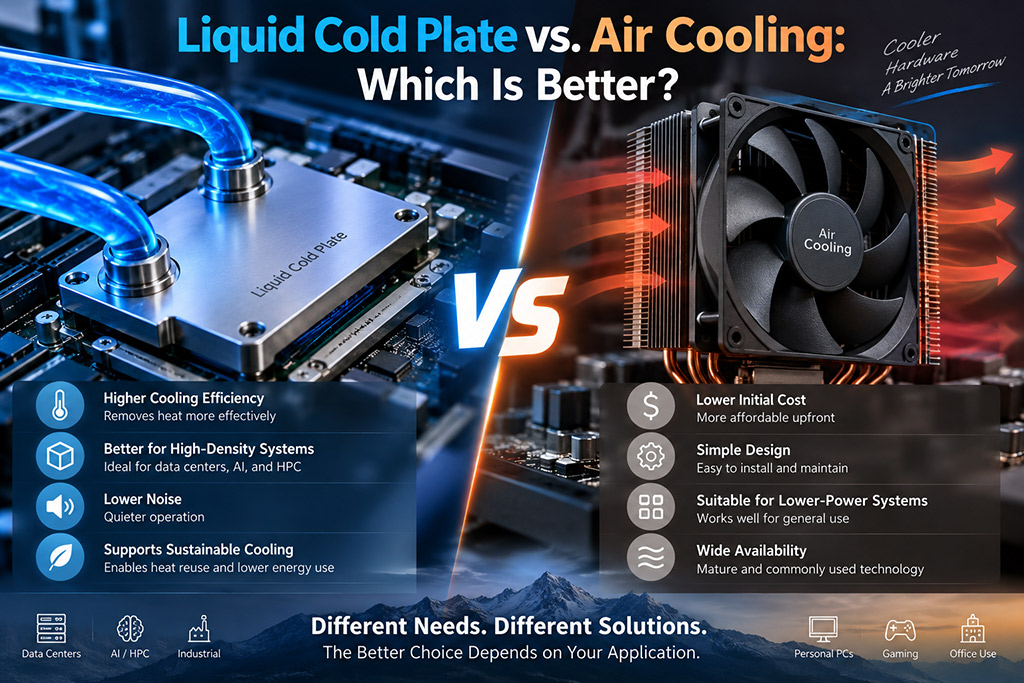
For low- to moderate-power applications, air cooling is often simpler and more economical. For high-power and high-heat-flux applications, however, liquid cold plates usually provide better thermal performance and more compact system integration.
What Is Air Cooling?
Air cooling removes heat by transferring it from an electronic component to a heat sink and then into the surrounding air.
A typical air cooling system may include:
Aluminum or Copper Heat Sink
Thermal interface material
Cooling fins
Fan or blower
Heat pipes or vapor chambers
Heat moves from the electronic component into the heat sink base and fins. Natural convection or forced airflow then transfers this heat into the surrounding environment.
Air cooling is widely used in:
Its biggest advantages are simplicity, relatively low cost, and easy maintenance.
What Is a Liquid Cold Plate?
A liquid cold plate is a metal plate containing internal channels through which coolant flows.
The cold plate is installed directly against a heat-generating component. Heat travels from the component through the cold plate material and into the coolant.
The basic heat transfer path is:
Electronic Component → Thermal Interface → Cold Plate → Coolant → Heat Exchanger
A complete liquid cooling system usually includes:
Common coolant options include water, water-glycol mixtures, and other application-specific cooling fluids.
Liquid cold plates are commonly used in high-power applications such as:
AI servers
CPUs and GPUs
EV battery packs
IGBT modules
Inverters
Energy storage systems
Semiconductor equipment
Medical equipment
Industrial lasers
Liquid Cold Plate vs. Air Cooling: Key Differences
| Factor | Liquid Cold Plate | Air Cooling |
|---|
| Cooling Capacity | High | Low to Moderate |
| High Heat Flux | Excellent | Limited |
| Temperature Uniformity | Excellent | Moderate |
| System Size | Compact at heat source | May require larger heat sinks |
| Noise | Low at heat source | Often fan dependent |
| Initial Cost | Higher | Lower |
| System Complexity | Higher | Lower |
| Maintenance | More complex | Relatively simple |
| Customization | Very High | High |
| High-Power Applications | Excellent | Limited |
| Leak Risk | Must be controlled | No liquid leak risk |
| Typical Applications | AI, EV, ESS, power electronics | General electronics, telecom, lighting |
1. Cooling Performance
Cooling performance is the most important difference between liquid cold plates and air cooling.
Air has relatively limited heat-carrying capability. As heat load increases, air cooling systems may require:
Larger heat sinks
Taller fins
Higher airflow
Larger fans
Multiple fans
Heat pipes
Vapor chambers
Eventually, increasing airflow and heat sink size becomes impractical.
Liquid cooling allows heat to be carried away from the source more efficiently. The coolant flows directly through channels inside the cold plate, providing continuous heat removal from high-power components.
Therefore, for high heat loads and high heat flux, liquid cold plate cooling generally provides greater thermal capacity than conventional air cooling.
2. Thermal Resistance
Thermal resistance describes how difficult it is for heat to move from the heat source to the cooling medium.
Lower thermal resistance generally means better cooling performance.
An air-cooled system typically follows this thermal path:
Component → TIM → Heat Sink → Air
A liquid cold plate follows:
Component → TIM → Cold Plate → Coolant
Cold plate channels can be positioned directly beneath high-heat areas, reducing the thermal path between the device and coolant.
Design features such as:
Microchannels
Pin fins
Serpentine channels
Parallel channels
Localized cooling zones
can further improve heat transfer.
For high-power-density applications, this ability to control the thermal path is a major advantage of liquid cooling.
3. Temperature Uniformity
Temperature uniformity is particularly important in:
Airflow may not distribute evenly across every component. Some areas receive more airflow than others, potentially creating hot spots.
With a custom liquid cold plate, the internal channel layout can be designed according to the location of individual heat sources.
Coolant can therefore be routed toward high-temperature areas.
This helps reduce temperature gradients and provides more consistent cooling across the surface.
For battery systems, maintaining a relatively uniform operating temperature across cells can also support more stable performance and thermal management.
4. Space Requirements
Air cooling often requires large fin areas because heat ultimately needs to be transferred into surrounding air.
As heat load increases, engineers may need:
This can become difficult in compact equipment.
A liquid cold plate can remove heat from a much smaller area and transport it to a remote heat exchanger.
This allows the heat rejection system to be located away from the heat-generating component.
That advantage is particularly useful in:
AI servers, data centers, EV power electronics, medical devices, and compact industrial systems.
5. Noise
Air cooling systems often depend on fans.
Higher thermal loads normally require greater airflow, which may require faster or larger fans.
This can increase:
Acoustic noise
Vibration
Fan power consumption
Liquid cold plate systems still require pumps and often use fans elsewhere in the heat rejection system, so they are not completely silent.
However, they can significantly reduce dependence on high-speed airflow directly around the electronic components.
This makes liquid cooling attractive for systems where acoustic performance is important.
6. Cost
Air cooling usually has an advantage in initial cost.
A conventional cooling solution may only require:
Heat Sink + Fan + Thermal Interface Material
Liquid cooling requires more components:
Cold Plate + Pump + Tubing + Coolant + Connectors + Heat Exchanger/CDU
For low-power electronics, this additional complexity may not be economically justified.
However, cost should not be evaluated only by the price of the cooling component.
For high-power systems, liquid cooling may help enable:
Therefore, the correct solution depends on the total system requirements rather than simply comparing the cost of a heat sink with the cost of a cold plate.
7. Reliability and Maintenance
Air cooling systems are mechanically simple.
Their main maintenance concerns typically include:
Dust accumulation
Fan wear
Airflow blockage
Bearing failure
Liquid cooling introduces additional considerations:
Coolant leakage
Corrosion
Galvanic corrosion
Pump reliability
Connector sealing
Coolant compatibility
Pressure drop
These risks can be controlled through proper engineering and manufacturing.
A high-quality liquid cold plate manufacturer should consider:
Material compatibility
Channel design
Welding quality
Sealing
Pressure testing
Leak testing
Coolant compatibility
during product development.
8. Design Flexibility
Liquid cold plates provide extensive customization possibilities.
Cold plates can be designed around specific:
Common liquid cold plate structures include:
CNC-machined internal channels are sealed using friction stir welding (FSW).
This method is widely used for aluminum liquid cold plates requiring complex internal channels and strong welded joints.
Brazed Liquid Cold Plate
Internal fins, pin structures, or channels are assembled and joined through brazing.
Brazed liquid cold plates are suitable for complex cooling structures and high heat transfer requirements.
Tube Liquid Cold Plate
Copper or stainless-steel tubing is embedded into an aluminum plate.
Tube cold plates can provide a practical balance between thermal performance, reliability, and manufacturing cost.
When Should You Choose Air Cooling?
Air cooling is usually suitable when:
Heat load is relatively low
Power density is moderate
There is sufficient installation space
Ambient airflow is available
Low initial cost is important
Simple maintenance is preferred
Noise requirements are not extremely strict
Typical applications include standard electronics, lighting equipment, telecom devices, power supplies, and many industrial control systems.
For these applications, a properly designed extruded, skived, bonded fin, or Heat Pipe Heat Sink may provide sufficient thermal performance.
When Should You Choose a Liquid Cold Plate?
Liquid cold plate cooling becomes more attractive when:
Heat load is high
Heat flux is concentrated
Installation space is limited
Temperature uniformity is important
Air cooling has reached its practical limit
Multiple high-power components need cooling
Noise needs to be reduced
Heat must be transported away from the source
Typical applications include:
AI Servers and Data Centers
Modern CPUs, GPUs, and AI accelerators can generate significant heat within very compact spaces.
Direct-to-chip liquid cooling places cold plates directly on high-power processors, allowing heat to be transferred into a liquid cooling loop.
Electric Vehicles
Liquid cold plates are commonly used for:
Battery packs
IGBT modules
Inverters
On-board chargers
DC-DC converters
Energy Storage Systems
Battery modules and power conversion systems require stable temperature control, particularly under high charging and discharging loads.
Industrial Power Electronics
High-power converters, power modules, lasers, and semiconductor equipment can benefit from the higher cooling capacity of liquid cold plates.
Is Liquid Cooling Always Better Than Air Cooling?
No.
The best cooling technology depends on the application.
If a component generates only a moderate amount of heat and there is enough space for a heat sink and airflow, switching to liquid cooling may unnecessarily increase cost and system complexity.
However, as power density rises, engineers may reach a point where larger heat sinks and faster fans can no longer provide the required thermal performance.
At this stage, liquid cold plate cooling becomes a more practical solution.
A good thermal design therefore starts with the actual system requirements rather than selecting a cooling technology first.
Important parameters include:
Maximum heat load
Heat flux
Maximum component temperature
Ambient temperature
Available installation space
Coolant inlet temperature
Coolant flow rate
Allowable pressure drop
Acoustic requirements
Reliability requirements
Target cost
Liquid Cold Plate or Air Cooling: Which Should You Choose?
For low- to medium-power electronics, air cooling is often the most economical and straightforward solution.
For high-power, high-density, and temperature-sensitive systems, liquid cold plates generally provide greater thermal performance, better temperature uniformity, and greater packaging flexibility.
The decision can be summarized simply:
Choose air cooling when simplicity and cost are the priority.
Choose liquid cold plate cooling when thermal performance, high power density, and compact integration are the priority.