
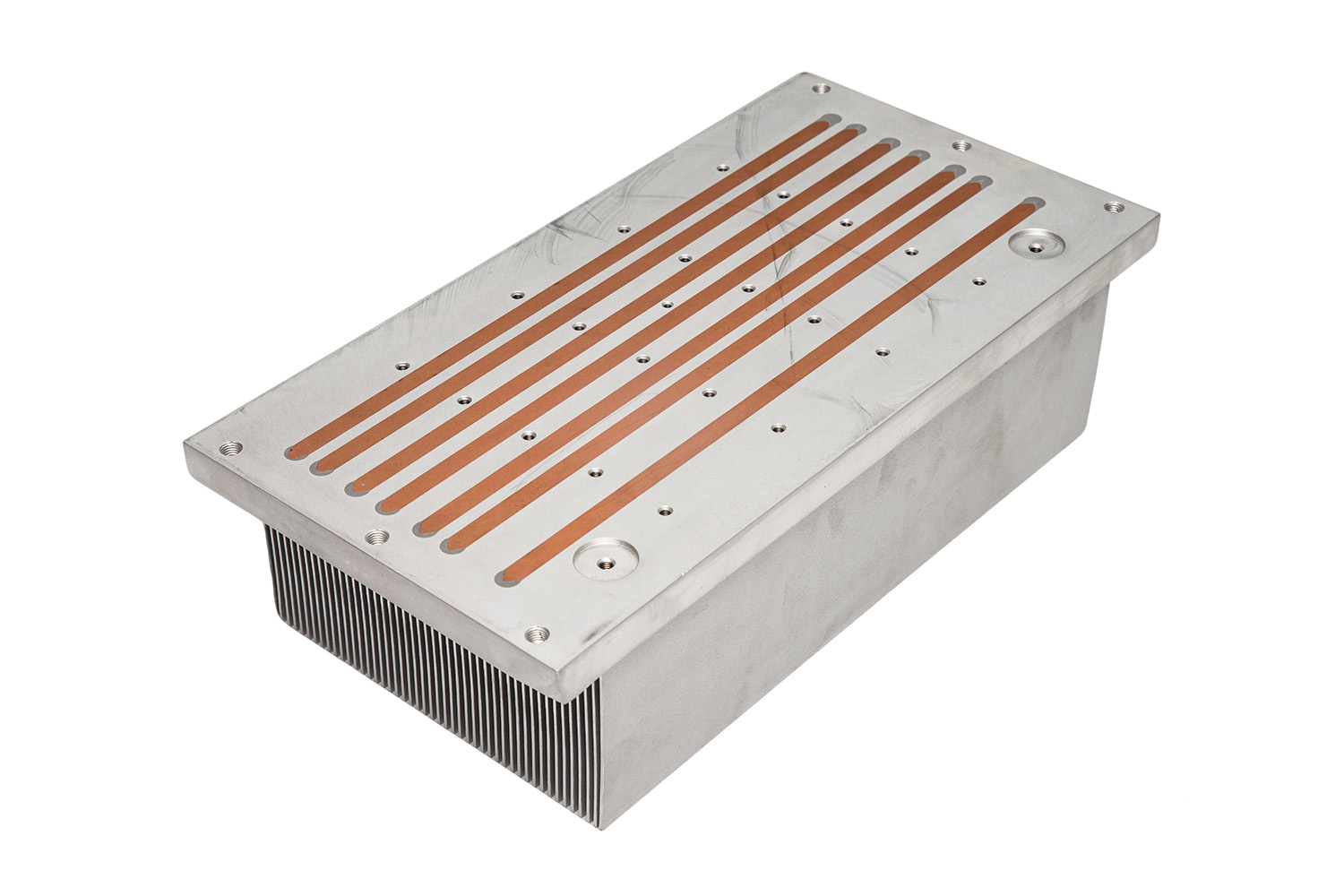
KINGKA Tech Industrial Limited is a professional thermal management manufacturer specializing in custom aluminum heat sinks and liquid cooling solutions. Our Aluminum Skiving Fin Heatsink is manufactured using a precision skiving process that cuts ultra-thin fins directly from a solid aluminum block, creating a continuous base-to-fin structure with excellent thermal conductivity and high fin density.
Compared with conventional extruded heat sinks and die cast heat sinks, a Skived Fin Heat Sink can achieve thinner fins, smaller fin pitches, and a larger effective heat dissipation area. This makes it particularly suitable for high-power-density electronics, telecom equipment, power electronics, LED lighting, automotive electronics, and other applications with limited installation space.
A skiving fin heat sink is manufactured by using a precision blade to slice fins directly from a solid aluminum or copper block. Instead of attaching separate fins to a base plate, the fins and base remain part of the same piece of material.
This continuous base-to-fin structure reduces thermal contact resistance between the base and fins and provides excellent mechanical stability.
The skiving process can produce very thin fins and high fin density, allowing engineers to maximize the heat dissipation area within a compact footprint.
Because the fins are formed directly from the base material, there is no separate bonding, soldering, or brazing interface between the fins and the base.
This monolithic structure provides a direct thermal conduction path:
Heat Source → Thermal Interface → Aluminum Base → Skived Fins → Air
The continuous material structure is particularly beneficial for applications requiring reliable long-term thermal performance and high mechanical integrity.
Our aluminum skiving fin heat sinks can be manufactured from AL1050, AL6061, or AL6063 aluminum alloys. Selected aluminum alloys provide a good combination of thermal conductivity, lightweight construction, corrosion resistance, and manufacturability.
For applications requiring higher thermal conductivity, copper materials such as C1100 and C1020 can also be considered.
Typical thermal conductivity ranges include approximately 180–220 W/m·K for selected aluminum alloys and 380–400 W/m·K for copper.
The skiving process can produce fins as thin as approximately 0.2 mm, depending on the material, geometry, fin height, and application requirements.
Thin fins allow more fins to be arranged within the same area, increasing the effective surface area available for heat dissipation.
High fin density is one of the major advantages of a Skived Fin Heat Sink. Closely spaced fins increase the surface area available for convection while maintaining a compact overall size.
Fin pitch should be selected according to airflow conditions. Excessively narrow spacing may restrict airflow, while excessive spacing can reduce the available heat dissipation area.
The combination of a continuous material structure, thin fins, high fin density, and optimized airflow can significantly reduce thermal resistance.
Actual thermal resistance depends on heat load, ambient temperature, airflow velocity, fin geometry, base thickness, thermal interface material, and mounting conditions.
Aluminum offers a favorable balance between thermal performance and weight. This makes an aluminum heat sink particularly suitable for telecommunications, automotive electronics, aerospace systems, portable equipment, and compact electronic devices.
Skiving allows engineers to customize fin height, thickness, pitch, density, and orientation according to the thermal and mechanical requirements of the application.
The fin structure can be optimized for natural convection or forced-air cooling.
| Specification | Details |
|---|---|
| Product Name | Aluminum Skiving Fin Heatsink |
| Manufacturing Process | Precision Skiving + CNC Machining |
| Material | AL1050 / AL6061 / AL6063 |
| Optional Material | C1100 / C1020 Copper |
| Thermal Conductivity | Aluminum: 180–220 W/m·K; Copper: 380–400 W/m·K |
| Fin Thickness | 0.2–1.0 mm |
| Fin Height | 5–60 mm |
| Fin Pitch | 0.5–3 mm |
| Base Thickness | 2–10 mm |
| Maximum Length | Up to approximately 400 mm, customizable |
| Cooling Method | Natural Convection / Forced Air Cooling |
| Thermal Resistance | ≤0.05°C/W, application-dependent |
| Application Power | Approximately 10–1500 W, depending on design |
| Surface Treatment | Anodizing / Nickel Plating / Powder Coating / Sandblasting |
| Mounting | Screws / Clips / Thermal Pads / Adhesive Bonding |
| Machining | CNC Milling / Drilling / Tapping |
| Operating Temperature | -40°C to +150°C |
| Customization | OEM / ODM / Custom Design |
| Certifications | ISO 9001:2015 / CE / RoHS |
The actual thermal performance should be validated according to the specific heat load, airflow, ambient temperature, mounting configuration, and required junction temperature.
The ability to manufacture thin, closely spaced fins increases the effective heat transfer area. This helps improve convective heat dissipation without significantly increasing the overall footprint.
Since the fins are skived directly from the base material, there is no separate adhesive or solder layer between the fins and the base. This provides a continuous thermal conduction path from the heat source to the cooling fins.
The monolithic construction eliminates the risk of individual fins becoming detached from the base due to bonding failure, vibration, or thermal cycling.
Unlike extrusion heat sinks, the skiving process does not require a long extrusion profile with a dedicated extrusion die. This provides greater flexibility for customized designs and can reduce tooling requirements for certain projects.
With high fin density and optimized thermal geometry, an aluminum skiving fin heatsink can provide efficient cooling in applications where conventional extruded heat sinks cannot provide sufficient surface area within the available space.
High-quality aluminum blocks are selected according to the required thermal conductivity, mechanical properties, dimensions, and application environment.
AL1050, AL6061, and AL6063 are commonly considered for aluminum heat sink applications.
A precision cutting blade moves across the aluminum block and raises the material to form continuous fins.
The blade angle, cutting depth, feed rate, fin thickness, and fin pitch are controlled to achieve the required fin geometry.
After skiving, CNC machining can be used to process mounting holes, threaded holes, thermal interfaces, locating features, and other critical dimensions.
The base surface can also be precision machined to improve flatness and contact with the heat-generating component.
Depending on the application, the aluminum skiving fin heatsink can be treated through anodizing, nickel plating, powder coating, or sandblasting.
Black or natural anodizing is commonly selected for aluminum heat sinks to improve surface protection and corrosion resistance.
Finished heat sinks can undergo dimensional inspection, flatness inspection, visual inspection, and thermal performance testing.
For customized projects, thermal resistance can be evaluated under specified heat load and airflow conditions.
A custom heatsink manufacturer must consider the complete thermal system rather than simply increasing fin density.
Important design parameters include:
Heat load
Maximum component temperature
Ambient temperature
Airflow velocity
Fin height
Fin thickness
Fin pitch
Fin density
Base thickness
Thermal interface resistance
Installation orientation
KINGKA can optimize the skived fin structure according to the customer's thermal and mechanical requirements.
As a custom heatsink manufacturer, KINGKA supports OEM and ODM projects based on customer drawings, 3D CAD models, samples, or technical specifications.
Customization includes:
Overall heat sink dimensions
Fin thickness and pitch
Fin height and density
Base thickness
Mounting hole locations
Thermal interface surface
Material selection
Surface treatment
Prototype development
Thermal simulation and validation
Aluminum skiving fin heat sinks are suitable for IGBT modules, MOSFETs, rectifiers, power supplies, inverters, converters, and other semiconductor devices.
They can be used in base stations, servers, routers, RF modules, communication power supplies, and other telecom equipment requiring compact thermal management.
Applications include EV controllers, power electronics, automotive LED headlights, motor controllers, and inverter systems.
High-power LED modules generate significant heat at the junction. A properly designed skived fin heat sink helps transfer heat away from the LED substrate and maintain a suitable operating temperature.
Skived fin heat sinks are widely applicable to PLC systems, variable-frequency drives, industrial power supplies, automation controllers, and other industrial electronic equipment.
The lightweight structure and high thermal performance of aluminum make skived fin heat sinks suitable for aerospace electronics, avionics, medical instruments, diagnostic equipment, and precision systems.
KINGKA Tech Industrial Limited combines thermal engineering, precision skiving, CNC machining, surface treatment, and thermal testing capabilities to provide complete custom heat sink solutions.
From initial thermal analysis and design optimization to prototype production and mass manufacturing, our engineering team can develop an aluminum skiving fin heatsink according to your required heat load, available installation space, airflow conditions, and mechanical specifications.
Our goal is to provide reliable thermal management solutions with optimized thermal performance, mechanical stability, manufacturing efficiency, and cost.
An Aluminum Skiving Fin Heatsink is a heat sink manufactured by cutting thin fins directly from a solid aluminum block. The fins and base remain one continuous piece, providing an efficient thermal path and strong mechanical integrity.
An extruded heat sink is formed by pushing heated aluminum through a die, while a skived fin heat sink is manufactured by cutting fins directly from a solid metal block. Skiving can produce thinner fins and higher fin density, making it suitable for compact, high-performance applications.
Depending on the material and design, skived fins can be approximately 0.2 mm thick. The practical fin thickness depends on fin height, pitch, material, and manufacturing requirements.
Yes. Aluminum provides a good combination of thermal conductivity, low density, corrosion resistance, and cost efficiency. For extremely high heat flux applications, copper or hybrid aluminum-copper designs can also be considered.
Yes. KINGKA provides custom skived fin heat sinks based on customer drawings, CAD files, samples, thermal requirements, and mechanical constraints.
Common options include anodizing, nickel plating, powder coating, and sandblasting. The appropriate finish depends on corrosion resistance, appearance, electrical requirements, and application conditions.

Kingka Tech Industrial Limited
We specialize in Heat Sink、Liquid Cold Plate、precision CNC machining and our products are widely used in telecommunication industry, aerospace, automotive, industrial control, power electronics, medical instruments, security electronics, LED lighting and multimedia consumption.


Address:
Da Long New Village, Xie Gang Town, Dongguan City, Guangdong Province, China 523598
Email:
WhatsAPP: