
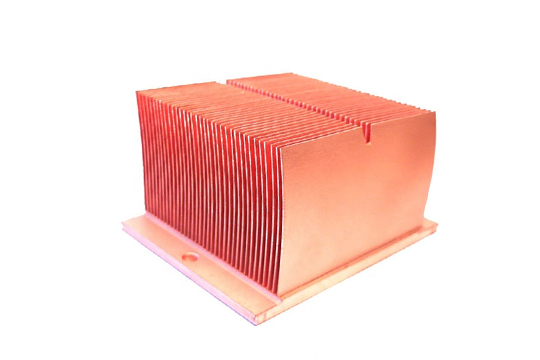
With the rapid growth of data centers, AI computing, and high-performance electronic systems, heat flux density continues to increase while available installation space becomes more limited. Conventional extruded or bonded heat sinks often struggle to meet these thermal challenges.
Skived Fin Heat Sinks provide a highly efficient and reliable air-cooling solution by enabling ultra-dense fin structures formed directly from a solid metal base. Through advanced heat sink skiving technology, thermal resistance is minimized, making skived fin heat sinks ideal for high-power and high-reliability applications.
A skived fin heat sink—also referred to as a skived heatsink or skiving heat sink—is manufactured using a precision skiving process. During this process, a specialized cutting tool gradually slices thin layers of metal from a solid aluminum or copper block and lifts them into vertical fins.
Unlike extrusion, brazing, or bonded-fin processes, skived fin structures remain fully integrated with the base material, creating a monolithic heat sink with no thermal interface between fins and base.
This structure significantly improves heat conduction efficiency and mechanical strength.
Because the fins and base are formed from the same piece of material, there is no solder layer, adhesive, or brazing interface. This eliminates interface thermal resistance and ensures direct heat flow from the heat source to the fins.
The skiving process allows:
Thinner fin thickness
Smaller fin pitch
Higher fin aspect ratio
This results in a much larger heat dissipation surface area compared to traditional extruded heat sinks.
High-density skived fins increase turbulence in forced-air environments, improving convective heat transfer when paired with fans or ducted airflow.
Common alloys: Aluminum 6061 / 6063
Lightweight and cost-effective
Suitable for most server, telecom, and industrial air-cooling applications
Manufactured through copper skiving
Extremely high thermal conductivity
Ideal for high heat flux applications where rapid heat spreading is critical
Commonly used in AI accelerators, GPUs, and power modules
Skived copper heatsinks are often selected when performance is prioritized over weight and material cost.
Our skiving heat sink production follows a tightly controlled, step-by-step process to ensure consistency, precision, and traceability.
Aluminum or copper coil material incoming inspection
RoHS / REACH compliance testing
Material certificate verification
Batch traceability and controlled warehouse storage
Review of customer drawings and 3D models
Skived fin feasibility analysis
DFM (Design for Manufacturability) report
Process route confirmation with customer
CAM programming for skiving and CNC operations
Custom fixture design
First article inspection plan preparation
Base Preparation
Coil material feeding and blank cutting
CNC rough machining and reference surface creation
Fin Skiving
Dedicated skiving machine setup
Tool installation and calibration
First article skived fin inspection
Adjustment of fin height, pitch, and geometry
Mass production skiving with real-time monitoring of:
Tool wear
Fin consistency
Surface finish
Precision Machining
CNC finishing of mounting holes, threads, and locating features
Chamfering and deburring
Ultrasonic cleaning to remove oil and debris
Drying process
Optional surface treatments:
Anodizing (natural, black, custom colors)
Electroless nickel plating
Sandblasting
Polishing (mirror or brushed finish)
Secondary cleaning and drying
CMM inspection: fin height, fin pitch, flatness, parallelism
Optical inspection of fin profile and angles
Visual inspection for scratches, dents, or coating defects
Optional salt spray testing
Coating adhesion testing (when applicable)
Anti-static and anti-scratch packaging
Desiccant placement
Optional vacuum packaging
Labeling with part number, batch number, and inspection status
Complete documentation delivery:
Dimensional inspection reports
Material certificates
Quality inspection records
| Process | Control Parameter | Inspection Method | Standard |
|---|---|---|---|
| Skived Fin | Fin height tolerance | Optical projector / CMM | ±0.05 mm |
| Skived Fin | Fin pitch consistency | Optical comparator | ±0.02 mm |
| Surface Treatment | Coating thickness | Thickness gauge | Customer spec ±10% |
| Appearance | Surface defects | Visual / AOI | No visible defects |
Data center servers
AI computing and GPU modules
Telecom and 5G equipment
Power electronics and inverters
Industrial automation systems
High-reliability embedded systems
Higher fin density than extruded heat sinks
Lower thermal resistance than bonded or brazed designs
Strong mechanical integrity and long service life
Excellent performance under forced-air cooling
Highly customizable for complex thermal requirements
Q1: What makes skived fin heat sinks better than extruded heat sinks?
Skived fin heat sinks offer higher fin density and lower thermal resistance, making them suitable for higher power densities and compact designs.
Q2: When should I choose a skived copper heatsink?
When heat flux is extremely high or rapid heat spreading is required, skived copper heatsinks provide superior performance.
Q3: Can skived fin heat sinks be customized?
Yes. Fin geometry, base thickness, mounting features, and surface treatments can all be customized.
Q4: What is the typical production lead time?
Standard lead time is 7–15 working days, depending on complexity and quantity.

Kingka Tech Industrial Limited
We specialize in precision CNC machining and our products are widely used in telecommunication industry, aerospace, automotive, industrial control, power electronics, medical instruments, security electronics, LED lighting and multimedia consumption.


Address:
Da Long New Village, Xie Gang Town, Dongguan City, Guangdong Province, China 523598
Email:
Tel:
+86 137 1244 4018