
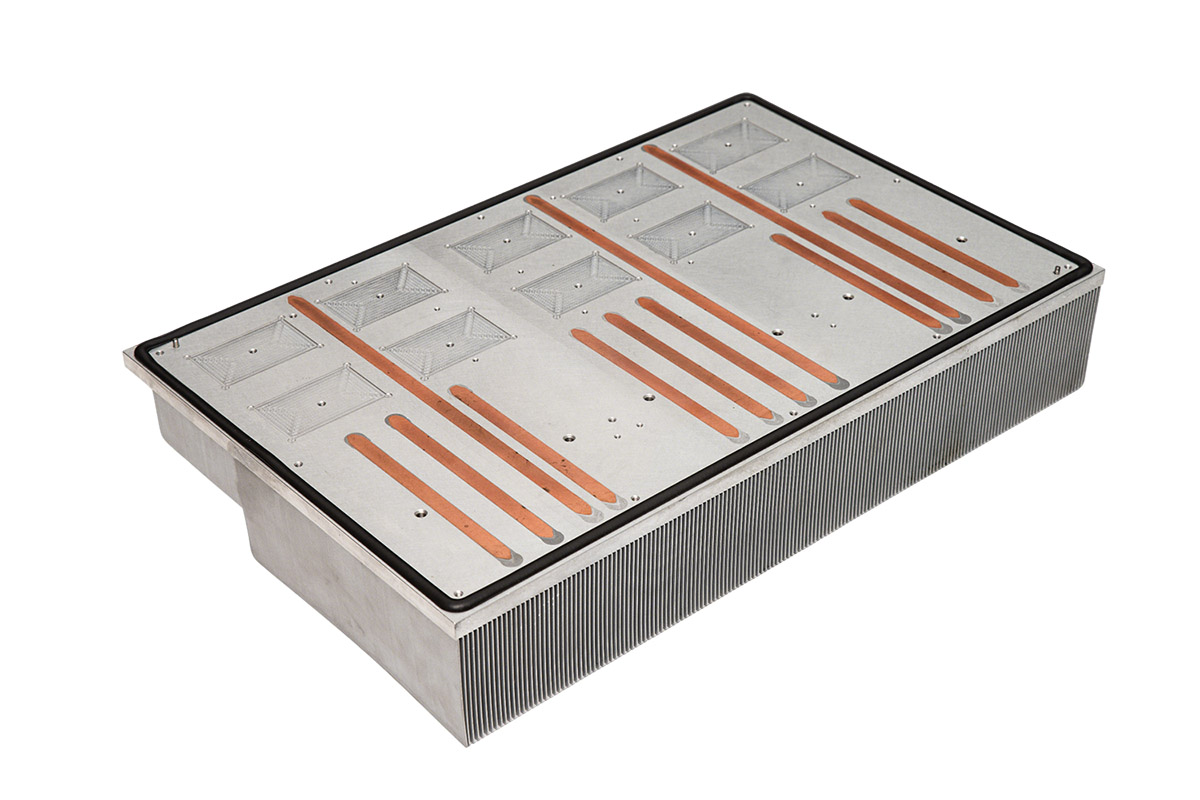
Heat Pipe Heat Sink is a high-performance thermal management component that combines copper heat pipes with aluminum or copper cooling fins to efficiently transfer and dissipate heat from electronic components. Through phase-change heat transfer, the heat pipe rapidly moves heat away from the heat source and distributes it across a larger fin area for effective heat dissipation.
As a professional heat sink manufacturer, we provide custom heat pipe heat sink solutions for CPUs, GPUs, LED lighting, power electronics, telecommunications equipment, industrial systems, laser equipment, and other high-power applications. Our OEM/ODM services support customized dimensions, heat pipe layouts, fin structures, mounting interfaces, and surface treatments according to customer drawings and thermal requirements.
A heat pipe heat sink works through a continuous evaporation-condensation cycle inside a sealed heat pipe.
When the heat pipe contacts a hot electronic component, the working fluid inside the pipe absorbs thermal energy and evaporates. The vapor moves rapidly toward the cooler section of the heat pipe, where it condenses and releases heat to the surrounding cooling fins.
The condensed liquid then returns to the evaporator section through the internal wick structure by capillary action. This creates a continuous passive heat transfer cycle without requiring a mechanical pump.
Heat Source → Copper Base → Heat Pipe → Cooling Fins → Ambient Air
This phase-change mechanism provides much higher effective thermal conductivity than conventional solid metal heat conduction, making a heat pipe cooler suitable for applications with high heat flux and limited installation space.
Copper heat pipes are typically made from high-conductivity copper tubing with an internal wick structure. The heat pipe is evacuated and filled with an appropriate working fluid before being sealed.
Common heat pipe diameters include 4 mm, 6 mm, 8 mm, and 10 mm, with the diameter and length selected according to the required heat transport capacity.
Aluminum fins provide a large surface area for convection and allow heat transferred through the heat pipes to be released into the surrounding air. Fin thickness, fin pitch, fin height, and fin density can be optimized according to airflow conditions and thermal resistance requirements.
The base plate provides the thermal interface between the electronic component and the heat pipe assembly. Copper is suitable for applications requiring high thermal conductivity, while aluminum offers a good balance between weight, cost, and thermal performance.
The wick structure inside the heat pipe returns condensed working fluid to the evaporator section through capillary pressure. Sintered powder, grooved, and mesh wick structures can be selected according to orientation, heat load, and thermal performance requirements.
Heat pipes utilize latent heat and phase-change heat transfer to transport large amounts of thermal energy with a relatively small temperature difference. This makes them effective for high-power electronic cooling and high heat flux applications.
A heat pipe heat sink can transfer heat away from a concentrated heat source and spread it across a larger fin area. This allows engineers to design compact cooling systems when direct fin cooling is insufficient.
The use of thin aluminum fins provides a large effective heat dissipation area while maintaining a relatively lightweight structure. Fin spacing can be optimized for natural convection or forced airflow.
Unlike liquid cooling systems, a standard heat pipe heat sink does not require a pump or external coolant circulation system. It contains no moving components, which helps reduce maintenance requirements and operating noise.
Heat pipe diameter, quantity, length, bending shape, fin thickness, fin pitch, base material, mounting holes, and surface treatment can all be customized according to the application.
| Parameter | Specification / Range |
|---|---|
| Heat Pipe Diameter | 4–10 mm |
| Heat Pipe Material | Copper |
| Fin Material | Aluminum / Copper |
| Base Material | Copper / Aluminum |
| Fin Type | Stamped / Extruded / Bonded |
| Working Fluid | Water / Methanol or application-specific fluid |
| Fin Thickness | Customized |
| Fin Pitch | Customized according to airflow |
| Thermal Resistance | Application-dependent |
| Surface Treatment | Anodizing / Nickel Plating / Natural Finish |
| Manufacturing Process | CNC Machining, Stamping, Soldering, Brazing, Press-Fitting |
| Heat Pipe Structure | Sintered Wick / Grooved / Mesh Wick |
| Mounting | Customized mounting holes and interfaces |
| Size | Custom according to customer drawings |
| OEM/ODM | Available |
Actual thermal performance depends on heat load, heat pipe length and diameter, fin geometry, airflow rate, ambient temperature, orientation, and installation conditions.
Copper or aluminum base plates are precision machined to achieve the required mounting dimensions, flatness, and thermal interface quality.
Copper heat pipes are cut, flattened, bent, and positioned according to the thermal and mechanical design. The bending radius and deformation are controlled to maintain the internal wick structure and heat transfer performance.
Aluminum cooling fins can be produced through stamping, extrusion, or other forming processes. Fin density and geometry are optimized to increase the effective heat dissipation area.
Heat pipes can be integrated with the base and fins using soldering, brazing, press-fitting, or thermally conductive bonding technologies. The selected joining method depends on thermal resistance, mechanical strength, operating temperature, and production requirements.
Optional surface treatments include anodizing, nickel plating, and other protective finishes to improve corrosion resistance, appearance, or application compatibility.
Finished heat pipe heat sinks can undergo thermal testing to verify temperature rise, thermal resistance, heat spreading performance, and overall cooling capability under specified operating conditions.
For custom heat pipe heat sinks, the thermal design begins with key application parameters such as heat load, allowable component temperature, ambient temperature, airflow rate, installation orientation, and available installation space.
Thermal simulation can be used to optimize heat pipe quantity, pipe location, fin density, fin pitch, and base thickness before prototype production.
We provide OEM heat sink and ODM thermal management services based on customer drawings, 3D models, samples, or application requirements.
Customization can include:
Heat pipe diameter and quantity
Heat pipe length and bending configuration
Aluminum or copper fin design
Fin thickness and pitch
Base plate thickness
Mounting hole locations
Thermal interface surface
Surface treatment
Overall dimensions
Thermal resistance target
Heat pipe heat sinks are widely used for CPUs, GPUs, chipsets, and other high-performance computing components where concentrated heat loads require rapid heat spreading.
LED lighting heat sinks help remove heat from high-power LED modules, reducing junction temperature and supporting stable light output and longer component life.
Heat pipe cooling solutions can be used for power modules, MOSFETs, IGBTs, inverters, converters, and power supplies that generate substantial heat during operation.
Heat pipe heat sinks are suitable for base stations, communication equipment, routers, and other systems where high power density and limited installation space create thermal management challenges.
High-power laser systems, industrial controllers, and precision equipment can use customized heat pipe thermal solutions to maintain stable operating temperatures.
Customized heat pipe cooling assemblies can also be designed for automotive electronics, battery-related systems, power converters, and other temperature-sensitive components.
A properly engineered heat pipe heat sink can provide an effective combination of heat spreading, compact size, passive operation, and design flexibility. Compared with a conventional solid aluminum heat sink, the heat pipe provides a highly efficient pathway for transferring heat from a concentrated source to a larger fin area.
For applications with higher thermal loads, our engineering team can optimize the heat pipe layout and fin structure according to the required heat transport capacity, airflow conditions, thermal resistance, and mechanical constraints.
As a custom heat sink manufacturer, we support the complete development process from thermal design and simulation to prototype verification, production, thermal testing, and mass production.
A Heat Pipe Heat Sink is a passive cooling assembly that uses sealed heat pipes to transfer heat from an electronic component to cooling fins. It combines phase-change heat transfer with air convection to efficiently dissipate heat.
Copper is commonly used for heat pipes because of its excellent thermal conductivity and compatibility with common working fluids. Aluminum is frequently used for cooling fins because it is lightweight, cost-effective, and easy to manufacture.
The working fluid inside the heat pipe evaporates at the hot section, moves as vapor to the cooler section, condenses, and releases heat. The liquid then returns through the wick structure by capillary action.
Yes. Heat pipe diameter, quantity, length, bending configuration, fin structure, base material, dimensions, mounting interface, and surface treatment can be customized according to application requirements.
Yes. Heat pipe heat sinks are particularly useful for high-power electronics because they can rapidly spread concentrated heat over a larger cooling area. The actual heat dissipation capability depends on the heat pipe design, fin geometry, airflow, and operating conditions.
Depending on the design, heat pipes can be connected to the base or fins using soldering, brazing, press-fitting, or thermally conductive bonding.

Kingka Tech Industrial Limited
We specialize in Heat Sink、Liquid Cold Plate、precision CNC machining and our products are widely used in telecommunication industry, aerospace, automotive, industrial control, power electronics, medical instruments, security electronics, LED lighting and multimedia consumption.


Address:
Da Long New Village, Xie Gang Town, Dongguan City, Guangdong Province, China 523598
Email:
WhatsAPP: