
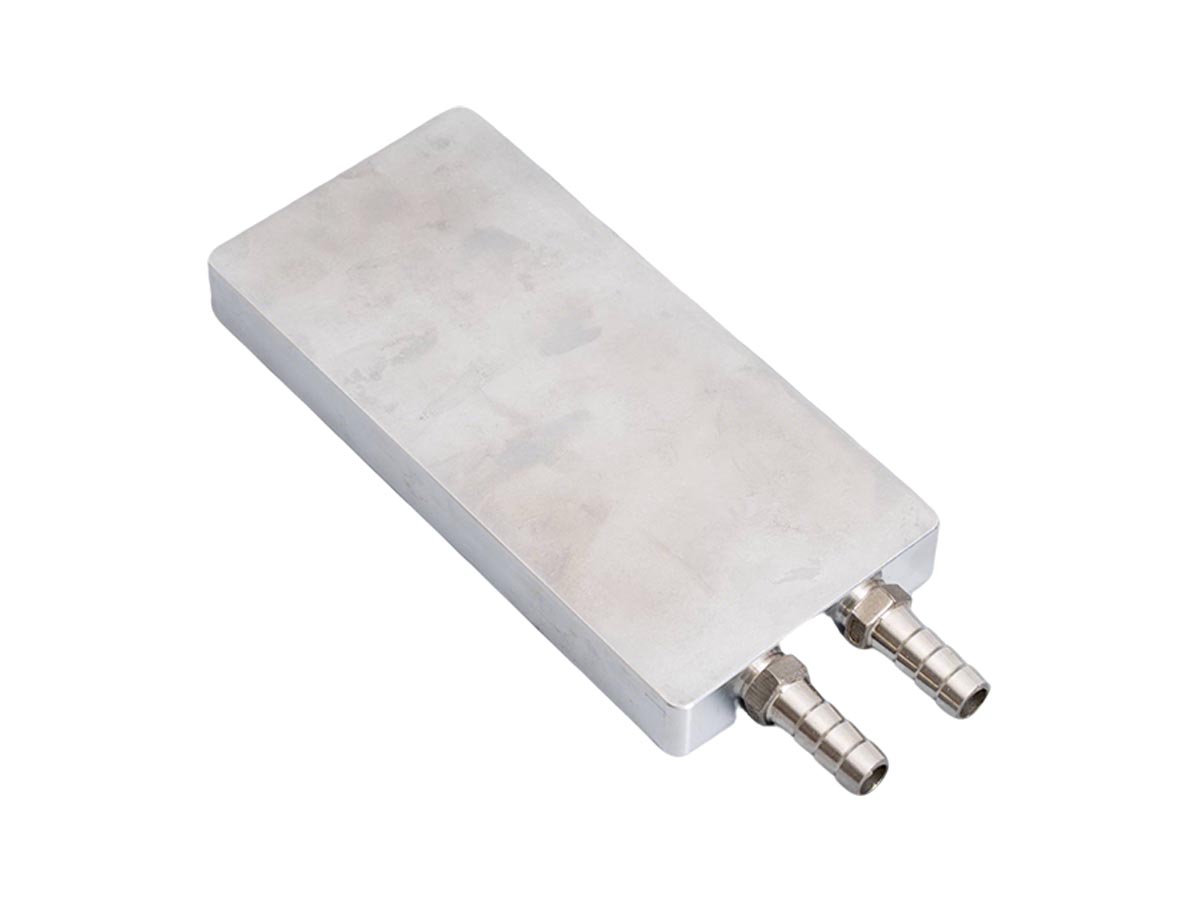
As electronic devices, EV battery systems, energy storage equipment, and industrial automation continue to evolve toward higher power density, efficient thermal management has become a critical factor in ensuring reliability and performance. FSW Liquid Cold Plate Parts are widely used in advanced cooling systems due to their excellent heat dissipation capability, leak-proof structure, and long-term stability.
Compared with traditional brazed or welded cooling plates, Friction Stir Welding (FSW) technology provides stronger bonding performance, lower deformation, and superior thermal conductivity. As a result, FSW Liquid Cold Plate components are increasingly adopted in electric vehicles, battery packs, inverters, data centers, and power electronics applications.
FSW Liquid Cold Plate Parts are precision-machined cooling components manufactured using friction stir welding technology to create sealed liquid cooling channels inside aluminum or copper plates. These parts are designed to transfer heat efficiently from heat-generating devices to circulating coolant.
The internal flow channels allow coolant to absorb and carry away heat, maintaining optimal operating temperatures for critical electronic systems.
Common product types include:
Aluminum liquid cold plates
Copper liquid cooling plates
Battery cooling plates
Water-cooled heat sink plates
Custom liquid cooling solutions
FSW cold plate assemblies
These products are commonly customized according to customer requirements, including channel design, dimensions, material thickness, surface treatment, and connector positions.
The working principle of FSW liquid cold plate parts is based on efficient heat transfer through liquid circulation.
Heat generated by electronic components is transferred to the cold plate surface.
Coolant flows through internal channels inside the liquid cold plate.
The coolant absorbs heat from the plate.
Heated liquid is transported to an external cooling system for heat dissipation.
Cooled liquid circulates back into the system continuously.
Friction Stir Welding technology plays a key role in ensuring the internal cooling channels remain highly sealed and structurally reliable under high pressure and long-term operation.
Compared with conventional welding methods, FSW technology offers several important benefits:
FSW creates solid-state joints with minimal porosity, reducing leakage risks in liquid cooling systems.
The welding process improves mechanical integrity, making the cold plate suitable for vibration-sensitive applications such as EVs and rail transit systems.
The seamless welding structure improves heat transfer efficiency and overall cooling performance.
Because FSW operates below the melting point of the material, thermal distortion is significantly reduced.
FSW liquid cooling plates offer excellent corrosion resistance and fatigue performance for demanding industrial environments.
The specifications of FSW liquid cold plate parts can be customized according to different applications.
| Parameter | Specification |
|---|---|
| Material | Aluminum 6061 / 6063 / Copper |
| Welding Process | Friction Stir Welding (FSW) |
| Cooling Method | Liquid Cooling / Water Cooling |
| Plate Thickness | 3 mm – 50 mm |
| Channel Design | Serpentine / Parallel / Customized |
| Surface Treatment | Anodizing / Nickel Plating / Powder Coating |
| Leak Test | Helium Test / Air Pressure Test |
| Working Pressure | Up to 2.0 MPa |
| Operating Temperature | -40°C to 120°C |
| Manufacturing Tolerance | ±0.02 mm |
| Application | EV Battery, IGBT, Energy Storage, Data Center |
The optimized internal flow channel design improves coolant distribution and heat transfer capability.
Aluminum FSW liquid cold plates provide lightweight cooling solutions for electric vehicles and portable systems.
Manufacturers can provide customized liquid cold plate parts based on CAD drawings or thermal management requirements.
FSW processing minimizes welding defects and enhances sealing reliability.
Surface treatments such as anodizing improve durability in harsh environments.
FSW battery cold plates are widely used in EV battery packs to maintain safe operating temperatures and improve battery lifespan.
Liquid cooling plates help stabilize temperatures in large-scale energy storage and power conversion systems.
IGBT modules, inverters, converters, and high-power semiconductors require efficient thermal management to ensure stable operation.
High-performance computing equipment generates substantial heat, making liquid cold plate cooling increasingly important in modern server systems.
5G base stations and communication devices use liquid cooling technology to enhance thermal stability.
Servo drives, laser equipment, and industrial controllers often integrate FSW liquid cooling plates for improved reliability.
Custom FSW liquid cold plate parts can be designed according to specific thermal performance requirements, installation space limitations, and coolant flow conditions.
Professional manufacturers usually provide:
Thermal simulation analysis
Customized channel design
CNC machining services
Leak testing and quality inspection
Prototype development
Mass production support
By combining CNC precision machining with friction stir welding technology, manufacturers can achieve high-performance cooling solutions with excellent dimensional accuracy and durability.
The manufacturing process generally includes:
Material preparation
CNC machining of cooling channels
Friction stir welding sealing
Surface treatment
Leak testing
Pressure testing
Dimensional inspection
Final assembly and packaging
Strict quality control ensures each liquid cold plate component meets industrial standards and customer requirements.
As industries continue moving toward high-power-density systems, the demand for advanced thermal management solutions will continue to increase. FSW liquid cold plate parts are becoming an important technology in EVs, AI servers, renewable energy systems, and aerospace equipment.
With the advantages of efficient cooling performance, lightweight structure, and high reliability, friction stir welded liquid cold plates are expected to play an even greater role in next-generation thermal management applications.
FSW stands for Friction Stir Welding, a solid-state welding process used to create strong and leak-proof joints in liquid cooling plates.
Aluminum alloys such as 6061 and 6063 are the most commonly used materials due to their lightweight properties and excellent thermal conductivity.
FSW liquid cold plate parts offer excellent sealing, high thermal conductivity, low deformation, strong mechanical strength, and long service life.
They are widely used in electric vehicles, energy storage systems, data centers, power electronics, telecommunications equipment, and industrial automation systems.
Yes. Most manufacturers provide custom liquid cold plate solutions based on customer drawings, thermal requirements, and application scenarios.

Kingka Tech Industrial Limited
We specialize in Heat Sink、Liquid Cold Plate、precision CNC machining and our products are widely used in telecommunication industry, aerospace, automotive, industrial control, power electronics, medical instruments, security electronics, LED lighting and multimedia consumption.


Address:
Da Long New Village, Xie Gang Town, Dongguan City, Guangdong Province, China 523598
Email:
WhatsAPP: