
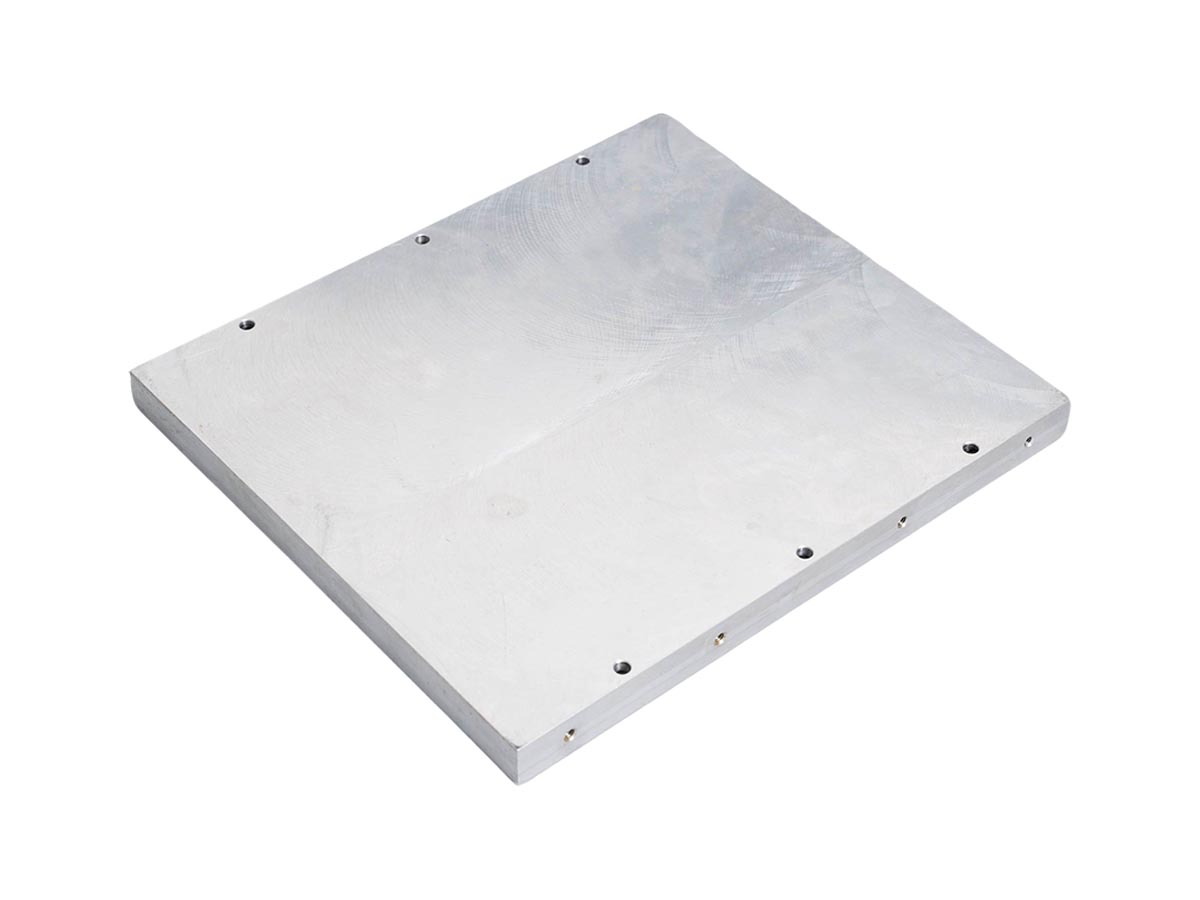
FSW Liquid Cold Plate Parts are advanced thermal management components manufactured using Friction Stir Welding (FSW) technology. Designed for high heat flux applications, these liquid cooling plates provide efficient and reliable heat dissipation for industries requiring stable thermal performance and long-term operational reliability.
Compared with conventional brazed or bonded cooling plates, friction stir welded Liquid Cold Plates offer superior mechanical strength, lower thermal resistance, and excellent leak-proof performance. The FSW process creates a solid-state weld without melting the base material, resulting in a highly durable and defect-free cooling structure.
KINGKA provides custom FSW Liquid Cold Plate parts tailored to customer thermal requirements, including cooling channel design, material selection, size customization, and surface treatment. These liquid cooling solutions are widely used in battery cooling systems, power electronics, EV thermal management, data centers, and industrial equipment.
An FSW Liquid Cold Plate is a type of liquid cooling plate fabricated using Friction Stir Welding technology to seal internal coolant channels within a metal plate, typically aluminum.
The cold plate works by circulating coolant through precisely designed flow channels. Heat generated by electronic devices or power modules transfers to the metal plate and is rapidly removed by the flowing coolant.
Unlike traditional fusion welding methods, FSW produces a solid-state joint through frictional heat and material plastic deformation, minimizing porosity, distortion, and leakage risks.
As a result, FSW liquid cold plate parts are ideal for applications requiring:
High heat transfer efficiency
Reliable coolant sealing
Lightweight construction
High structural integrity
Long service life
Stable cooling under demanding conditions
FSW liquid cold plate cooling relies on conductive and convective heat transfer.
The cooling process typically follows these steps:
Electronic components, batteries, or power modules generate heat during operation.
Heat transfers from the heat source into the thermal interface material and then into the aluminum liquid cold plate.
Coolant such as water or glycol flows through internal channels engineered inside the cold plate.
The coolant absorbs heat from the plate surface and carries it away toward an external heat exchanger or radiator.
The cooling cycle repeats continuously to maintain safe operating temperatures and stable equipment performance.
Because FSW cold plate cooling creates highly sealed and uniform flow channels, coolant circulation remains efficient while minimizing pressure loss and leakage risk.
Friction Stir Welding has become one of the most advanced joining technologies for liquid cooling systems.
Unlike brazing or traditional welding, FSW uses a rotating tool that generates frictional heat and plastically joins the material without melting it.
This process offers several advantages.
The solid-state welding structure creates highly reliable sealed channels, significantly reducing coolant leakage risk.
FSW produces intimate material bonding with minimal voids, improving thermal conductivity and heat transfer efficiency.
Because melting is avoided, the process reduces thermal deformation and preserves dimensional accuracy.
The welded joint maintains excellent structural integrity under vibration, pressure, and thermal cycling.
FSW does not require filler materials or flux, reducing contamination and supporting cleaner production.
These benefits make friction stir welded cold plates particularly suitable for high-power and mission-critical cooling systems.
Optimized coolant channels maximize heat transfer and improve overall cooling performance.
Most liquid cold plate parts are manufactured from aluminum alloys, combining thermal conductivity with low weight.
FSW technology forms durable welded seals for long-term coolant containment.
Cooling channels can be engineered based on heat density, flow rate, and pressure requirements.
Available channel structures include:
Serpentine channels
Parallel channels
Pin-fin structures
Multi-pass flow channels
Customized thermal layouts
Optional surface treatments improve durability and coolant compatibility.
FSW cooling plates are capable of withstanding thermal cycling and harsh industrial environments.
The following specifications may vary according to project requirements and custom design.
| Item | Specification |
|---|---|
| Product Type | FSW Liquid Cold Plate Parts |
| Material | Aluminum 6061 / 6063 / 1050 / Copper Optional |
| Manufacturing Process | CNC + Friction Stir Welding |
| Cooling Method | Liquid Cooling |
| Coolant | Water / Water-Glycol / Custom |
| Channel Design | Customized |
| Surface Treatment | Anodizing / Nickel Plating / Passivation |
| Pressure Resistance | Custom Design |
| Operating Temperature | Customized |
| Leak Test | Air Leak / Helium Leak Testing |
| Tolerance | Precision Machining Available |
| Size | Customizable |
KINGKA adopts a strict manufacturing and quality control process to ensure consistent product performance.
High-quality aluminum or copper materials are selected based on thermal and structural requirements.
Internal coolant channels are precision machined to achieve optimal heat transfer and fluid flow.
The FSW process seals the cooling channels and forms a strong metallurgical joint.
Optional finishing processes improve corrosion resistance and appearance.
Every FSW liquid cold plate undergoes leak and pressure testing to ensure sealing reliability.
Products are inspected for flatness, dimensional accuracy, and overall quality before shipment.
Due to their superior thermal performance, FSW liquid cooling plates are widely used across multiple industries.
Battery packs generate significant heat during charging and discharge cycles. Battery cooling plates help maintain safe operating temperatures and extend battery lifespan.
Modern servers and AI computing systems require high-efficiency data center cooling solutions to manage increasing thermal loads.
IGBTs, inverters, and converters require stable cooling to maintain electrical performance and prevent overheating.
Large-scale ESS installations rely on liquid cooling systems to ensure thermal balance and operational safety.
Industrial machinery and automation systems use cold plate heat sinks to improve system reliability.
High-density communication devices require efficient thermal management to maintain stable operation.
Precision systems benefit from temperature-controlled cooling to ensure operational accuracy.
KINGKA specializes in thermal management solutions and precision cooling components with extensive manufacturing experience.
Equipped with CNC machining, skiving, friction stir welding, and precision testing equipment.
Our engineering team develops custom liquid cold plate solutions based on customer cooling requirements.
Products undergo comprehensive testing and inspection to ensure consistent reliability.
From design and prototyping to production and assembly, we provide complete thermal solution support.
Efficient manufacturing processes shorten lead times and accelerate project delivery.
An FSW liquid cold plate is a liquid cooling component manufactured using friction stir welding to seal coolant channels and dissipate heat efficiently.
FSW provides stronger joints, lower thermal resistance, and better leak prevention compared with traditional welding or brazing.
Yes. Properly manufactured friction stir welded cold plates offer excellent sealing reliability and are typically subjected to leak testing.
Yes. Material, channel layout, size, pressure requirements, and surface finishing can all be customized.
Common coolants include deionized water and water-glycol mixtures, depending on system requirements.

Kingka Tech Industrial Limited
We specialize in Heat Sink、Liquid Cold Plate、precision CNC machining and our products are widely used in telecommunication industry, aerospace, automotive, industrial control, power electronics, medical instruments, security electronics, LED lighting and multimedia consumption.


Address:
Da Long New Village, Xie Gang Town, Dongguan City, Guangdong Province, China 523598
Email:
WhatsAPP: