
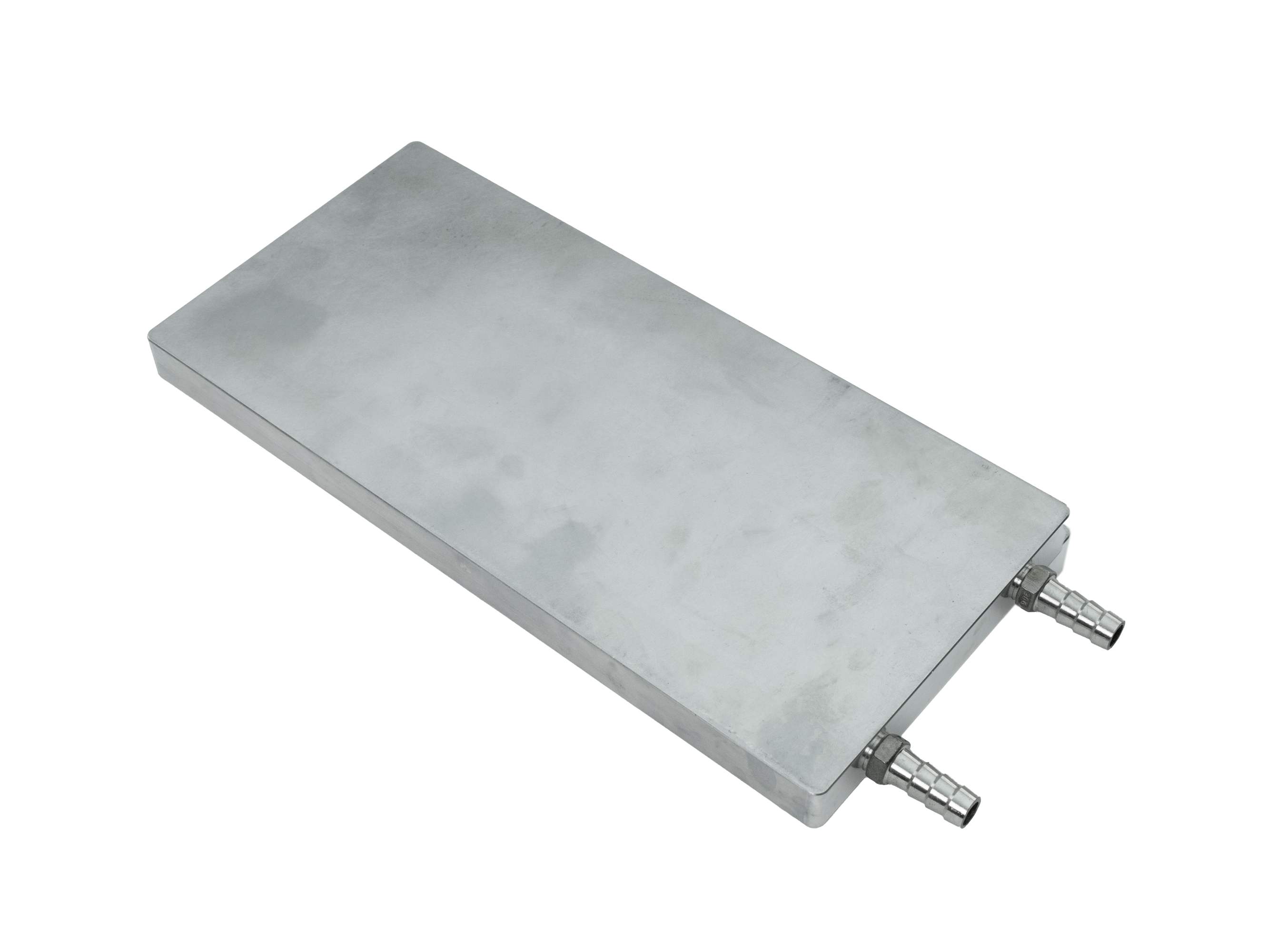
Custom Friction Stir Welding (FSW) liquid cold plates are advanced thermal management components engineered for high-performance heat dissipation in demanding applications. Utilizing FSW technology ensures high-integrity, leak-free bonding of complex aluminum structures, making these cold plates ideal for long-term reliability under elevated thermal loads.
Custom FSW Liquid Cold Plates are widely used across industries requiring precise thermal management:
Electric Vehicle (EV) Battery Cooling Systems
Power Electronics: IGBT, MOSFET, inverter modules
Renewable Energy Systems: Solar inverters, wind turbines
Medical Imaging Devices: MRI, CT, and laser systems
High-Performance Computing (HPC) & Data Centers
Telecommunications Systems and Laser Equipment
KINGKA specializes in fully customized FSW Liquid Cold Plate production, from design to final assembly. Our in-house capabilities include:
Friction Stir Welding Machines (multi-axis): Precision bonding of aluminum components
CNC Machining Centers (3, 4, 5-axis): Manifold and microchannel fabrication
Tube Bending & Expanding Systems: For embedded channel paths
Helium Leak Testing Equipment: Ensuring 100% leak-proof integrity
Coordinate Measuring Machines (CMM): Dimensional accuracy verification
3D CAD/CAM Design & Thermal Simulation: Optimize internal flow paths and heat dissipation
Typical Manufacturing Steps:
CAD-based thermal and flow simulation for optimized channel layout.
CNC machining of base plates and manifolds.
Tube bending, insertion, or microchannel fabrication.
FSW sealing of plates along linear, circular, or spiral weld paths.
Leak testing via helium mass spectrometry.
Surface finishing (anodizing, nickel plating, powder coating) as required.
Final inspection including CMM, flow verification, and thermal testing.
Base Aluminum: 6061-T6, 1060, or 3003 for high strength and corrosion resistance
Embedded Tubes: Copper (C10200, C11000) or aluminum
Optional Inserts: Stainless steel for critical ports or connectors
Surface Finishes: Anodizing (clear, black, hard coat), Electroless Nickel Plating, Chromate Conversion Coating, or custom powder coating
| Specification | Details |
|---|---|
| Max Plate Dimensions | 1200mm × 800mm |
| Wall Thickness | 1.5–10 mm |
| Tolerance | ±0.05 mm (critical areas) |
| Operating Temperature | -40°C to +125°C |
| Pressure Rating | Up to 6 Bar |
| Flow Rate | 0.5–10 L/min |
| Thermal Resistance | <0.02 K/W |
| Surface Flatness | ≤0.1 mm per 100 mm |
| Leak Test | Helium Mass Spectrometry ≤ 1×10⁻⁶ Pa·m³/s |
High Thermal Performance: Optimized internal flow channels for efficient heat transfer
Leak-Free Reliability: FSW provides porosity-free, robust joints
Customizable Design: Channel layout, manifold configuration, and mounting features fully adjustable
Scalable Production: From single prototypes to high-volume orders
Material Flexibility: Copper or aluminum tubes based on thermal and mechanical requirements
Prototypes: 7–15 working days
Mass Production: 3–5 weeks depending on complexity and volume
Cost Considerations: FSW reduces post-processing, enhances durability, and lowers failure risk; material choice and plate size influence final pricing
| Industry | Recommended Cold Plate Type |
|---|---|
| EV Battery Systems | Custom FSW Liquid Cold Plate with embedded copper channels |
| HPC & Data Centers | High-performance aluminum FSW plates with micro-channel flow |
| Medical Devices | FSW cold plates for precise, leak-free heat removal |
| Power Electronics | FSW liquid cold plates for inverter and IGBT modules |
| Renewable Energy | Modular FSW cold plates for solar inverters and wind turbines |
Enhanced FSW Processes: Multi-axis and adaptive welding paths for even higher density channel layouts
Hybrid Designs: Combining FSW with CNC machining or epoxy resin filling for complex geometries
Integration with AI/IoT Sensors: Real-time thermal monitoring embedded in cold plates
Sustainability: Recyclable aluminum components and optimized material usage
Q1: Can internal channels be customized?
Yes, channel paths (serpentine, parallel, or pin-fin) can be fully tailored to your thermal and flow requirements. CAD files or simulation-assisted designs are supported.
Q2: What is the typical lead time?
Prototypes: 7–15 days. Mass production: 3–5 weeks depending on complexity.
Q3: How do you guarantee leak-proof performance?
FSW ensures strong, porosity-free joints, with 100% helium leak testing conducted for all units.
Q4: Which file formats are acceptable?
STEP, IGES, DWG, PDF, and 2D/3D drawings are all supported.
Q5: Is there an MOQ?
We support both low-volume prototypes (1–5 pcs) and high-volume production runs.

Kingka Tech Industrial Limited
We specialize in precision CNC machining and our products are widely used in telecommunication industry, aerospace, automotive, industrial control, power electronics, medical instruments, security electronics, LED lighting and multimedia consumption.


Address:
Da Long New Village, Xie Gang Town, Dongguan City, Guangdong Province, China 523598
Email:
Tel:
+86 137 1244 4018