A heat sink is one of the most widely used thermal management components in electronics and industrial equipment. Its job is to absorb heat from a heat-generating component and transfer that heat into the surrounding air more efficiently. In simple terms, a heat sink helps keep devices cooler, more stable, and more reliable during operation. Industry thermal references describe the heat sink as a fundamental cooling component used when simple conduction through the device alone is not enough, and note that its structure is typically made up of a base plus fins designed to increase surface area for heat dissipation.
As power density continues to rise in electronics, EV systems, telecom equipment, LED lighting, industrial controls, and computing hardware, the role of the heat sink becomes even more important. Overheating can reduce efficiency, shorten component life, and in severe cases lead to failure. Thermal-management guidance consistently emphasizes that heat must be controlled early in the design process rather than treated as an afterthought.
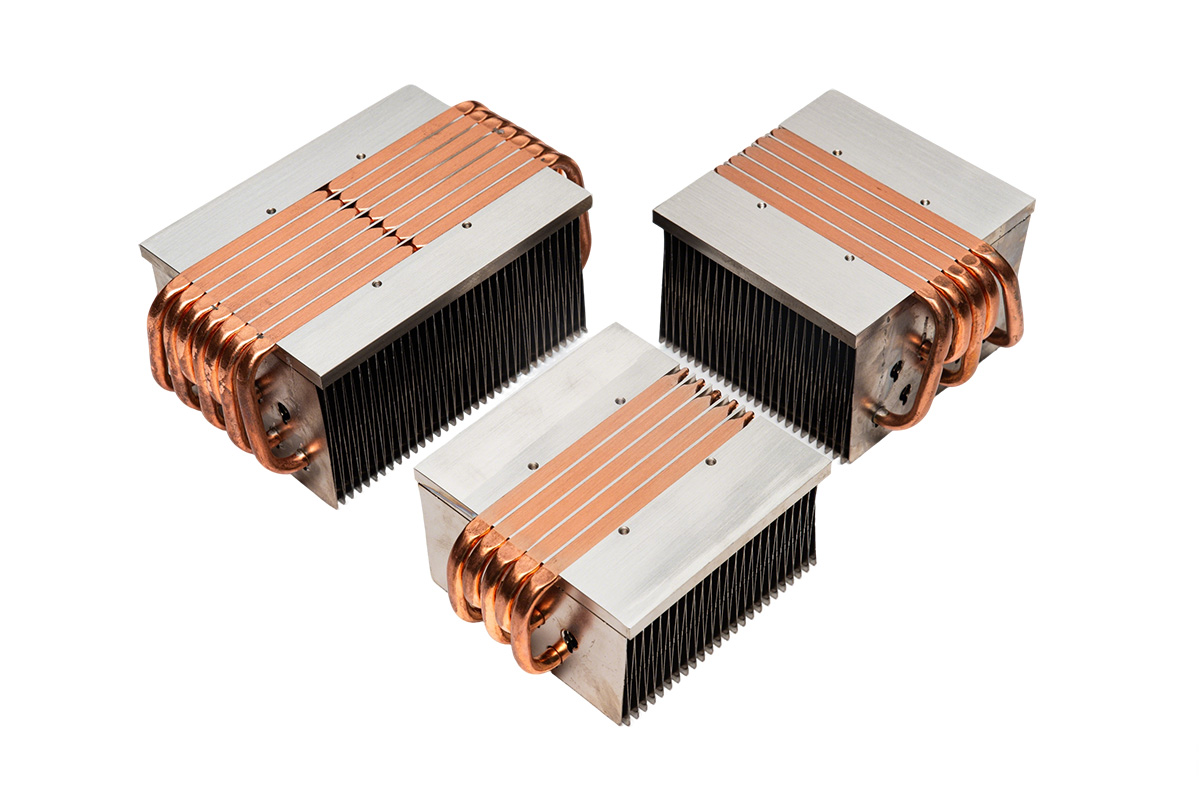
What a Heat Sink Is
A heat sink is usually a thermally conductive metal part attached to a device that generates heat, such as a processor, power transistor, LED module, inverter component, or industrial electronic assembly. The heat sink collects heat from the hot component through direct contact, often with the help of a thermal interface material, and then releases that heat to the ambient air. DigiKey’s thermal guidance explains that heat sinks reduce device temperature by improving heat transfer across the solid-to-air boundary, while Celsia notes that heat moves from the component through the thermal interface material, then into the sink base and fins.
The reason most heat sinks have fins is simple: fins increase the available surface area. More surface area gives the surrounding air more opportunity to carry heat away. Boyd’s fabrication guide specifically notes that the goal of the heat sink is to optimize surface area so the most heat can be transferred and dissipated.
How a Heat Sink Works
The heat sink working principle is based mainly on three heat-transfer mechanisms: conduction, convection, and radiation. In most practical electronics applications, conduction and convection are the most important. Celsia’s design fundamentals explain that conduction moves heat from the component through the thermal interface material into the heat sink, while convection removes that heat from the fins into the surrounding air; radiation usually plays a smaller role in typical electronics temperatures.
The process can be understood in three stages:
| Stage | What Happens | Why It Matters |
|---|
| Heat absorption | Heat moves from the device into the heat sink base | The base spreads heat away from the hot spot |
| Heat spreading | Heat conducts from the base into the fins | Better spreading improves overall sink efficiency |
| Heat dissipation | Air removes heat from the fins through convection | This is how heat leaves the system |
This is why a good heat sink is not just “a metal block.” Its performance depends on contact quality, base design, fin geometry, airflow, and material selection. Thermal references also describe heat sink performance as a thermal-resistance chain involving the interface material, the base, the fins, and the air side.
Why Heat Sinks Matter in Thermal Management
Without a proper heat sink, electronic components may run above their ideal operating temperature. That can affect efficiency, signal stability, power output, and long-term reliability. DigiKey notes that designers must keep component junction temperatures below the manufacturer’s maximum temperature rating, often around 150°C for many devices, to prevent damage.
A properly designed heat sink helps by:
lowering device temperature
improving product reliability
extending service life
supporting higher power density
reducing thermal stress during long operation
In thermal-management design, the heat sink is often one of the simplest and most cost-effective ways to improve cooling performance before more complex solutions are needed.
Main Types of Heat Sinks
Not all heat sinks are the same. The right design depends on heat load, available space, airflow conditions, cost targets, and manufacturing method. Boyd’s guide identifies several common fabrication routes, while Kingka’s website currently presents multiple custom heat sink categories including extruded heat sink, Skived Fin Heat Sink, Bonded Fin Heat Sink, cold forged heat sink, heat pipe thermal module, and die cast heat sink.
| Type | Main Features | Typical Use |
|---|
| Extruded heat sink | Cost-effective profile-based design, often in aluminum | General electronics, industrial devices |
| skived fin heat sink | High fin density and strong thermal performance | Power electronics, compact high-load systems |
| Bonded fin heat sink | Fins bonded to base for flexible geometry | Higher performance air cooling |
| Cold forged heat sink | Dense metal structure with robust shape formation | LEDs, automotive, compact applications |
| Heat pipe thermal module | Uses heat pipes to spread heat efficiently | High-power electronics, uneven hotspots |
| Die cast heat sink | Good for complex shapes and larger production volumes | Automotive, housings, integrated assemblies |
Natural Convection vs. Forced Convection
A heat sink may operate in either natural convection or forced convection conditions. Boyd explains that passive heat sinks rely on natural airflow with no active component, while active designs use fans or blowers to force air across the fins and improve heat transfer. DigiKey also notes that forced air can significantly reduce thermal resistance versus natural convection.
| Cooling Mode | Description | Best For |
|---|
| Natural convection | Air moves by buoyancy without a fan | Low-power or silent systems |
| Forced convection | Air is driven across fins by a fan or blower | Higher heat loads and compact products |
This distinction matters because a heat sink that performs well in forced airflow may not work as well in a passive design. Airflow direction, fin spacing, and pressure drop all influence performance. Celsia specifically notes that fin spacing that is too tight can reduce airflow efficiency and increase pressure drop, while overly wide spacing is also inefficient.
Common Heat Sink Materials
The most common heat sink materials are aluminum and copper. Boyd states that aluminum is the most common because it is lightweight, inexpensive, and thermally conductive, while copper offers higher thermal conductivity but is heavier and more expensive. Their guide gives representative conductivity values of about 235 W/m·K for aluminum and 400 W/m·K for copper.
| Material | Advantages | Limitations |
|---|
| Aluminum | Lightweight, cost-effective, easy to extrude and machine | Lower conductivity than copper |
| Copper | Higher thermal conductivity, strong heat spreading | Heavier, more expensive, harder to process |
For many commercial applications, an aluminum heat sink offers the best balance between performance, weight, and cost.
What Affects Heat Sink Performance
Heat sink performance depends on more than material alone. Celsia’s heat sink design guidance highlights several factors that influence overall thermal resistance, including the thermal interface material, base conduction, fin-to-air heat transfer, airflow, and air temperature rise across the fin stack. The same source also points to fin thickness, fin spacing, and fin height as important design variables.
The most important factors include:
| Factor | Effect on Performance |
|---|
| Material conductivity | Higher conductivity generally helps heat spread faster |
| Base design | Determines how well heat moves away from the hotspot |
| Fin geometry | Influences surface area and airflow efficiency |
| Fin spacing | Affects pressure drop and air movement |
| Airflow condition | Stronger airflow often lowers thermal resistance |
| Thermal interface material | Improves contact between device and sink |
This is why heat sink selection should be based on the real application, not only on appearance or size.
Where Heat Sinks Are Commonly Used
Heat sinks are used across a wide range of industries. Kingka describes its heat sink solutions as serving industries such as telecommunications, aerospace, automotive, industrial control, power electronics, medical equipment, security electronics, LED lighting, and multimedia consumer products.
Typical applications include:
| Industry | Example Applications |
|---|
| Consumer electronics | CPUs, GPUs, power modules |
| LED lighting | LED arrays and driver cooling |
| Power electronics | IGBTs, inverters, converters |
| Telecom equipment | Base stations, network hardware |
| Industrial automation | Controllers, motor drives, power modules |
| Automotive | ECU modules, EV subsystems |
A heat sink works by moving heat away from a hot component, spreading it through a conductive base and fins, and then releasing it into the air through convection. Its performance depends on material choice, fin design, airflow, and thermal interface quality. For modern electronics and industrial systems, a well-designed heat sink is essential for maintaining safe temperatures and stable performance. Thermal-management references consistently show that the right heat sink can lower thermal resistance, improve reliability, and support higher power density in increasingly compact designs.