A Liquid Cold Plate is a thermal management component designed to remove heat from high-power devices by circulating coolant through internal flow channels. It is commonly used in systems where traditional air cooling cannot provide enough heat dissipation efficiency.
In a typical application, the heat-generating component is mounted directly onto the cold plate surface. Heat is transferred from the component into the metal plate, then carried away by the flowing coolant inside the plate. Because of this direct and efficient heat transfer path, cold plate cooling is widely used in electronics, power systems, EV battery packs, communication equipment, industrial automation, and high-performance computing.
Compared with ordinary air cooling, a liquid cooling plate can handle higher heat loads in a more compact space. This is one of the main reasons it has become increasingly important in modern thermal design.
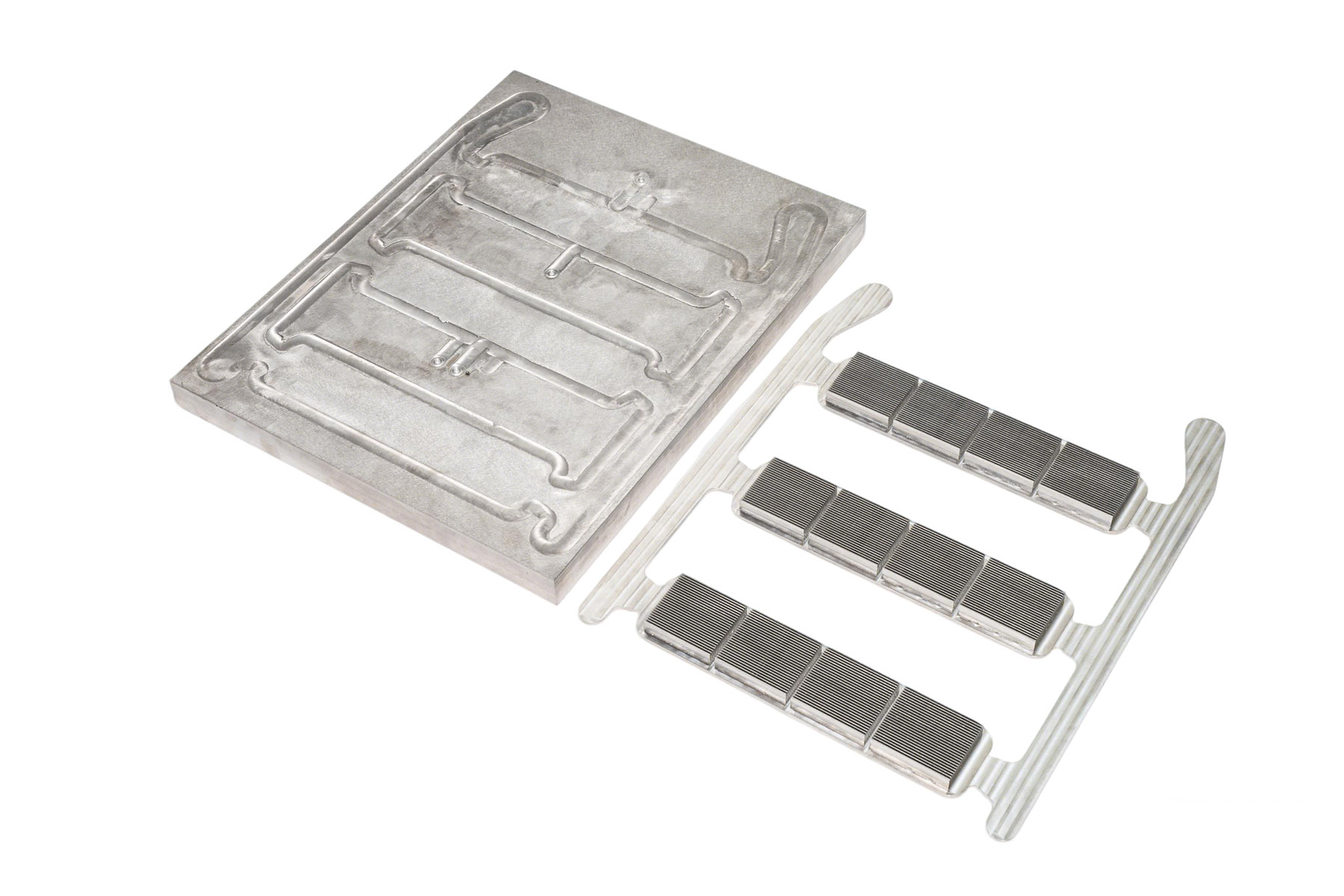
How Does a Liquid Cold Plate Work?
The working principle of cold plate liquid cooling is based on thermal conduction and liquid convection.
Step 1 – Heat Transfer from the Device to the Plate
The heat source, such as a CPU, IGBT, battery module, inverter, or laser system, is attached to the cold plate. Heat first moves from the device into the metal surface of the plate.
Step 2 – Coolant Flows Through Internal Channels
Coolant enters the plate through the inlet and flows through internal channels or tubes. As it moves, it absorbs heat from the plate.
Step 3 – Heat Is Carried Away from the System
The heated coolant exits through the outlet and continues to a heat exchanger or radiator, where the heat is released before the coolant recirculates.
This process allows a liquid cold plate to continuously remove heat while maintaining more stable operating temperatures.
Why Is a Liquid Cold Plate Important in Thermal Management?
As devices become smaller and more powerful, heat density continues to increase. In many applications, poor temperature control can cause efficiency loss, performance instability, shorter service life, or even component failure.
A custom liquid cold plate helps solve these problems by providing:
efficient heat removal
better temperature stability
improved system reliability
compact thermal design
reduced dependence on large air-cooling structures
For applications with high heat flux and limited installation space, liquid cooling systems are often a more effective solution than conventional air cooling.
Common Types of Liquid Cold Plates
There is no single design suitable for all applications. Different structures are chosen based on heat load, cost target, space limitation, manufacturing process, and sealing requirements.
Main Types at a Glance
| Type | Structure | Main Advantages | Typical Applications |
|---|
| FSW Liquid Cold Plate | Friction stir welded cooling channels | Strong sealing, reliable structure, good thermal performance | New energy, power systems, industrial automation |
| Tube Liquid Cold Plate | Embedded or bonded tube channels | Simple structure, cost-effective, stable performance | Electronics cooling, industrial equipment, HPC |
| Brazed Liquid Cold Plate | Brazed internal channel structure | Complex channel design, high thermal efficiency | Power electronics, AI servers, photovoltaic inverters |
FSW Liquid Cold Plate
An FSW liquid cold plate uses friction stir welding to form sealed cooling channels. This process is often chosen when structural integrity and leakage control are important.
Tube Liquid Cold Plate
A tube liquid cold plate uses metal tubes embedded into or bonded with the plate body. It is often preferred for projects requiring reliable performance and relatively straightforward production.
Brazed Liquid Cold Plate
A brazed liquid cold plate uses brazing technology to create a metallurgical bond. This design is suitable for more complex channel paths and demanding cooling requirements.
What Materials Are Commonly Used?
Material choice affects performance, weight, corrosion resistance, and manufacturing cost.
| Material | Key Features | Common Use |
|---|
| Aluminum | Lightweight, good thermal conductivity, cost-effective, easy to machine | Most custom liquid cold plates |
| Copper | Higher thermal conductivity, heavier, more expensive | High heat flux applications |
| Stainless Steel Tube + Aluminum Base | Good structural support with selected coolant compatibility | Certain tube cold plate designs |
In many projects, an aluminum cold plate is the preferred option because it offers a good balance between performance and cost.
Key Benefits of Liquid Cold Plate Cooling
A liquid cold plate offers several important advantages over traditional cooling methods.
Better Cooling Efficiency
Liquid has a much higher heat carrying capacity than air, which allows more efficient heat removal.
Compact Design
Because the cooling performance is higher, the overall thermal solution can often be more compact.
Improved Reliability
Stable operating temperatures reduce thermal stress on components and help improve long-term reliability.
Flexible Customization
A custom liquid cold plate can be designed based on heat load, mounting layout, coolant conditions, and space limitations.
Typical Applications of Liquid Cold Plates
Liquid cold plates are widely used in industries where heat control directly affects safety, performance, and product life.
| Industry | Typical Use of Liquid Cold Plate |
|---|
| EV & New Energy | Battery modules, inverters, converters |
| Power Electronics | IGBT modules, semiconductor cooling |
| High-Performance Computing | CPUs, GPUs, server thermal management |
| Industrial Automation | Motor drives, control cabinets |
| Medical Equipment | Imaging systems, precision electronics |
| Communication Equipment | Base station electronics, power modules |
How to Choose the Right Liquid Cold Plate
When selecting a liquid cooling plate, engineers usually consider the following factors:
total heat load
heat distribution
allowable temperature rise
coolant type and flow rate
pressure drop requirement
available installation space
material preference
manufacturing method
sealing reliability
production cost
A good supplier should not only manufacture the part but also help optimize the thermal design.
A liquid cold plate is one of the most effective solutions for managing heat in compact and high-power systems. Whether the application is power electronics, EV battery cooling, industrial automation, or AI computing, the right cold plate design can greatly improve thermal performance and system reliability.
If your project requires efficient and stable cold plate cooling, choosing the right structure—such as FSW liquid cold plate, tube liquid cold plate, or brazed liquid cold plate—is the key first step.