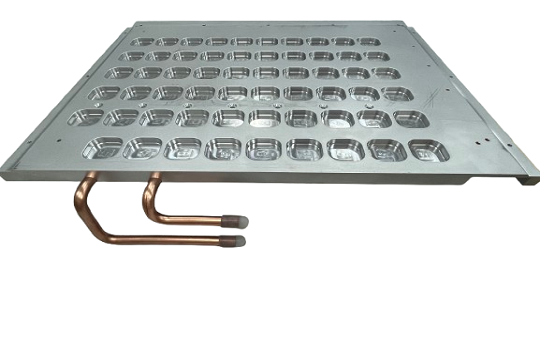
Extruded liquid cold plates are integrated thermal management components manufactured through aluminum alloy extrusion processes. These liquid cold plates utilize liquid cooling media—such as water, water–glycol mixtures, or fluorinated fluids—to achieve efficient heat exchange.
The core feature of this cold plate liquid cooling technology is the formation of enclosed or multi-cavity internal flow channels within a single extruded aluminum profile. This structure provides low flow resistance, high pressure tolerance, compact design, and controlled cost, making it widely used in high power density electronics, battery packs, server liquid cooling, and power electronics.
Understanding how liquid cold plates work is critical: heat is conducted from the heat source into the cold plate body, transferred to the internal liquid flow channels, and then carried away by forced convection. Compared with tubed cold plates or brazed liquid cold plates, extruded designs offer higher structural integrity and reduced leakage risk.
Core Technical Characteristics
One-piece extruded flow channels
Seamless internal channels formed during extrusion eliminate weld seams and reduce leakage risk compared to brazed or tubed structures.
High thermal conductivity materials
Typically manufactured from 6061 or 6063 aluminum alloys with thermal conductivity ≥ 180 W/m·K. While copper cold plates offer higher conductivity, aluminum provides a superior balance of weight, cost, and corrosion resistance.
Customizable flow channel designs
Supports parallel channels, serpentine channels, and multi-cavity configurations, enabling flexible Liquid Cold Plate design.
High pressure capability
Typical operating pressure: 0.5–1.5 MPa
Burst pressure: ≥ 3.0 MPa
Lightweight structure
20–40% lighter than CNC-machined or plate liquid cooling solutions.
Excellent surface treatment compatibility
Suitable for anodizing, electroless nickel plating, and functional coatings.
Typical Application Scenarios
Electric vehicle battery pack water cooling plate systems
Server CPU / GPU cold plates for electronics
High-power laser cooling systems
IGBT and power module cold plate cooling
Energy storage system thermal management
Extruded Liquid Cold Plates Manufacturing Process
1. Raw Material Preparation Stage
Aluminum billet selection → Chemical composition analysis (spectrometer) → Mechanical property testing (hardness, tensile strength) → Pre-processing (cutting, end-face machining) → Material warehousing
2. Die Design and Manufacturing Stage
Flow channel design (CFD thermal simulation optimization) → Extrusion die design (port holes, welding chamber, bearing land) → Die steel selection (H13 hot work tool steel) → CNC rough machining → Heat treatment (quenching + triple tempering) → Precision machining (EDM, wire cutting) → Polishing (bearing land Ra ≤ 0.4 μm) → Trial extrusion validation
This stage directly determines the internal geometry and performance of extruded liquid cold plates, distinguishing them from brazed liquid cold plate structures that rely on post-assembly bonding.
3. Extrusion Forming Stage
Aluminum billet preheating (480–520°C) → Die preheating (450–480°C) → Extrusion parameter setup → Profile extrusion (speed 1–5 m/min) → Online quenching (air or mist cooling) → Pulling and straightening → Fixed-length cutting → Aging treatment (T5 / T6 condition)
The extrusion process enables consistent internal flow channels that support stable plate liquid cooling performance.
4. CNC Precision Machining Stage
Datum surface machining (coordinate system establishment) → End-face machining (flow channel opening) → Interface machining (inlet/outlet ports, mounting holes) → Sealing surface machining (flatness ≤ 0.05 mm) → Deburring → Cleanliness inspection
Machining Requirements
5. End Cap Machining and Welding Preparation
End cap material selection (same or compatible alloy) → CNC finishing → Sealing surface finishing (Ra ≤ 1.6 μm) → Welding groove machining → Cleaning (ultrasonic cleaning) → Assembly positioning (dedicated fixtures)
End Cap Design Parameters
6. Welding and Sealing Stage
Welding process selection → Fixture assembly → Welding parameter setup → Automated welding execution → Post-weld heat treatment (stress relief) → Weld appearance inspection
Welding Process Comparison
Friction Stir Welding (FSW):
No filler material, high joint strength, ideal for long straight seams
Laser Welding:
Small heat-affected zone, high precision, suitable for complex seams
TIG Welding:
Cost-effective, flexible, suitable for small-batch custom liquid cold plate production
7. Pressure and Sealing Tests
Helium leak testing
Hydrostatic pressure testing (1.5× working pressure)
Burst pressure testing (≥ 3× working pressure)
Pressure cycle testing (100,000 cycles)
Test Standards
Leak rate: ≤ 1×10⁻⁷ mbar·L/s (helium)
Pressure holding: 1.5 MPa × 5 min, pressure drop ≤ 0.01 MPa
Burst pressure: ≥ 3.0 MPa
Pressure cycling: 0.2–1.0 MPa, 100,000 cycles without leakage
8. Surface Treatment Stage (Optional)
Pre-treatment (degreasing, pickling) → Anodizing (natural / black) → Sealing → Functional coatings → Baking and curing
Surface Treatment Options
Anodizing:
Electroless nickel plating:
PTFE coating:
Improved chemical resistance
Insulating coatings:
For electrical isolation requirements
9. Cleaning and Drying Process
High-pressure DI water flushing → Ultrasonic cleaning (neutral detergent) → Triple-stage counterflow rinsing → Hot air drying (80–100°C) → Vacuum drying (high-reliability applications) → Nitrogen filling for oxidation prevention
Cleanliness Standards
10. Accessory Assembly
Seal installation (silicone / FKM / EPDM) → Quick-connect fittings assembly → Temperature sensor installation (optional) → Pressure sensor installation (optional) → Labeling (product info and flow direction)
Accessory Requirements
Seal materials: EPDM, FKM, silicone (−40°C to 150°C)
Connector standards: DIN, SAE, JIS, BSPP
Sensor accuracy:
Temperature ±0.5°C
Pressure ±1% FS
11. Finished Product Performance Testing
Thermal resistance testing (standard heat source method) → Flow resistance testing (flow vs. pressure drop curve) → Flow uniformity testing (multi-channel designs) → Durability testing (thermal and pressure cycling) → Final helium leak reinspection (100% inspection)
Performance Indicators
Thermal resistance: 0.01–0.05 °C/W (design and flow dependent)
Flow resistance: ≤ 50 kPa @ 10 L/min (typical)
Flow uniformity deviation: ≤ 10%
Operating temperature range: −40°C to 120°C
12. Final Inspection and Packaging
Visual inspection → Dimensional sampling (CMM) → Documentation preparation → Anti-corrosion packaging (VCI) → Shockproof packaging → Outer carton labeling
Packaging Specifications
Single-unit protection: PE bag + VCI paper
Packing orientation: Vertical placement
Label content: Product ID, production date, flow direction, fragile marking
Storage conditions: −10°C to 40°C, ≤ 70% RH
13. Documentation and Traceability
Certificate of conformity → Material certificates → Performance test reports → Process records → Traceability labels (QR code / barcode) → Installation and operation manual
Critical-to-Quality (CTQ) Control Points
| Process Stage | Control Parameter | Method | Acceptance Criteria |
|---|
| Raw Material | Chemical composition | Spectral analysis | Conforms to 6061/6063 |
| Extrusion | Channel dimensions | Caliper / projector | ±0.1 mm |
| Machining | Flatness | Granite plate | ≤0.05 mm / 100 mm |
| Welding | Leak integrity | Helium leak test | ≤1×10⁻⁷ mbar·L/s |
| Surface | Coating thickness | Eddy current gauge | 10–15 μm ±2 μm |
| Final Test | Pressure resistance | Burst test | ≥3.0 MPa |
Process Capability and Production Capacity
Design Guidelines and Best Practices
Flow Channel Design
Hydraulic diameter: 4–8 mm
Aspect ratio: ≤ 10:1
Bend radius: ≥ 1.5× channel width
Bell-mouth inlet/outlet design
Optional internal fins for enhanced heat transfer
Structural Design
Uniform wall thickness
Reinforcement ribs at critical locations
Stress-free mounting layout
Thermal expansion allowance
Material Selection Strategy
General applications: 6063-T5
High-performance applications: 6061-T6
Harsh environments: Additional coatings
Cost Optimization
Standardized cross-sections
Improved material utilization
Reduced secondary machining
Economies of scale in mass production
With their one-piece extruded structure, low leakage risk, high reliability, and excellent cost efficiency, extruded liquid cold plates play an irreplaceable role in high power density cold plate cooling applications. As industries such as electric vehicles, data centers, 5G communications, and renewable energy continue to grow, Custom Cold Plates and custom liquid cold plate solutions will evolve toward higher performance, lighter weight, and smarter thermal management—providing robust and scalable solutions for next-generation liquid cooling systems.