Home > Blog > Kingkametal Introduces Advanced Ultrasonic Immersion Testing (UT) to Set a New Quality Standard for Heat Sinks and Liquid Cold Plates
Kingkametal Introduces Advanced Ultrasonic Immersion Testing (UT) to Set a New Quality Standard for Heat Sinks and Liquid Cold Plates
2026-01-16 17:21:50
In the context of the rapid growth of high-performance computing (HPC), AI data centers, electric vehicles (EVs), laser systems, and power semiconductor devices, the reliability and performance of thermal management components have become the core bottleneck for long-term system stability.
Modern heat sinks and liquid cold plates are no longer simple metal parts—they integrate materials science, fluid dynamics, precision machining, and advanced joining techniques into complex functional assemblies. Their performance and reliability directly determine the efficiency and service life of high-power electronic devices.
As a leading thermal management solutions manufacturer, Kingkametal recognizes that:
Traditional pressure testing and visual inspection only verify the surface and sealing, and cannot reliably detect subsurface defects or potential failure points.
Therefore, we have introduced and fully implemented Ultrasonic Immersion Testing (UT), providing full-process high-definition video recording and digital reports, upgrading quality control from “surface verification” to quantitative internal integrity analysis.
1. Overview of Ultrasonic Immersion Testing (UT)
1.1 Technical Definition
Ultrasonic Immersion Testing (UT) is a non-destructive testing (NDT) technique in which both the test piece and the probe are submerged in water (or deionized water), using water as an acoustic coupling medium. Water ensures stable and uniform ultrasonic propagation, eliminating errors caused by manual contact pressure or poor coupling.
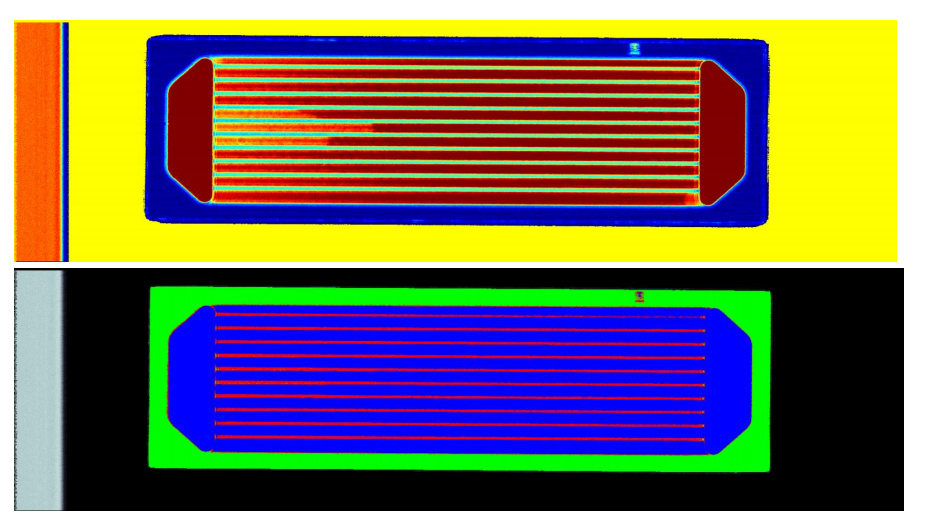
High-frequency ultrasonic waves (typically >1 MHz) propagate through the material. When they encounter material interfaces or internal defects, part of the acoustic energy is reflected. The probe receives the reflected echoes and generates data. Using A-Scan (waveform), B-Scan (cross-section), and C-Scan (planar/3D imaging), defects’ location, size, shape, and distribution can be visualized, enabling quantitative analysis of internal quality.
1.2 UT Immersion Testing Workflow
Using Liquid Cold Plates or Heat Sinks as examples, a typical UT workflow includes:
Fixture and Preparation The workpiece is precisely fixed in a water tank, with deionized water ensuring stable ultrasonic propagation.
Mechanical Scanning High-precision multi-axis scanning frames or robotic arms move the ultrasonic probe along predefined paths to cover the entire surface and internal flow channels.
Ultrasonic Incidence and Echo Collection Ultrasonic waves enter the workpiece through water. When encountering internal pores, cracks, inclusions, lack of fusion interfaces, or the bottom surface, part of the energy is reflected.
Data Processing and Imaging The received echoes are processed to generate:
A-Scan: Displays ultrasonic waveform, indicating defect depth and size.
B-Scan: Shows defect distribution along the workpiece cross-section.
C-Scan: Produces planar or 3D images for precise defect localization.
Reporting and Video Recording All test data, imaging results, and full-process HD video are compiled into digital inspection reports, providing auditable and traceable quality documentation.
1.3 Comparison with Traditional Methods
Feature
Manual Contact Ultrasonic Testing
UT Immersion Testing
Coupling Stability
Sensitive to probe pressure
Stable due to water coupling
Resolution
Medium
High, capable of detecting micron-level subsurface defects
Complex Geometry
Limited
High-precision scanning supports curved, thin, and irregular parts
Automation & Data Management
Manual operation, scattered data
Fully automated, digital storage, supports 100% inspection and analysis
Visualization & Traceability
Limited
C-Scan + video recording, fully auditable
2. Why UT Immersion Testing is Critical for Heat Sinks and Liquid Cold Plates
2.1 Vacuum Brazed Liquid Cold Plates
Vacuum brazing melts a filler material below the base metal in a vacuum, filling gaps via capillary action. Advantages include multi-layer complex channels in one pass, clean joints, and minimal distortion.
Potential Defects:
Brazing porosity
Dry spots (incomplete wetting)
Lack of fusion
These defects may not cause immediate leakage but create local hotspots that evolve into fatigue cracks under thermal cycling and pressure, impacting the performance and lifespan of Liquid Cold Plates.
2.2 Friction Stir Welded (FSW) Liquid Cold Plates
FSW is a solid-state welding method that uses a rotating tool to generate frictional heat, plasticizing the material and forming a dense metallurgical bond. Advantages include high thermal conductivity, low thermal distortion, and strong compression resistance.
Key Hidden Defects:
Wormhole defects
Weak bonding (Kissing Bonds)
Weak bonds are especially critical; although the surface appears intact and pressure tests may pass, insufficient atomic-level fusion can cause structural failure under vibration or thermal cycling. Ultrasonic Immersion Testing effectively detects these closed defects, ensuring FSW cold plate reliability.
2.3 Other Thermal Management Component Defects
Process
Key Advantage
Typical Application
Major Defects
Detection Challenge
Vacuum Brazing
Complex channels, one-pass assembly
Data center cold plates, aerospace heat exchangers
Porosity, dry spots, lack of wetting
Large-area, high-resolution scanning
FSW
High strength, low distortion
EV battery cooling plates, high-power inverters
Wormholes, weak bonding
Micron-level closed defect detection
Tooth/Kinematic Fins
High fin density, low mold cost
Industrial lasers, CPU cooling
Weak bonding at fin base
Acoustic impedance analysis of thin interfaces
3. Physical Principles of Ultrasonic Immersion Testing
3.1 Acoustic Impedance
Z=ρ⋅V
ρ: Material density
V: Ultrasonic wave velocity
3.2 Reflection Coefficient
Metal-Air interface: Large impedance mismatch → R → 1, high-amplitude echoes
Metal-Metal interface: Similar impedance → good transmission, low echoes
This impedance difference is the physical basis for detecting internal defects in Heat Sinks and Liquid Cold Plates.
4. Advantages of Kingkametal UT Immersion Testing
Stable coupling and high repeatability: Water medium eliminates manual pressure errors
Micron-level resolution: Detects subsurface and near-surface defects
Complex geometry adaptability: Supports curved, thin, and irregular parts
Fully automated and digital: Inspection paths, parameters, and data fully recorded
Visualization and traceability: C-Scan images plus HD video for auditable quality records
We provide not only pass/fail judgment but a complete traceable evidence chain of internal quality.
5. Key Application Areas
Ultrasonic Immersion Testing is critical for high-reliability, high-performance components, enabling quantitative internal defect detection, full visualization, and traceable quality control, ensuring Heat Sinks, Liquid Cold Plates, and high-end functional components perform reliably over the long term.
5.1 Aerospace
Turbine blades and blisks: Detect porosity, inclusions, and lack-of-fusion interfaces for high-temperature, high-stress reliability
Housings and landing gear: Ensure welds and forged interfaces are defect-free
Rocket engine components: Detect internal porosity and welding defects in high-pressure nozzles and complex channels
5.2 High-End Automotive and Rail Transit
EV battery pack welds: Inspect Liquid Cold Plate and heat exchanger welds to prevent coolant leakage
Lightweight aluminum structures: Detect internal porosity or lack-of-fusion
High-speed train axles and gears: Identify microcracks and internal voids
5.3 Energy and Power
Nuclear pipelines and valves: Detect internal cracks and voids for long-term reliability
Gas turbine blades: Detect porosity, inclusions, and weld defects
Ultra-high-voltage transmission castings: Precision scanning of contact surfaces and internal voids
5.4 Medical Devices
Artificial joints (Ti/Co-Cr-Mo) and implants: Detect microcracks, porosity, and delamination
High-value surgical instruments: Inspect blades, bearings, and precision metal components
Standardized quantitative assessment of internal porosity and lack-of-fusion
Full coverage of complex channels, thin walls, and porous structures
5.6 Precision Semiconductor and Electronics
Bonding interfaces: Inspect solder joints, copper wires, and paste layers
Ceramic substrates and thermal management components (Heat Sink/Liquid Cold Plate): Detect microvoids and delamination
Detect the Invisible, Ensure Long-Term Reliability
In high-power thermal management systems, seeing invisible defects is true engineering capability. Kingkametal’s Ultrasonic Immersion Testing provides Heat Sinks and Liquid Cold Plates with:
High-sensitivity defect detection
Fully traceable quality data
Long-term reliability assurance
We not only ensure products meet specifications but also provide verifiable, reliable, long-term internal quality information.For more information, please contact our quality team at kingkametal.com.
We specialize in precision CNC machining and our products are widely used in telecommunication industry, aerospace, automotive, industrial control, power electronics, medical instruments, security electronics, LED lighting and multimedia consumption.