
Custom liquid cold plates
from electronics cooling to power systems.
Engineer & Design support
EInstant Pricing & DFM
Tight Tolerances


Engineer & Design support
EInstant Pricing & DFM
Tight Tolerances
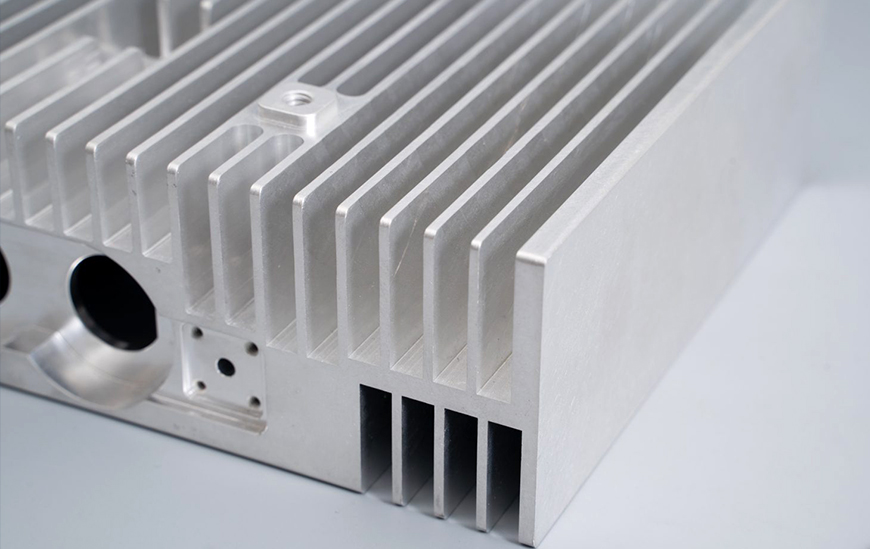
A heat sink is a device that transfers heat from a target object or medium to the surrounding environment through heat exchange, thereby lowering the target temperature and ensuring its stable operation. Its core function is to resolve heat accumulation issues generated during an object's operation, preventing performance degradation, malfunctions, or even damage caused by excessive temperatures.
Extruded heat sink components are primarily made of aluminum alloys (such as 6063 aluminum) or copper. Aluminum has a thermal conductivity of approximately 200 W/m·K, while copper exhibits a significantly higher value of 390 W/m·K,enabling rapid heat transfer to the radiator surface. The intricate fin structure design increases the heat dissipation surface area, allowing heat to be efficiently conducted and dispersed across the entire radiator surface. This prevents localized overheating and ensures stable equipment operation.
The core operating principle of a heat sink involves the synergistic interaction of three heat transfer mechanisms— thermal conduction, thermal convection, and thermal radiation—to efficiently dissipate heat from a heat-generating component into the surrounding environment, thereby achieving cooling.
Best for: High heat flux and large-area cooling Key advantages: Excellent thermal conductivity, strong leak-proof structure Limitations: Higher tooling cost, less suitable for complex microchannels Typical applications: EV batteries, power electronics, energy storage systems
Best for: Medium heat loads and flexible cooling layouts Key advantages: Simple structure, cost-effective, easy maintenance Limitations: Lower thermal performance than microchannel designs Typical applications: Industrial electronics, battery packs, telecom equipment
Best for: High power density and compact cooling systems Key advantages: Complex internal channels, strong thermal performance Limitations: Higher manufacturing complexity and cost Typical applications: Data center servers, high-performance CPUs, power modules
Best for: Localized high-power chip cooling Key advantages: High cooling efficiency, compact design Limitations: Designed for specific chip layouts, limited scalability Typical applications: Server CPUs, GPUs, high-performance computing systems
The core operating principle of a heat sink involves the synergistic interaction of three heat transfer mechanisms— thermal conduction, thermal convection, and thermal radiation—to efficiently dissipate heat from a heat-generating component into the surrounding environment, thereby achieving cooling.

Kingka Tech Industrial Limited
We specialize in precision CNC machining and our products are widely used in telecommunication industry, aerospace, automotive, industrial control, power electronics, medical instruments, security electronics, LED lighting and multimedia consumption.


Address:
Da Long New Village, Xie Gang Town, Dongguan City, Guangdong Province, China 523598
Email:
Tel:
+86 137 1244 4018